
Anisandrus
Anisandrus
Description
How to identify
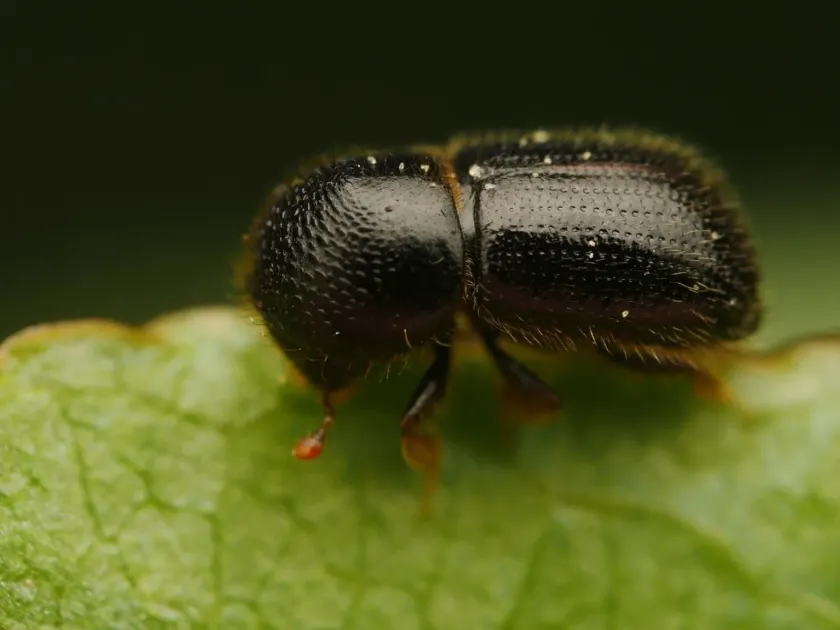
Anisandrus (commonly referred to as Anisandrus dispar or the European shot-hole borer) belongs to the Curculionidae family and the Scolytinae subfamily. These small, cylindrical beetles range from 2 to 3.5 mm in length, with females being significantly larger than males.
Externally, the beetles are characterized by a dark, almost black or brownish exoskeleton. The elytra surface has a distinct sculpted structure, while the pronotum is covered with small tubercles, which assists them in moving efficiently through wood tissue.
A unique aspect of this species' biology is its symbiosis with ambrosia fungi. They do not feed on the wood itself but cultivate fungal mycelium within their galleries, which serves as the primary food source for both larvae and adults.
The taxonomy of this species requires attention, as Anisandrus dispar is part of the "ambrosia beetle" group, whose presence in a tree is almost always accompanied by wood discoloration due to the progression of the fungal infection.
The life cycle of Anisandrus is closely linked to the tree's health status. Most often, they attack weakened specimens stressed by frost or drought, but in high-density populations, they can also infest healthy trees.
What it damages
This pest attacks a wide range of cultures, including fruit trees such as apple, pear, plum, cherry, and sweet cherry. It is also frequently found on forest species like oak, beech, maple, birch, and alder.
The pest's harmfulness lies in its deep penetration into the wood of trunks and thick branches. Unlike many other bark beetles, Anisandrus digs galleries radially, penetrating deep into the sapwood and heartwood of the tree.
As a result of the beetles' activity, the plant's vascular system is disrupted. The tree stops receiving sufficient nutrients and moisture, leading to premature wilting of individual branches or the death of the entire plant.
In addition to mechanical damage, the introduction of fungal spores poses a critical danger. The fungus Ambrosiella hartigii spreads rapidly through the vascular system, causing tissue necrosis and decay.
Severe infestation can lead to a sharp decline in crop yields, poor fruit quality, and ultimately, the total loss of nursery stock or adult commercial orchard trees.
When it appears
The flight of the beetles begins in spring, once the average daily temperature reaches 12–15 degrees Celsius. Females emerge first, actively searching for suitable trees to colonize.
The peak period of colonization usually occurs in April and May. During this time, females bore entrance holes and form brood galleries, laying eggs in specialized chambers.
Larval development occurs inside the wood throughout the summer. During this time, the pest remains hidden from the gardener's sight, as entrance holes are very small and can be masked by frass or sap flow.
Pupation occurs in late summer or early autumn, right inside the gallery system. Young beetles remain inside the mother galleries for the winter, preparing to emerge in the following season, making them highly resilient to external environmental influences.
Because the beetles spend the winter inside the wood, they are protected from winter frosts and extreme temperature fluctuations, ensuring high survival rates for the population across various climatic zones.
Signs of infestation
The primary sign of infestation is the presence of tiny entrance holes (about 1.5 mm in diameter) on the bark of the trunk or skeletal branches, often resembling traces of a fine drill bit.
Sap flow is often observed around the entrance holes, which indicates the tree's active reaction to the pest's entry and the development of the fungal infection.
Infested trees exhibit characteristic wilting and drying of leaves in the middle of the growing season. This can occur locally on individual branches or across the entire canopy.
Upon removing part of the bark in infested areas, dark spots and tunnels extending radially inward become visible. The wood surrounding the galleries often takes on a dark, almost black hue due to the activity of ambrosia fungi.
- Presence of fine wood dust at the base of the trunk.
- Loss of turgor and yellowing of foliage.
- Holes up to 2 mm in diameter.
- Dieback of individual skeletal branches.
- Darkening of the wood at the site of the damage.
Control measures
The primary method of control is an agrotechnical approach: maintaining a high level of tree health. Timely fertilization, irrigation, and pruning reduce the risk of Anisandrus colonization, as a healthy tree actively resists pest entry.
Severely infested branches and entire trees must be regularly removed and burned before the beetles' emergence period. Leaving deadwood on the site is unacceptable, as it serves as a reservoir for pest reproduction.
Using pheromone traps helps monitor the adult beetle population during their spring flight. Placing such traps in orchards assists in detecting the onset of insect expansion in a timely manner.
Chemical control against adult beetles is difficult because they spend most of their lives inside the wood. Spraying trunks with contact insecticides is effective only during the short period of emergence and the beginning of the females' entry into the bark.
In commercial orchards, it is recommended to carry out preventive treatments on trunks using authorized systemic and contact insecticides during the "green tip" stage to prevent the entry of the first wave of pests.
Taxonomy
- Latin name
- Anisandrus
- Order
- Coleoptera (beetles)
- Family
- Curculionidae
- EPPO code
- ANIDSP
Discussion
No discussions yet — be the first.