
Anhinga
Anhinga anhinga
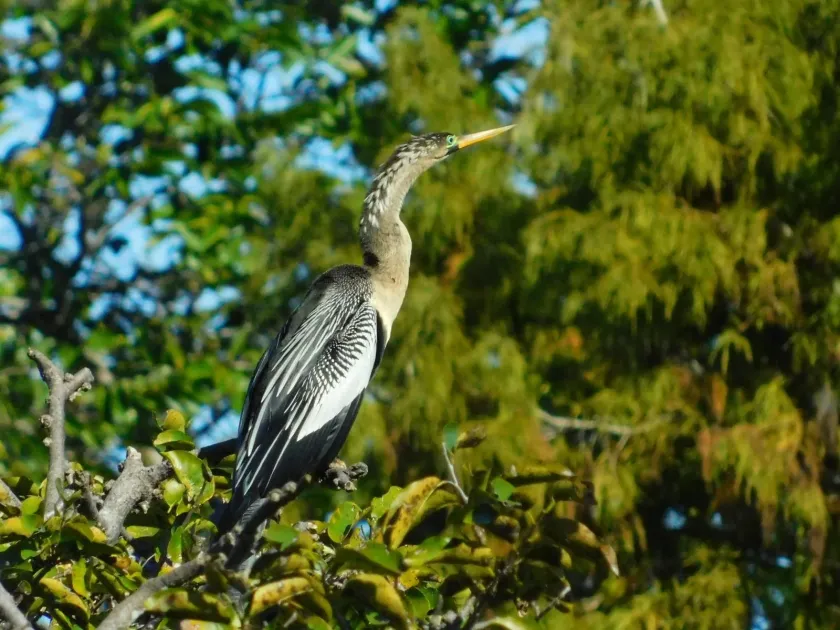
Description
How to identify
The Anhinga (Anhinga anhinga) is a member of the Anhingidae family within the order Suliformes. It is a large, water-dwelling bird primarily found in tropical and subtropical regions of the Americas.
The bird is distinguished by a long, slender neck and a sharp, pointed bill. It is frequently observed swimming with its body submerged, leaving only the head and neck visible, resembling a swimming snake.
Because its feathers lack the heavy waterproofing found in other aquatic birds, the Anhinga must spend considerable time drying its wings in the sun after diving.
Systematically, this bird is classified as a piscivore, relying entirely on hunting small to medium-sized fish in inland or coastal waters.
There is no evidence in agricultural or entomological literature to categorize this bird as a pest of field crops or orchards.
What it damages
The diet of the Anhinga is composed strictly of fish, amphibians, reptiles, and aquatic invertebrates, which are caught underwater.
The Anhinga does not feed on any agricultural crops, including cereals, vegetables, or fruits. It lacks the anatomical and physiological traits to damage plant tissues.
While the bird may exist near agricultural environments that border wetlands, its presence has zero impact on plant development or yield quality.
Reports of crop damage attributed to the Anhinga are non-existent, as it has no biological connection to plant-based food chains.
In the context of agronomy, the Anhinga is considered a harmless element of the ecosystem that does not pose a threat to farm productivity.
Control measures
Since the Anhinga does not cause damage to crops, no management or control strategies are required for agricultural purposes.
This species is protected under various wildlife conservation laws in many areas of its range, and any intentional harm is prohibited.
Agricultural practices should prioritize the preservation of riparian habitats, which support biodiversity without impacting crop safety.
If interaction with aquaculture ponds occurs, only non-lethal, deterrent-based management is recommended to resolve conflicts with fish producers.
No pesticides, baits, or mechanical traps should ever be employed against this species, as it is not a pest organism.
Taxonomy
- Latin name
- Anhinga anhinga
- Family
- Anhingidae
- EPPO code
- ANHIAN
Discussion
No discussions yet — be the first.