
Ancylis tineana
Ancylis tineana
Description
How to identify
Ancylis tineana is a small moth belonging to the family Tortricidae, within the order Lepidoptera. This species is commonly known for its larvae's leaf-rolling behavior, which is typical for the family.
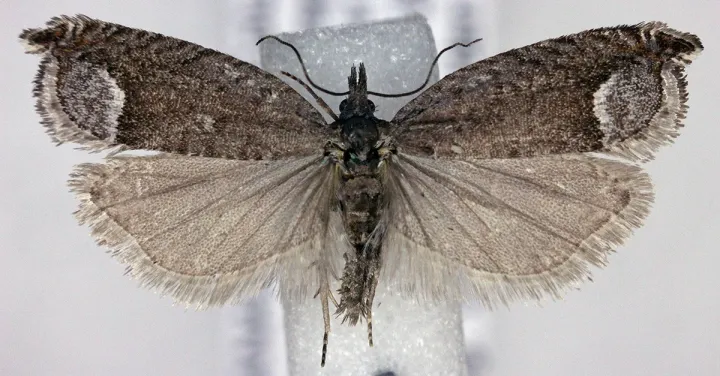
Adult moths have a wingspan of approximately 12-15 mm. Their forewings feature a distinctive mottled brown and grey pattern that provides excellent camouflage against tree bark.
The larvae progress through several instars. The caterpillar typically has a greenish to brownish body with a darker, often blackish head capsule, which is a key trait for accurate field identification.
Pupation occurs within a silken cocoon constructed inside a rolled leaf. The pupa is capable of movement, which helps it position itself before the moth emerges from the leaf roll.
Eggs are typically laid singly or in small clusters on the underside of host leaves. They are flattened and translucent, eventually darkening as the embryo inside develops.
What it damages
This species is a polyphagous pest, with a strong preference for plants within the Rosaceae family. It is frequently observed causing damage to apple, pear, and various ornamental shrub species.
In addition to orchard trees, Ancylis tineana also utilizes forest trees like willow, alder, and aspen, making adjacent wild areas a potential source of infestation for agricultural crops.
The caterpillars feed on the leaf parenchyma, essentially skeletonizing the foliage. This reduces the photosynthetic area of the tree, potentially weakening the plant over time.
Significant infestations can lead to heavy defoliation. In severe cases, the larvae may feed on young fruit or developing buds, directly impacting the quality and quantity of the harvest.
Continuous feeding pressure hampers the tree's ability to store energy for the winter, which can lead to reduced flowering and fruit set in the following growing season.
When it appears
The life cycle commences in early spring, synchronized with the bud burst of host trees. Overwintered larvae emerge to begin feeding on young, tender tissues.
Adult flight activity typically occurs during late spring and throughout the summer. Depending on local climate conditions, the species can complete one or two generations per year.
Peak feeding activity for the larvae is usually observed in June and July. During this time, the characteristic leaf-rolling behavior becomes most apparent in the canopy.
Winter is spent as a mature larva inside a protective cocoon. These cocoons are hidden deep within bark crevices, under lichen, or among leaf litter at the base of the trees.
Warmer temperatures accelerate larval development. A short, hot summer can lead to an increased number of generations, significantly boosting the pest population density.
Signs of infestation
The most reliable sign of an Ancylis tineana presence is the presence of rolled or folded leaves fastened with silk threads. These structures serve as protection for the developing larvae.
Within these leaf rolls, one can find the caterpillar, its frass (waste), and damaged tissue. The leaf often turns brown and dries out, making the infested areas stand out.
Early-stage feeding manifests as small, transparent patches on the leaves. These "windows" occur when the larva eats the tissue while leaving the upper or lower epidermis intact.
- Leaves rolled into tubes or tight packets bound with silk.
- Stunted growth of new shoots due to larval feeding at the tips.
- Premature browning and abscission of damaged foliage.
A heavy infestation often results in a web-like appearance on the branches, where accumulated dust and larval silk can create an unsightly mess on the tree.
Control measures
Cultural control practices are essential. This includes pruning to remove damaged branches and maintaining clean orchard floors by removing leaf litter to destroy overwintering sites.
Pheromone traps are highly effective for monitoring the flight periods of adult moths. This allows for precise timing of interventions, which is crucial for successful pest management.
Biological control methods, such as the use of Bacillus thuringiensis or egg-parasitoids like Trichogramma, can significantly suppress larval populations without disrupting the ecosystem.
Chemical control should be applied based on threshold monitoring. Systemic or contact insecticides are most effective when applied during the period of larval emergence from eggs.
Adopting an Integrated Pest Management (IPM) approach is recommended to balance efficacy and environmental impact, ensuring long-term health for orchard trees.
Taxonomy
- Latin name
- Ancylis tineana
- Order
- Lepidoptera (butterflies)
- Family
- Tortricidae
- EPPO code
- ANCYTI
Discussion
No discussions yet — be the first.