
Beech leaf roller
Ancylis mitterbacheriana
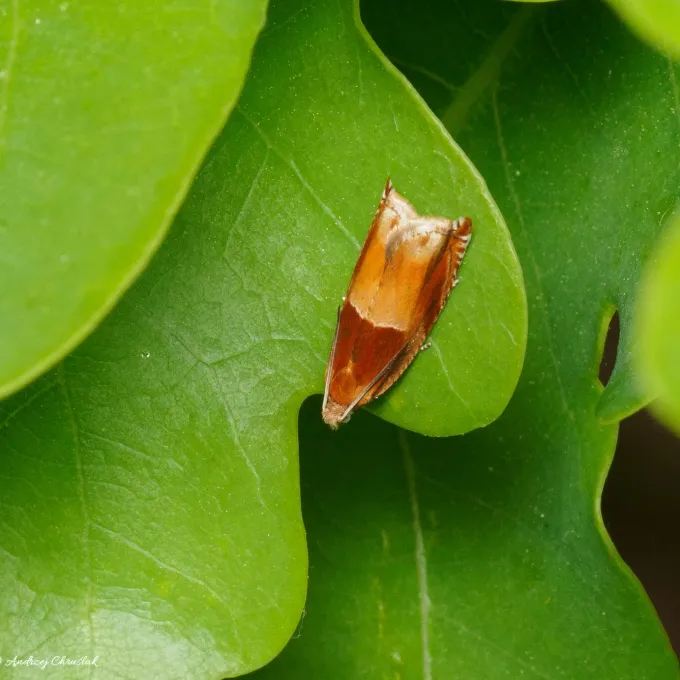
Description
How to identify
The beech leaf roller (Ancylis mitterbacheriana) is a small moth belonging to the family Tortricidae, within the order Lepidoptera. The wingspan of the adult moth ranges from 14 to 18 millimeters, with forewings displaying a grey-brown pattern.
The larva of this pest reaches a length of up to 12-14 millimeters. Its body is yellowish-green or whitish with a dark head capsule. Larvae are highly active and will quickly drop on silk threads if disturbed.
The pupa develops within a rolled leaf. It is dark brown and features specific small spines on the abdominal segments, which help the pupa remain secure inside its leaf nest until the adult moth emerges.
The species overwinters as a young larva. It hides in leaf litter or crevices in the bark, surviving adverse conditions until the arrival of spring temperatures.
The flight of the moths typically occurs during the spring and summer. Depending on the climate, the development of the pest can span one or two generations per season.
What it damages
The primary host plant for this species is the European beech (Fagus sylvatica). The damage manifests as injury to young shoots and leaves, which significantly weakens the tree and hinders its development.
Beyond beech trees, larvae may occasionally be found on related deciduous tree species if they grow in close proximity to major infestation centers.
Young leaves become a source of food for larvae shortly after the buds open. This feeding behavior disrupts photosynthesis and slows the growth of young saplings in forest nurseries.
When population densities are high, the beech leaf roller can cause significant defoliation of beech stands, leaving the trees susceptible to secondary pests and diseases.
This pest is particularly dangerous for young plantations and ornamental alley trees, where crown damage diminishes both the biological health and the aesthetic value of the trees.
Signs of infestation
The primary sign of infestation is leaves that are curled or bound together with silk. Larvae tie the edges of the leaf to create a tube or envelope, where they hide and feed.
Upon inspection, one can observe skeletonized areas where the leaf tissue has been consumed, leaving behind only the thin outer skin, which eventually browns and dies.
A high density of silk threads connecting leaves together in the crown is a clear indicator of active larval development within the canopy.
In the areas where larvae feed, one can often find frass, which appears as tiny dark pellets scattered on the surface of leaves located below the feeding sites.
Gradual wilting and premature dropping of rolled leaves during mid-summer are reliable signals that the tree has been attacked by the beech leaf roller.
Control measures
For the protection of forest stands, the collection and disposal of leaf litter where larvae overwinter is a highly effective method for reducing the next generation's population.
In forest nurseries, the application of biological insecticides, such as Bacillus thuringiensis-based products, during the peak larval emergence period is recommended.
In cases of severe infestation, the use of systemic or contact insecticides approved for forestry use may be necessary to preserve the health of the tree stands.
Encouraging natural predators, such as insectivorous birds and predatory insects, is a sustainable approach to suppressing the moth population in natural environments.
- Monitoring population levels using pheromone traps.
- Sanitary clearing of forest litter.
- Timely application of pesticides during the growing season.
Taxonomy
- Latin name
- Ancylis mitterbacheriana
- Order
- Lepidoptera (butterflies)
- Family
- Tortricidae
- EPPO code
- ANCYMI
Discussion
No discussions yet — be the first.