
Mandarin leaf roller
Ancylis mandarinana
Description
How to identify
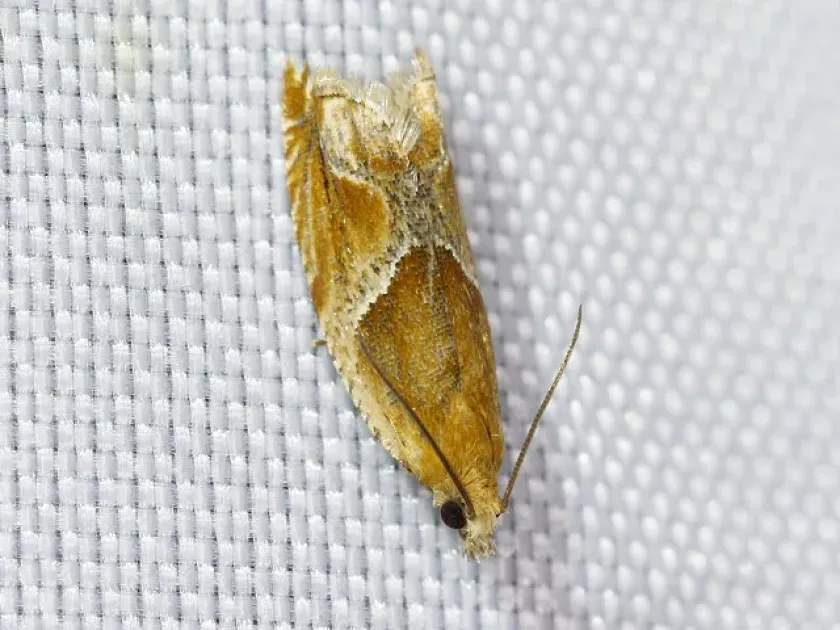
The Mandarin leaf roller (Ancylis mandarinana) belongs to the order Lepidoptera and the family Tortricidae. The adult moth is a small insect with a wingspan of approximately 12–15 mm.
The forewings have a distinctive grayish-brown or ochre color with complex dark patterns, which provides effective camouflage against the bark of host trees.
The larvae are spindle-shaped, ranging in color from pale yellow to green, and possess a prominent dark-colored head capsule and thoracic plates.
The life cycle encompasses four distinct stages: egg, larva (caterpillar), pupa, and adult (moth). Depending on the local climate, multiple generations can occur annually.
Detection is often challenging due to the secretive behavior of the larvae, which spend most of their time sheltered within rolled leaves or silk webbing.
What it damages
The pest primarily targets members of the Rutaceae family, specifically focusing on various Citrus species, including mandarins, lemons, and oranges.
Larvae feed on young foliage, utilizing silk to bind and roll leaves into tubes or clusters, creating protected micro-habitats where they consume plant tissue.
In addition to leaves, the larvae frequently attack developing buds and blossoms, feeding on internal reproductive parts and resulting in significant yield loss.
High infestation levels can severely weaken the tree, leading to premature leaf drop and a reduction in the plant's overall photosynthetic capacity.
Economic damage includes a loss in fruit quality and yield, as well as stunted growth in young citrus trees subjected to repeated infestations.
When it appears
Adult moth activity typically commences in the spring when consistent ambient temperatures trigger the emergence of overwintering individuals.
Oviposition occurs primarily on the undersides of leaves near the midrib or directly on young fruitlets during the active growing season.
The period of greatest damage corresponds with the tree's spring and summer growth flushes, when young, tender plant tissues are most abundant and vulnerable.
In warm, subtropical climates, the insect may develop continuously, with overlapping generations appearing throughout the entire vegetative period.
The pest typically survives the winter in the pupal stage, hidden within silk cocoons tucked into leaf folds or crevices in the bark of the citrus trunk.
Signs of infestation
The most reliable indicator of an infestation is the presence of tightly rolled leaves, often containing webbing and larval excrement (frass) inside.
When an infested leaf is opened, the larva will exhibit rapid, wriggling movements and may drop from the leaf on a silk thread to escape.
Damage symptoms include irregular holes and "skeletonized" patches on the leaf surface as larvae consume the soft tissue between the leaf veins.
Blossom damage is indicated by the browning and subsequent shedding of buds before they have the opportunity to open into flowers.
Severe infestations cause wilting and terminal dieback of young shoots, resulting in deformed growth and reduced structural health of the citrus canopy.
Control measures
Integrated pest management begins with cultural practices, including regular orchard sanitation and the manual removal of rolled leaves harboring larvae or pupae.
Pheromone monitoring traps are essential for determining the timing of adult emergence, allowing for precision in applying control measures.
Biological control options include the use of Bacillus thuringiensis-based insecticides, which are highly effective against early-instar larvae while remaining eco-friendly.
Chemical intervention with systemic insecticides may be necessary for heavy infestations, but should be strictly timed to occur before flowering to protect pollinators.
Encouraging natural enemies, such as Trichogramma wasps, can provide significant population suppression and serve as a sustainable long-term management strategy.
Taxonomy
- Latin name
- Ancylis mandarinana
- Order
- Lepidoptera (butterflies)
- Family
- Tortricidae
- EPPO code
- ANCYMA
Discussion
No discussions yet — be the first.