
Willow leafroller
Ancylis biarcuana
Description
How to identify
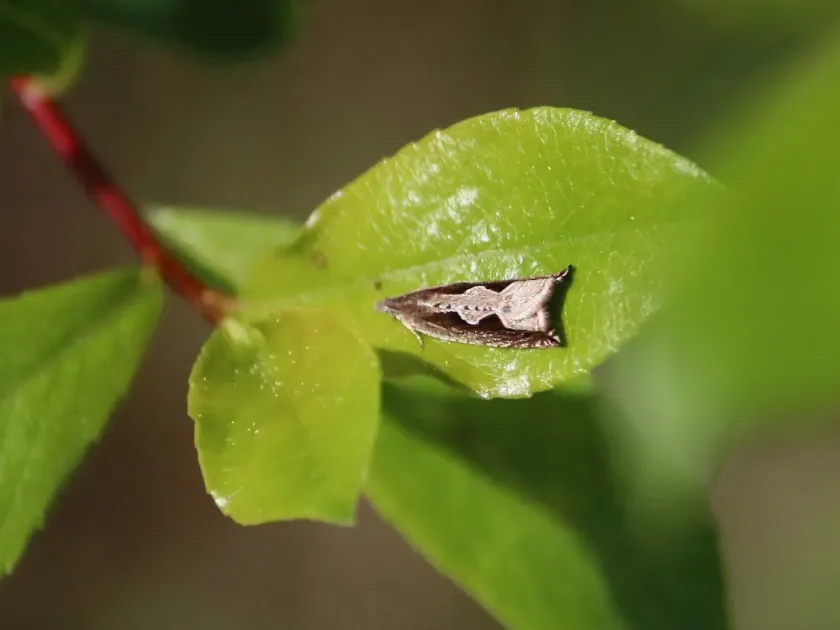
The willow leafroller (Ancylis biarcuana) belongs to the Tortricidae family. It is a small moth, with adult wingspans typically ranging between 12 and 16 mm.
The forewings are marked with two distinct arched lines against a brownish-gray background, which is the primary feature used for visual identification of this specific species.
The larvae are typically greenish or brownish with a darker head capsule, showing active movement when disturbed within their silk shelters.
Adult moths are nocturnal, spending the daylight hours resting on tree bark, where their camouflage coloration makes them very difficult to detect.
The eggs are small and flattened, usually deposited singly on the underside of leaves, often near the veins to provide protection and stability.
What it damages
The primary hosts for Ancylis biarcuana are various species of willow (Salix). The larvae feed on the leaf tissue, significantly reducing the tree's foliage quality.
Feeding damage consists of consuming the soft tissues between the veins, a process often referred to as skeletonization, which reduces the photosynthetic capacity of the tree.
In nursery settings, damage to the terminal buds can result in distorted growth, affecting the overall symmetry and commercial value of the saplings.
Severe infestations can lead to premature leaf drop, which weakens the tree's health and reduces its ability to store energy for the subsequent growing season.
While mature trees can usually withstand moderate infestations, young or stressed trees may suffer from stunted growth and increased susceptibility to secondary infections.
When it appears
Adult moth activity typically commences in late spring or early summer, following the emergence from overwintering pupae or larvae.
Development is temperature-dependent, and in warmer regions or seasons, the insect may complete two full life cycles within a single year.
The larvae are most active during the peak of the growing season, feeding on the fresh, tender foliage of the host plants throughout late spring and midsummer.
Overwintering occurs primarily in the larval stage, protected within cocoons hidden in debris, fallen leaves, or deep crevices of the tree bark.
Monitoring the flight periods is essential for timing any necessary control interventions, as the larvae are most vulnerable during their early developmental stages.
Signs of infestation
The most diagnostic sign is the presence of leaves that have been rolled, folded, or tied together with fine silk threads created by the larvae.
Inside these rolled leaves, one can find the larvae or the cast skins from their molting process, often accompanied by small amounts of frass.
Skeletonized patches on the leaves are clear indicators of feeding activity, as the leaf tissue is consumed while the tougher veins remain untouched.
A sudden decline in the aesthetic appeal of a willow tree, combined with the presence of tied leaves, strongly suggests a leafroller infestation.
If you disturb a rolled leaf and see a small larva drop rapidly on a silk thread, it is a definitive behavioral sign of the Tortricidae family.
Control measures
Sanitation is a primary control measure, which involves raking and removing fallen leaves from under the trees in autumn to reduce the overwintering population.
Physical removal of tied leaf clusters in small or ornamental gardens is a highly effective, pesticide-free method for managing small-scale infestations.
Biological control using formulations of Bacillus thuringiensis (Bt) is highly effective against young larvae while remaining safe for beneficial insects.
Maintaining tree health through proper irrigation and fertilization ensures that the willow has the resources to recover from minor leaf damage.
Encouraging natural predators such as birds, parasitic wasps, and predatory bugs is essential for long-term integrated pest management in willow plantations.
Taxonomy
- Latin name
- Ancylis biarcuana
- Order
- Lepidoptera (butterflies)
- Family
- Tortricidae
- EPPO code
- ANCYBI
Discussion
No discussions yet — be the first.