
Fruit leafroller
Ancylis achatana
Description
How to identify
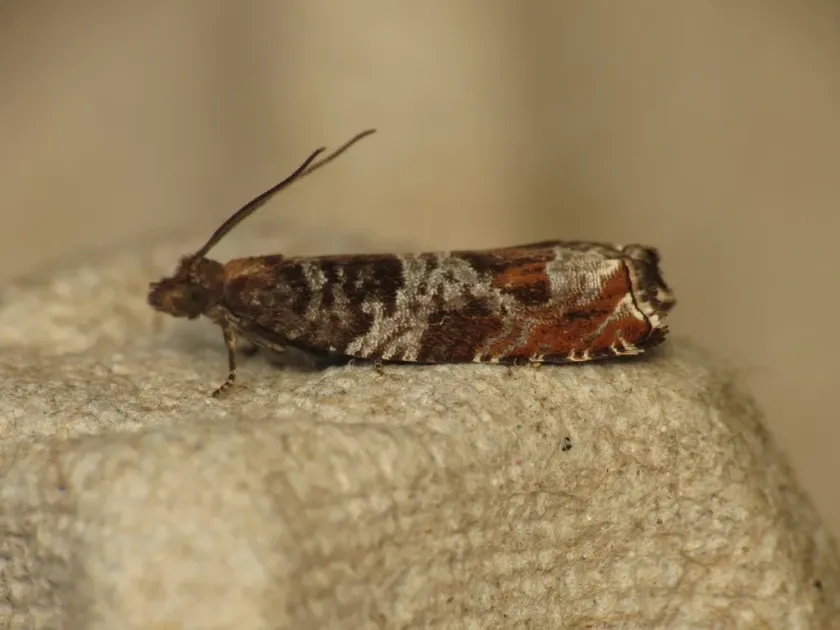
The fruit leafroller (Ancylis achatana) is a moth belonging to the family Tortricidae, order Lepidoptera. Adult moths typically have a wingspan of 15–18 mm, with brown-grey forewings featuring a pattern that resembles tree bark, providing excellent camouflage against predators.
The larvae, or caterpillars, reach a length of 12–15 mm. They are characterized by a yellowish-green or brownish body with a darker head capsule. The body is covered with sparse hairs emerging from small, pale warts, which is a diagnostic feature used in entomological identification.
The pupae are brown, reaching about 9 mm in length, and are usually encased in a silk cocoon spun by the larva. This cocoon is typically hidden within rolled leaves or tucked into the crevices of the tree bark, where the pupa undergoes transformation.
Systematically, this species is a specialized herbivore that has adapted its life cycle to match the phenology of fruit-bearing trees. It is well-documented in temperate regions as a significant pest of orchard ecosystems.
Early identification of the species relies on pheromone monitoring traps. These traps capture adult males, allowing orchard managers to assess population density and determine if chemical or biological intervention is required.
What it damages
The primary damage is caused by the caterpillars, which feed on buds, blossoms, and young foliage. During early spring, they penetrate developing buds and consume the inner tissues, often destroying the potential fruit yield before the tree fully blooms.
As the larvae mature, they shift their feeding to leaves, using silk to roll or web them into clusters. Within these protective shelters, they consume leaf tissue, leaving only the veins behind, which severely impairs photosynthesis and weakens the tree's overall vigor.
The host range includes apple, pear, plum, and cherry trees, as well as hawthorn and blackthorn. In years with high pest pressure, this leafroller can defoliate a significant portion of the canopy, impacting tree health and future fruit bud formation.
Feeding on young blossoms and fruitlets often leads to premature fruit drop or the development of deformed, unmarketable fruit. This results in direct economic losses and reduces the overall grade of the harvest.
Furthermore, the damaged foliage and buds provide entry points for opportunistic fungal pathogens. These secondary infections can lead to bark diseases and limb dieback, exacerbating the damage caused by the larvae alone.
When it appears
The life cycle begins in early spring as temperatures rise, coinciding with the swelling of buds on host trees. This is when overwintering larvae become active, transitioning from their dormancy to feed on developing growth.
The first generation of adult moths typically emerges in early summer, around June. After mating, females lay eggs on the upper surface of the leaves. The incubation period for these eggs usually lasts between 7 and 12 days depending on warmth.
A second generation of larvae develops during July and August, continuing the cycle of damage to the foliage. This extended period of activity necessitates vigilant monitoring by growers throughout the warmer months of the year.
Overwintering occurs in the larval stage. The caterpillars construct robust silk cocoons in bark crevices or tree forks, where they remain dormant until the following spring, showing high resistance to winter weather conditions.
Understanding these biological phases is essential for successful pest management, as applications of control agents are most effective when timed precisely with the vulnerable larval stages of the insect.
Signs of infestation
The earliest sign of infestation is the appearance of damaged buds that fail to open correctly or show uneven development. Tiny silk threads wrapped around these buds are clear indicators of larval activity.
The most recognizable sign is the presence of leaves that are rolled into tubes or webs. These structures serve as nests for the larvae, and shaking the branch often causes the caterpillar to drop down on a silk thread.
Presence of larval excrement—small, dark, sand-like pellets—within the rolled leaves or on the ground below indicates active feeding. As the season progresses, damaged leaves turn brown and necrotic, creating a patchy, unhealthy appearance in the canopy.
During the dormant winter season, inspectors can find the white, silken cocoons tucked into bark cracks. Locating and removing these overwintering sites is a key part of reducing the population for the next growing season.
Significant fruit drop or evidence of surface feeding on young fruitlets are also signs of high population density, suggesting that the leafroller population has reached an economic injury level requiring immediate action.
Control measures
Cultural control measures, such as scraping loose bark from tree trunks during winter and clearing away fallen debris, are fundamental. These practices physically remove overwintering larvae and reduce the next generation's population.
Biological control includes the use of Bacillus thuringiensis (Bt) based formulations, which are highly effective against young larvae while sparing beneficial predatory insects and pollinators in the orchard environment.
Chemical control should be employed only when necessary. Selective insecticides should be applied during the "pink bud" stage or immediately after petal fall, ensuring that systemic or contact-action products hit the active caterpillars.
Pheromone traps serve as an excellent IPM (Integrated Pest Management) tool. They help disrupt the mating process by lowering the probability of males finding females, thereby naturally suppressing population growth.
- Prune tree crowns to ensure better air circulation and light penetration.
- Remove and destroy severely infested shoots manually.
- Encourage natural predators like lacewings and parasitic wasps.
- Regularly monitor pest levels to optimize intervention timing.
Taxonomy
- Latin name
- Ancylis achatana
- Order
- Lepidoptera (butterflies)
- Family
- Tortricidae
- EPPO code
- ANCYAC
Discussion
No discussions yet — be the first.