
Caribbean yellow-banded millipede
Anadenobolus monilicornis
Description
How to identify
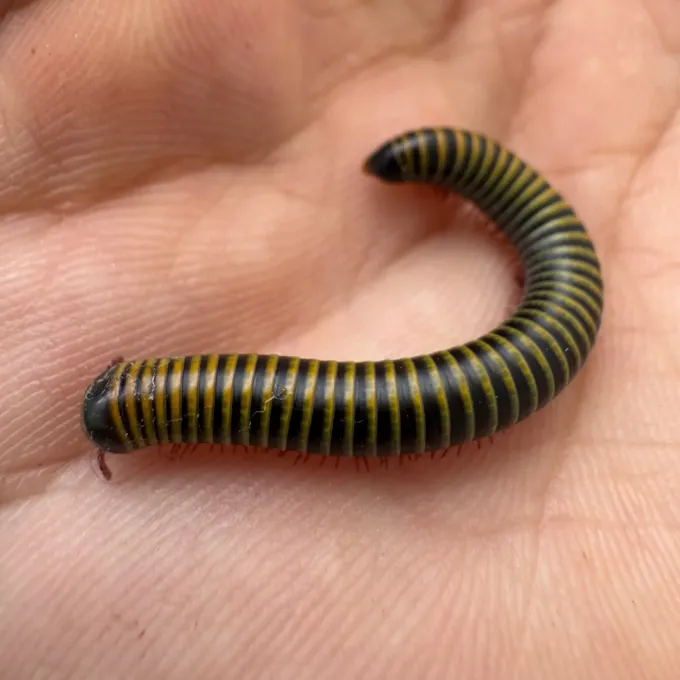
The Caribbean yellow-banded millipede, known scientifically as Anadenobolus monilicornis, belongs to the order Spirobolida and the family Rhinocricidae.
These arthropods are easily identified by their elongated, segmented bodies, typically measuring between 4 and 7 centimeters in length, depending on the age and environment.
They are characterized by their striking coloration: a dark brown or black base with a distinctive, bright yellow or orange band running along the edges of each body segment.
Equipped with numerous legs, they demonstrate high mobility in soil, leaf litter, and compost piles, allowing them to navigate complex horticultural environments efficiently.
Their exoskeleton is highly resistant to environmental stressors, and their sensory antennae allow them to detect moisture and food sources with high precision in dark soil conditions.
What it damages
While primarily scavengers, this species is considered a pest in agricultural settings when it switches to feeding on live plant tissues, particularly in moist greenhouses.
They pose a significant threat to young seedlings and transplants, as they frequently feed on delicate root systems and the base of subterranean stems.
Such feeding damage often leads to stunted growth, yellowing foliage, and the eventual death of the plant due to the disruption of water and nutrient transport.
Moreover, they create entry points for secondary bacterial and fungal infections by damaging plant surfaces, which can lead to rapid rot in tubers and root vegetables.
High population densities can cause substantial economic losses in vegetable production, as the produce becomes damaged and unsuitable for market sale.
When it appears
The activity of these millipedes is strictly regulated by environmental humidity and soil moisture levels, as they are highly prone to desiccation in dry conditions.
They are most active during the spring and late autumn, when temperatures are moderate and the soil remains consistently moist, creating ideal breeding conditions.
In hot and dry summer months, they tend to retreat deep into the soil or congregate under damp debris to avoid dehydration and exposure to sunlight.
In controlled greenhouse environments, their activity can be continuous throughout the year if high humidity levels and moisture in the growing medium are maintained.
The life cycle is closely tied to the availability of organic matter, with peak feeding activity usually coinciding with the presence of decomposing plant material in the soil.
Signs of infestation
The most visible sign of an infestation is the presence of numerous small tunnels or surface-level burrowing marks in the soil surrounding the base of the crop.
Observing stunted plant growth alongside visible damage to the root system when inspecting the soil is a strong indicator of millipede infestation.
The presence of adult millipedes on the soil surface during late evening or early morning hours is a clear signal of high population density in the garden.
Signs of plant tissue decay at the crown level, especially in young seedlings, often point to the activity of millipedes feeding on the roots and lower stems.
Farmers may also notice missing tissue on tubers or roots, characterized by deep, irregular indentations that differentiate them from other insect bite patterns.
Control measures
Effective management begins with proper sanitation, including the removal of rotting organic matter and weeds that provide food and shelter for the millipedes.
Managing soil moisture is critical; overwatering should be avoided, and good drainage systems should be implemented to make the environment less attractive to them.
- Use bait traps made of damp potato slices or wooden boards to collect and manually remove millipedes.
- Till the soil thoroughly at the end of the season to expose individuals to predators and climatic extremes.
- Incorporate biological control agents such as entomopathogenic fungi to suppress millipede populations naturally.
- Use soil-applied insecticides only as a final resort and in strict accordance with local agricultural regulations.
Maintaining a healthy, balanced soil ecosystem encourages natural predators, which can help regulate millipede numbers and prevent population explosions.
Taxonomy
- Latin name
- Anadenobolus monilicornis
- Family
- Rhinocricidae
- EPPO code
- ANDBMO
Discussion
No discussions yet — be the first.