
Palm weevil Amerrhinus ynca
Amerrhinus ynca
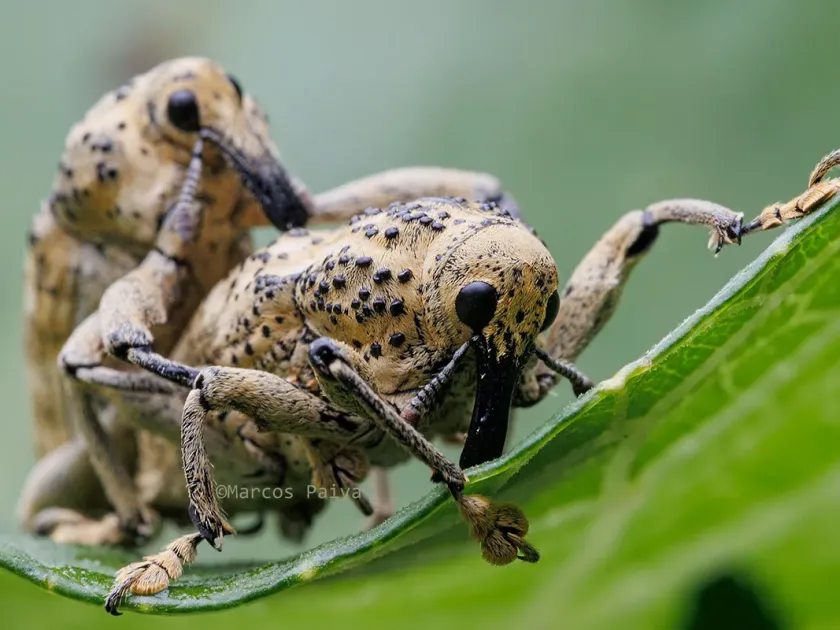
Description
How to identify
Amerrhinus ynca is a member of the Curculionidae family, order Coleoptera. Like other weevils, it possesses a distinct rostrum (snout) and a hard exoskeleton, making it well-adapted to surviving on woody plants.
The adult weevils are often camouflaged, featuring patterns that blend with the bark and fibers of palm trees. They are nocturnal or crepuscular, hiding in leaf axils or bark crevices during the day.
Larvae are legless, fleshy, and typically white to cream-colored with a sclerotized brownish head capsule. They are specialized for internal feeding within the vascular and fibrous tissues of palm stems.
The pupal stage occurs inside the plant, often enclosed in a protective fiber cocoon made by the mature larva before metamorphosis. This provides a stable environment for the transition from larva to adult.
The life cycle encompasses eggs, multiple larval instars, pupa, and adult stages. The duration of each cycle depends heavily on temperature and the health status of the host palm.
What it damages
This pest primarily attacks various palm species in its native range of Central and South America. Both ornamental palms and agricultural palm crops are susceptible to infestation.
The primary damage is caused by larvae boring into the apical meristem and the heart of the palm. Because palms rely on a single growing point, this destruction is usually fatal.
In addition to physical tissue destruction, the boring activities disrupt the flow of sap and nutrients, leading to the rapid decline and yellowing of the foliage.
Outbreaks can lead to significant economic loss in plantations. When a tree is infested, it often cannot recover, and it becomes a breeding ground for future generations of the weevil.
Secondary damage often includes bacterial and fungal infections that gain access to the tree through the larval entry points, significantly accelerating the death of the palm.
Signs of infestation
Initial signs include small holes at the base of leaf petioles, often accompanied by frass (a mixture of excrement and chewed plant material) being pushed out by the larvae.
Wilting of the central leaves (the spear leaf) is a key symptom. This indicates that the internal vascular system of the palm has been compromised by larval feeding.
Adult weevils leave exit holes in the bark of the trunk when they emerge. A fermented or decaying odor might be detected near the infested tree due to the combined action of insects and opportunistic rot.
In advanced stages of infestation, the crown of the palm may snap off completely. This occurs when the internal tissues have been so thoroughly riddled that they lose their structural integrity.
Frequent scouting is essential for detection, as early symptoms are often easily overlooked until the damage has become irreparable.
Control measures
Strict quarantine measures on the movement of plant material are the most effective way to prevent the spread of Amerrhinus ynca to new areas.
Chemical control usually involves the application of systemic insecticides that can penetrate the trunk tissues to reach the hidden larvae effectively.
Cultural practices should emphasize keeping the trees healthy and free of physical wounds, as open cuts are attractive sites for adult weevils to lay eggs.
- Deployment of pheromone-baited traps for monitoring and adult population reduction.
- Sanitation, including the prompt removal and destruction of heavily infested palms.
- Preventative insecticide sprays during peak flight periods of the adults.
- Regular inspection of the crown and base of the trunk for signs of boring.
An integrated pest management (IPM) approach is necessary to balance chemical intervention with biological controls to ensure long-term sustainability of the plantation.
Taxonomy
- Latin name
- Amerrhinus ynca
- Order
- Coleoptera (beetles)
- Family
- Curculionidae
- EPPO code
- AMERYN
Discussion
No discussions yet — be the first.