
Tiger salamander
Ambystoma tigrinum
Description
How to identify
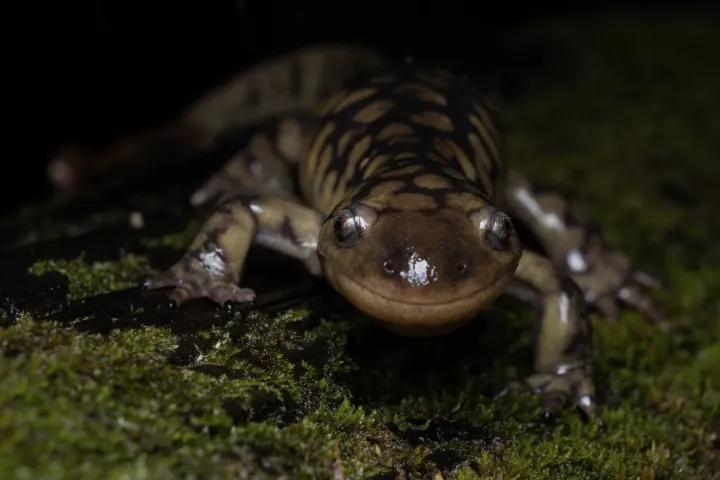
The tiger salamander (Ambystoma tigrinum) belongs to the order Caudata and the family Ambystomatidae. These amphibians can grow quite large, typically reaching 20–30 centimeters in length.
They are easily recognizable by their dark brown or olive skin featuring distinct yellow spots or stripes, which serves as a warning pattern in the wild.
Their skin is permeable and kept moist by mucus, which requires them to live in damp environments to maintain their physiological functions.
The larvae are fully aquatic and have prominent gills, while adults transition to terrestrial life, spending most of their time in underground burrows.
As nocturnal creatures, they are rarely seen during the day unless environmental conditions are exceptionally humid or rainy.
What it damages
While tiger salamanders are not herbivores and do not directly eat plant tissues, they can negatively impact agricultural ecosystems in several ways.
By preying on beneficial insects such as ground beetles and earthworms, they disrupt the natural balance of soil health and pest control on your property.
Their burrowing activity around the root zones of young seedlings can lead to soil instability and root exposure, causing stunted growth or plant wilting.
In greenhouses, their movement can inadvertently damage delicate young plants, leading to mechanical stress and creating entry points for secondary infections.
Accumulation of these amphibians in irrigation water sources can lead to contamination of the water supply, which is problematic for sensitive garden crops.
When it appears
Tiger salamanders are most active during the warmer months, starting in early spring when they migrate to water bodies for the mating season.
During the summer, they remain active, especially at night or following heavy rainfall, when they emerge to forage for prey across agricultural plots.
Autumn marks the period of preparation for dormancy, as the salamanders begin to search for deeper, frost-free burrows to overwinter safely.
Winter is the period of inactivity or hibernation, during which they remain buried deep in the ground, making them invisible to the gardener.
Early spring is the most critical time for monitoring, as this is when the population migrates and establishes itself in new areas near crops.
Signs of infestation
Direct sightings of adults during damp nights or in the early morning are the most reliable indicators of their presence on your land.
The presence of egg clutches in ponds, ditches, or irrigation canals serves as a clear sign of an established breeding population nearby.
Unusual soil disturbance or small burrows found near logs, garden debris, or under mulch often indicate the locations of their daytime shelters.
- Slime trails left on soil surfaces near garden beds.
- Unexpected decline in beneficial insect populations without clear cause.
- Mechanical damage to the base of young seedlings.
Monitoring compost piles or wet, shaded areas often reveals their presence, as these locations provide both humidity and a steady supply of prey.
Control measures
The primary control method involves removing potential breeding habitats, such as draining stagnant water in minor ponds or clogged ditches.
Maintaining a tidy garden by clearing away brush, wood piles, and loose debris limits the availability of daytime hiding spots for the amphibians.
Installing physical barriers like fine-mesh fencing around the perimeter of garden beds effectively prevents the salamanders from entering high-value zones.
Reducing late-evening or nighttime irrigation helps to keep the soil surface drier, making the area less hospitable for moisture-dependent amphibians.
Chemical intervention is not advised, as these animals are highly sensitive to pesticides, and their disappearance would harm the ecosystem's natural insect control.
Taxonomy
- Latin name
- Ambystoma tigrinum
- Family
- Ambystomatidae
- EPPO code
- ABYSTI
Discussion
No discussions yet — be the first.