
Black ambrosia beetle
Ambrosiophilus atratus
Description
How to identify
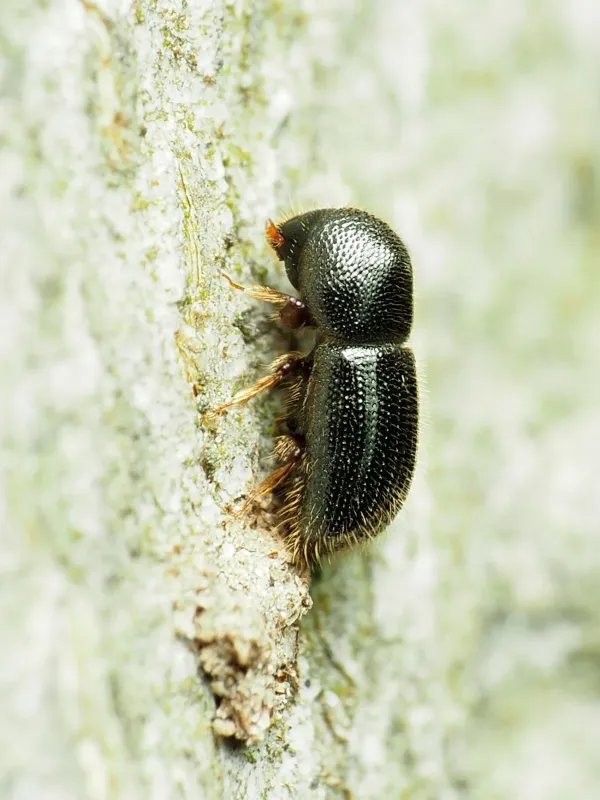
The black ambrosia beetle (Ambrosiophilus atratus) belongs to the Curculionidae family, subfamily Scolytinae. This is a small insect, typically measuring 3–4 mm in length, with a cylindrical, black or dark-brown body.
This pest leads a concealed lifestyle, burrowing deep into the wood of host trees. The adult beetle can be identified by the specific shape of its pronotum and elytra, typical of the ambrosia beetle group.
The biology of this species is closely linked to fungi of the genus Ambrosiella. Adult beetles carry fungal spores in specialized organs called mycangia to cultivate fungal gardens that serve as the primary food source for their larvae.
Unlike most bark beetles, they do not feed on the wood itself. Instead, their life cycle revolves around maintaining the fungal crop inside the tunnels, which the developing offspring consume to reach maturity.
Adult beetles exhibit sexual dimorphism, with females being significantly larger and possessing functional wings, allowing them to actively disperse to new host plants in search of suitable nesting sites.
What it damages
The black ambrosia beetle is a polyphagous pest, attacking a wide range of deciduous trees. Susceptible hosts include orchard crops like apple, pear, and plum, as well as forest trees such as maple, beech, and oak.
The beetle is most aggressive towards stressed or weakened trees, but it can also infest apparently healthy trees when population densities are high. It is also known to damage grapevines, causing significant agricultural losses.
The galleries bored by the beetles disrupt the vascular system of the tree, hindering the transport of water and nutrients. This leads to branch wilting and, in cases of severe infestation, the death of the entire tree.
The symbiotic fungi introduced by the beetle cause staining of the wood, known as "blue stain" or wood discoloration. This significantly reduces the timber quality, making it unsuitable for woodworking or lumber production.
Due to its ability to adapt to a wide variety of tree species, this insect is considered a serious quarantine threat in many regions, necessitating strict monitoring and phytosanitary controls.
When it appears
The flight of adult beetles typically begins in the spring when daily mean temperatures reach 15-18 degrees Celsius. Mass emergence usually coincides with the period of active sap flow in host trees.
Females bore entrance holes into the bark and create radial galleries deep into the sapwood, where they establish chambers for oviposition. The breeding season can extend over several months depending on regional climate.
Depending on environmental conditions, one or two generations may occur per year. Larvae thrive best in moderately moist, warm wood that supports the growth of their symbiotic fungal crop.
Activity tapers off during the autumn. The beetles generally overwinter as adults within their maternal galleries or in protected crevices under the bark, awaiting the arrival of favorable spring temperatures.
Pest management relies on pheromone traps, which allow agronomists to accurately track the timing of adult emergence and plan targeted chemical interventions.
Signs of infestation
The primary sign of infestation is the presence of tiny entrance holes, approximately 1.5–2 mm in diameter, on the bark. Fine, powdery wood dust, known as frass, is often visible around these entry points.
If affected branches are cut open, branching galleries can be found inside. The walls of these tunnels are often stained dark or black due to the growth of the symbiotic fungus that the beetles cultivate.
Visible symptoms on the tree include sudden wilting of the foliage, yellowing, leaf curling, and premature leaf drop. Affected branches become brittle and dry out without other apparent causes.
Gummosis or sap bleeding may occur around the beetle entrance sites (particularly in stone fruits) as the tree attempts to defend itself and seal off the damaged tissues from further fungal infection.
Chronic infestation leads to thinning of the crown and eventual dieback of branches, which serves as a critical indicator for orchard managers to initiate sanitation measures.
Control measures
Controlling the black ambrosia beetle is challenging because the insects spend most of their life cycle protected within the wood. Management focuses on preventive measures and maintaining overall orchard health.
Sanitary pruning and the destruction of infested wood are essential. It is crucial to remove and burn woody debris from the orchard, as this material serves as a breeding ground for future generations.
Reducing tree stress through proper irrigation and balanced fertilization increases the tree's natural resistance to wood-boring pests, making it less attractive for colonization.
Chemical control involves the use of systemic insecticides during the peak flight of adult beetles. Treatments must be timed precisely based on data from monitoring traps to ensure maximum efficacy.
Emerging strategies include biological control methods, such as utilizing natural predators or applying antagonistic fungi that can suppress the growth of the beetle's symbiotic fungal crops.
Taxonomy
- Latin name
- Ambrosiophilus atratus
- Order
- Coleoptera (beetles)
- Family
- Curculionidae
- EPPO code
- XYLBAT
Discussion
No discussions yet — be the first.