
Ambrosia beetle
Ambrosiophilus
Description
How to identify
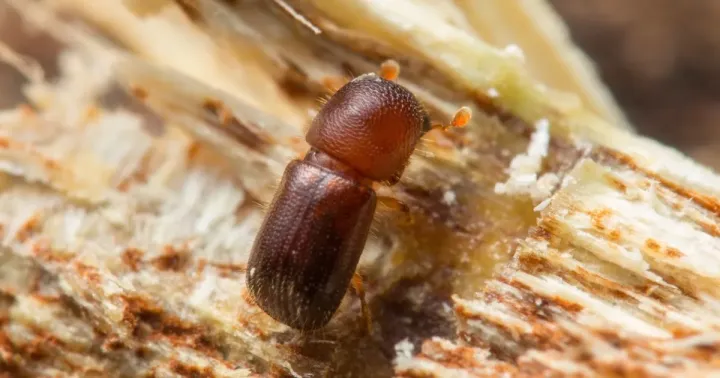
Ambrosia beetles (Ambrosiophilus) belong to the Curculionidae family, subfamily Scolytinae. These insects are small, typically ranging from 2 to 3 millimeters in length, with cylindrical, brown-to-black bodies adapted for boring into wood.
The defining characteristic of these beetles is their symbiotic relationship with fungi of the genus Ambrosiella. They carry fungal spores in specialized body structures called mycangia and inoculate the wood galleries they excavate.
Unlike wood-boring beetles that feed directly on cellulose, Ambrosia beetles feed on the fungal gardens they cultivate. This unique biology allows them to colonize even relatively moist or living wood, as the fungi thrive in these environments.
The life cycle is completed entirely within the wood. Females drill tunnels to lay their eggs, while the larvae feed exclusively on the mycelium introduced by the mother. This makes the entire population protected from many environmental factors.
Adults emerge from the host tree through existing tunnels to find new breeding sites. They are strongly attracted to stressed trees that release volatile ethanol, signaling a weakened host capable of supporting fungal growth.
What it damages
These beetles are serious pests of a wide variety of fruit trees and woody ornamentals. They affect stone fruits like peaches, plums, and cherries, as well as pome fruits and many hardwood tree species found in commercial forestry.
The damage is two-fold: direct mechanical damage from the boring of tunnels, and biological damage from the introduction of fungal pathogens. The fungi block the plant's vascular tissues, disrupting water and nutrient transport.
Branches infested by these beetles often show sudden wilting, often referred to as "flagging." This occurs because the tree's xylem vessels become occluded by fungal growth, leading to rapid dieback of distal parts of the tree canopy.
Young orchards are particularly vulnerable, and heavy infestations can lead to total crop loss or the death of entire trees within a single growing season. The infestation often creates entry points for other opportunistic pathogens.
In addition to tree health, the presence of these beetles degrades the timber quality of affected trees. The dark staining left by the fungi inside the wood makes it commercially unusable for high-value purposes.
Signs of infestation
The most reliable sign of an infestation is the presence of small, round entry holes on the bark. These holes are typically about 1–1.5 mm in diameter, often accompanied by "frass," which looks like fine sawdust protruding from the trunk.
During peak growing periods, trees may show signs of sap or gum bleeding from these entry points. This is a stress response as the tree attempts to push the beetle out or seal off the damaged vascular tissue.
Canopy flagging, where individual branches turn brown or yellow suddenly, is a common indicator. If you examine the wood of such branches, you will likely find the characteristic galleries carved by the beetles.
When peeling back the bark of an affected tree, one can often see dark, discolored patches. This staining is a direct result of the symbiotic fungi spreading through the wood, which serves as a visual marker of internal colonization.
- Small, round entry holes in bark.
- Accumulation of fine sawdust (frass).
- Sudden wilting or flagging of branches.
- Sap or gum exuding from entry points.
- Dark fungal staining on the wood surface.
Control measures
Effective control starts with good cultural practices. Keeping trees healthy through proper irrigation and balanced nutrition makes them less attractive to the beetles, which actively seek out stressed or ethanol-releasing specimens.
Sanitation is critical; all heavily infested wood or fallen branches must be pruned and burned or chipped promptly. This destroys the current generation of beetles and prevents them from emerging to attack nearby healthy trees.
Monitoring using ethanol-baited traps is a professional strategy to detect the presence of the beetle early in the season. This allows for precise timing of interventions before the population reaches critical levels.
Chemical control is challenging because the beetles spend most of their life inside the tree, safe from surface sprays. Insecticides are effective only for a short window during the mass emergence and dispersal of the adults.
Applying barrier sprays to the trunk in spring can provide some protection for younger, vulnerable trees. However, these treatments should be considered part of an integrated pest management program rather than a standalone solution.
Taxonomy
- Latin name
- Ambrosiophilus
- Order
- Coleoptera (beetles)
- Family
- Curculionidae
- EPPO code
- AMBHSP
Discussion
No discussions yet — be the first.