
Ambrosiodmus minor
Ambrosiodmus minor
Description
How to identify
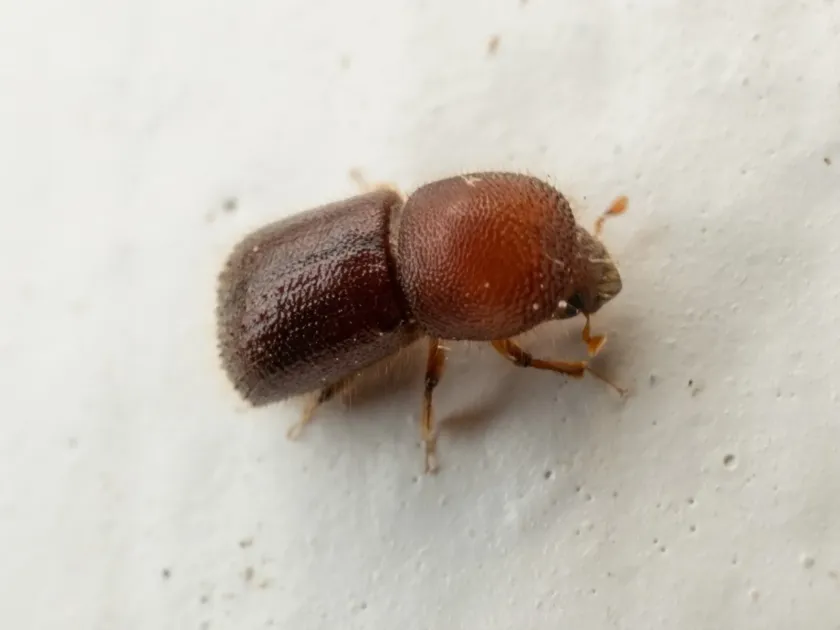
Ambrosiodmus minor is a species of bark beetle belonging to the Curculionidae family and the Scolytinae subfamily. These insects are small, typically measuring between 2.5 to 3.5 mm in length.
The adult beetle has a cylindrical body, often dark brown or black in color. A distinguishing feature is the presence of fine hairs or scales on the elytra, which helps in identifying this specific species.
The larvae are legless and white, with a distinct, hardened brown head capsule. They live and develop exclusively within the tunnels constructed by their parents inside the wood.
As a true ambrosia beetle, the female carries symbiotic fungi into the tunnels, planting them on the gallery walls. These fungi serve as the primary food source for the developing larvae.
These beetles are cryptic, living deep inside the sapwood of trees, making them difficult to detect until substantial internal damage has already occurred.
What it damages
This beetle is a polyphagous pest, meaning it attacks a wide range of deciduous and coniferous tree species. Fruit trees such as apples, pears, plums, and peaches are common targets.
The beetle primarily attacks trees that are already stressed due to drought, physical trauma, or pathogen infection. Healthy trees are usually less attractive, though severe outbreaks can overwhelm even robust specimens.
The damage is caused by both the physical mining of the wood, which creates tunnels, and the introduction of symbiotic fungi that interfere with the tree's nutrient and water transport.
Heavy infestation leads to the wilting of foliage, branch dieback, and in many cases, the eventual death of the entire tree. Young saplings in nurseries are particularly vulnerable.
Infested trees often become susceptible to secondary infections by other wood-boring insects and decay fungi, complicating the recovery process for the host plant.
When it appears
The adult flight period typically begins in spring when ambient temperatures become consistently warm. Beetles emerge to seek out suitable host trees, often attracted by the smell of ethanol released by stressed wood.
After mating, the female bores into the bark to create a gallery. Depending on the geographical location and climate, the beetle may complete one or several generations within a single season.
Summer activity is characterized by the dispersal of new adults. These beetles search for new host trees to colonize, which allows the population to expand through orchards or forest stands.
As autumn approaches, the final generation prepares for hibernation. They typically overwinter within the galleries they have carved inside the wood, protected from harsh weather.
Temperature plays a crucial role in the lifecycle; warmer and longer summers generally result in higher pest pressure and increased damage to the host trees.
Signs of infestation
The earliest visual sign of infestation is the appearance of tiny entry holes on the bark surface. These holes are often surrounded by small piles of sawdust, commonly referred to as frass.
These frass piles can sometimes look like thin, projecting matchsticks or hair-like structures emerging from the entry holes, indicating active tunneling by the beetles.
Wilting of foliage without an obvious cause, such as lack of irrigation, is a strong indicator of internal vascular disruption caused by the beetle’s galleries and associated fungi.
When the bark is carefully removed or the wood is cross-sectioned, dark, stained channels become visible. This staining is the result of the fungal growth introduced by the beetles.
In stone fruit trees, sap flow (gummosis) at the site of the entry holes is a common defensive response, which serves as a visible marker of an attempted or successful colonization.
Control measures
- Regular inspection of orchard trees for entry holes and frass to ensure early detection.
- Prompt removal and burning of heavily infested branches or entire trees to destroy the beetle population.
- Maintaining optimal tree vigor through proper irrigation and fertilization to minimize stress.
- Applying insecticides during the peak flight period to prevent adult beetles from boring into the bark.
- Utilizing pheromone traps to monitor adult flight activity and time the application of protective measures effectively.
Taxonomy
- Latin name
- Ambrosiodmus minor
- Order
- Coleoptera (beetles)
- Family
- Curculionidae
- EPPO code
- AMBDMI
Discussion
No discussions yet — be the first.