
Ambrosiodmus hagedorni
Ambrosiodmus hagedorni
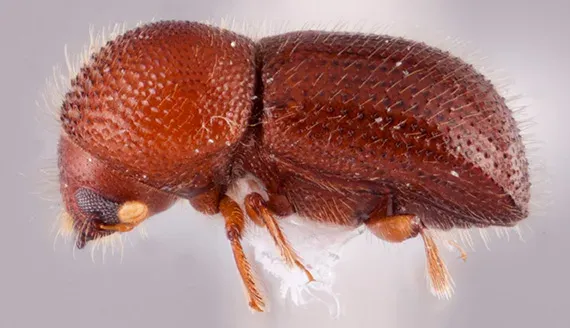
Description
How to identify
Ambrosiodmus hagedorni is a species of beetle belonging to the Curculionidae family, subfamily Scolytinae. Often referred to as an ambrosia beetle, it exhibits a symbiotic relationship with specific fungi, which serve as the primary food source for both the adults and the developing larvae.
Adult beetles are small, typically ranging from 2.5 to 3.5 mm in length. They possess a cylindrical, dark brown to black body, which is a structural adaptation for their wood-boring lifestyle. Their morphology is characteristic of the genus Ambrosiodmus, requiring specialized knowledge for accurate identification.
The lifecycle of this pest is entirely contained within the host tree's woody tissue. Females bore galleries into the wood, where they cultivate fungal gardens. Unlike typical bark beetles that eat wood fiber, these beetles utilize the nutritional value provided by the fungal hyphae.
Larvae are legless, white grubs that develop within these galleries. As they grow, they rely on the constant supply of fungi. This symbiotic strategy allows the beetles to exploit even woody tissues that would otherwise be low in nutrients for a wood-boring insect.
As an invasive species in many parts of the world, Ambrosiodmus hagedorni poses a significant threat to global trade in timber and nursery stock. Early detection is complicated by their habit of living hidden within the interior of the tree trunk or branches.
What it damages
The host range of Ambrosiodmus hagedorni includes a diverse array of hardwood tree species. It frequently attacks fruit orchards, nut-producing trees, and various deciduous forest trees such as oak, beech, maple, and many others.
Damage is primarily caused by the beetle's tunneling activities combined with the growth of the symbiotic fungus. These fungal hyphae colonize the plant's vascular system, blocking xylem vessels and leading to systemic wilting and eventual death of the affected branches or the entire tree.
In forestry and orchard management, the damage results in significant economic losses. Infested lumber suffers from internal discolouration and structural mining, reducing its market value. Furthermore, young saplings often perish quickly upon infestation due to their smaller diameter and vulnerability.
The beetle often favors stressed or weakened trees, though it is capable of attacking healthy individuals when population densities are high. This adaptability allows it to persist and spread efficiently through both natural forests and managed landscape environments.
The cumulative effect of galleries weakens the structural integrity of branches, making them more prone to breakage during storms or heavy snow loads. Once a tree is colonized, it becomes a reservoir for future infestations in the surrounding area.
Signs of infestation
The presence of Ambrosiodmus hagedorni is often first indicated by the appearance of "frass" (wood dust). This fine, sawdust-like material is pushed out of entrance holes by the beetles and accumulates on bark surfaces or in the forks of branches.
Entrance holes appear as small, perfectly circular tunnels, roughly 1–1.5 mm in diameter. In some tree species, the plant may respond to the invasion by exuding sap or resin near the tunnel entrance, which can be a visible indicator of an active or recent attack.
When the bark is removed or a branch is cross-cut, one may observe dark, stained galleries running through the sapwood. This dark colour is typically the result of the fungal growth that the beetle fosters within its tunnel system, serving as a clear diagnostic feature.
Canopy dieback, leaf yellowing, and sudden wilting are critical signs of advanced infestation. By the time these symptoms appear, the beetle population within the tree is often well-established, and the internal damage to the conductive tissue is extensive.
Using pheromone-based traps is the most effective way to monitor the presence of adult beetles in an area. This proactive approach allows growers to detect the initial flight phase and implement management strategies before mass colonization occurs.
Control measures
Strict phytosanitary regulations are essential for preventing the spread of Ambrosiodmus hagedorni. International trade must be monitored for wood packaging materials and nursery stock, which are primary pathways for the long-distance transport of this pest.
Effective management heavily relies on sanitation. Any trees identified as infested must be promptly removed and either chipped, burned, or debarked to destroy the beetles and their fungal gardens. Leaving infected material on-site provides a continuous breeding source.
Chemical control via insecticides is generally difficult because the beetles spend the majority of their lives protected inside the wood. Systemic treatments applied at the early stages of the flight period can help protect valuable landscape trees but are not a complete solution.
Cultural practices focused on maintaining tree vigour are vital. Ensuring adequate irrigation and soil health prevents water stress, which is a major attractant for many wood-boring insects. Well-maintained trees are significantly more capable of resisting initial colonization attempts.
While biological control options like the use of parasitic wasps are being explored, they are not yet a primary management tool. Therefore, integrated pest management (IPM) focusing on monitoring, sanitation, and prevention remains the most reliable strategy for this species.
Taxonomy
- Latin name
- Ambrosiodmus hagedorni
- Order
- Coleoptera (beetles)
- Family
- Curculionidae
- EPPO code
- AMBDHA
Discussion
No discussions yet — be the first.