
Ambrosia beetle
Ambrosiodmus compressus
Description
How to identify
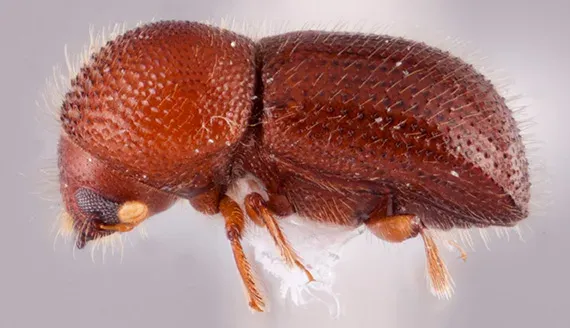
The ambrosia beetle, Ambrosiodmus compressus, is a member of the Curculionidae family, specifically the Scolytinae subfamily. These tiny beetles are specialized wood-borers.
Adult beetles have a dark brown to black cylindrical body, which is perfectly adapted for navigating through narrow tunnels inside the woody tissues of host plants.
The beetle shares a symbiotic relationship with ambrosia fungi. Adult females carry fungal spores in specialized organs called mycangia located on their bodies.
As they bore into the wood, they inoculate the tunnels with these fungi. The fungal mycelium grows on the walls, serving as the sole food source for the developing larvae.
They are cryptic insects, meaning they spend most of their life cycle hidden deep within the wood, making them difficult to detect until significant damage has occurred.
What it damages
This pest infests a wide range of deciduous and coniferous trees, including various fruit species like apple and pear, as well as forest trees like oak and beech.
The damage is caused by both the mechanical drilling of tunnels and the introduction of fungal pathogens that disrupt the tree's vascular system, hindering water transport.
Severe infestations can lead to canopy dieback, leaf wilting, and, eventually, the death of the tree, especially when the plant is already under physiological stress.
In nurseries and commercial orchards, these beetles cause significant economic losses by rendering wood structures brittle and destroying the structural integrity of young saplings.
Lumber or timber harvested from infested trees is often downgraded or rejected due to the permanent staining and galleries left by the beetles within the wood.
When it appears
Adult beetle activity is highly dependent on temperature, with the initial spring emergence occurring when temperatures reach a certain thermal threshold.
The peak flight and colonization period typically occurs during late spring and summer, when environmental conditions are ideal for finding and settling in host trees.
Beetles are highly attracted to stressed trees, which release ethanol and other volatile compounds as a result of water deprivation or mechanical injury.
Depending on the region's climate, the beetle may produce multiple generations per year, which significantly increases the pressure on local tree populations.
As autumn approaches and temperatures drop, the beetles cease their dispersal flights and seek shelter inside host wood or other protective habitats to overwinter.
Signs of infestation
The most visible sign of infestation is the presence of small, circular entry holes on the tree bark, often no larger than the tip of a fine drill bit.
Look for piles of frass, or "boring dust," near these holes; this fine, sawdust-like material is expelled by the beetles as they excavate their galleries.
Crown symptoms include premature yellowing of leaves, wilting, and branch dieback, indicating that the fungal infection is impacting the tree's water-conducting vessels.
Occasional sap flow or weeping on the bark surface at the site of the boring holes is a common reaction of the tree trying to flush out the invaders.
Peeling back a small section of bark or examining a cross-section reveals dark, stained tunnels carved into the wood, covered in the fungal layer the larvae feed upon.
Control measures
Sanitation is the primary control method: infested trees should be removed and destroyed promptly to eliminate breeding sites and reduce the local beetle population.
Maintaining tree vigor through proper irrigation, fertilization, and site management is critical, as healthy trees are less susceptible to beetle colonization.
Using ethanol-baited traps provides an effective way to monitor beetle activity, identify peak flight times, and assess the level of infestation risk in an area.
- Remove and burn or chip infested trees and wood debris.
- Apply systemic insecticides during high-risk periods if infestation is confirmed.
- Minimize mechanical damage to tree trunks to prevent ethanol emission.
Biological control, such as encouraging natural predators and parasitoids, can help manage beetle populations in forest ecosystems and sustainable agricultural settings.
Taxonomy
- Latin name
- Ambrosiodmus compressus
- Order
- Coleoptera (beetles)
- Family
- Curculionidae
- EPPO code
- AMBDCO
Discussion
No discussions yet — be the first.