
Amasa
Amasa
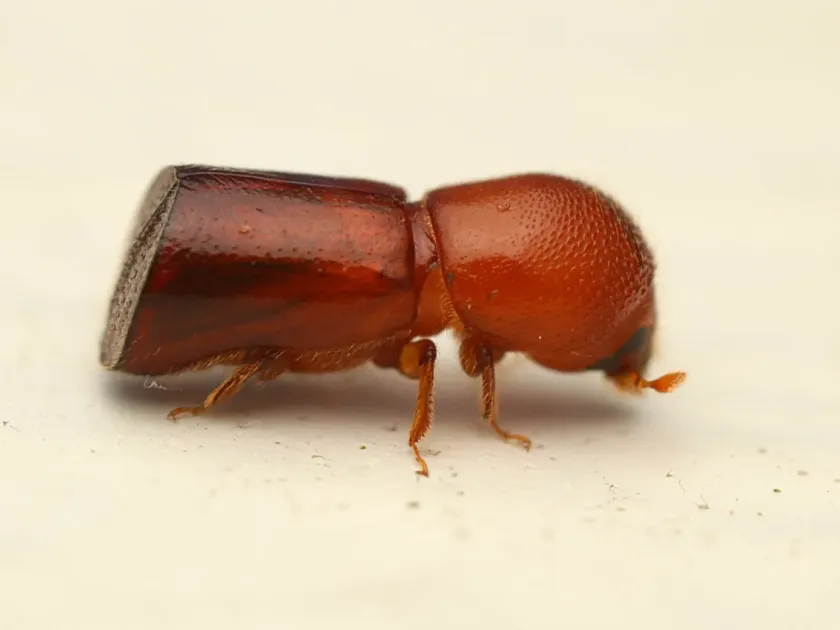
Description
How to identify
The genus Amasa belongs to the Curculionidae family and the Scolytinae subfamily. These insects are classified as ambrosia beetles, known for their unique relationship with fungi that they farm within their galleries.
Adult beetles are typically small, cylindrical, and well-adapted to life inside wood tunnels. Their body shape allows them to navigate narrow galleries efficiently while their mandibles facilitate wood excavation.
A key biological trait of Amasa is the presence of specialized structures called mycangia, which are used to transport fungal spores from tree to tree, ensuring a food supply for their larvae.
Systematically, identifying these beetles requires careful examination of their pronotal structure and elytral declivity, which differ across species within the genus and are distinct from other bark beetles.
Sexual dimorphism is common in this genus, with females often exhibiting different anatomical features than males, reflecting the division of labor in gallery maintenance and reproduction.
What it damages
Amasa species primarily infest weakened, stressed, or fallen trees, but during high population peaks, they can successfully attack healthy host trees, leading to significant ecological and economic damage.
By boring into the sapwood and heartwood, these insects physically disrupt the tree's vascular system, preventing the effective transport of water and nutrients throughout the stem and branches.
The damage is exacerbated by the symbiotic fungi introduced by the beetles. These pathogens cause wood discoloration and decay, significantly reducing the economic value of timber and structural wood quality.
Larvae feed exclusively on the fungal mycelium growing on the walls of the tunnels rather than on the wood itself. This interaction accelerates the decomposition of internal tree layers.
In orchards, the infestation of major limbs or the trunk can lead to "dieback," where branches slowly wither and die, ultimately reducing the productivity and overall longevity of fruit-bearing trees.
When it appears
The activity of Amasa is highly dependent on temperature, with adult emergence typically occurring as soon as spring temperatures stabilize and support insect flight.
Depending on the climatic zone, these beetles may undergo multiple generations within a single year, making population control challenging due to the overlapping presence of different life stages.
The developmental cycle from egg to mature adult is influenced by both ambient heat and the moisture content of the wood, which is critical for the survival of the fungal colonies that sustain the larvae.
During peak summer months, adults are most active in dispersing to new host plants, often guided by chemical signals emitted by stressed or dying timber.
Overwintering usually occurs in the adult stage within the protection of the galleries deep inside the wood, shielding the insects from severe cold and harsh weather conditions.
Signs of infestation
The most prominent sign of an Amasa infestation is the appearance of frass, or "boring dust," on the bark surface or at the base of the tree. This fine particulate matter is the waste discarded by the beetles as they expand their tunnels.
Entry holes are often small, circular, and clean, unlike those of other wood-boring insects that may produce messy resin outflows or thick sawdust around the entrance.
- Discoloration of the bark around entry points.
- Visible fungal staining on the wood surface near the tunnels.
- Premature leaf drop or yellowing of the canopy.
- Reduced annual growth and overall vigor of the host tree.
A musty or fermented odor emanating from the bark can also indicate the presence of extensive fungal gardens within the tree's internal vascular structure.
Control measures
The primary control strategy for Amasa is stringent silvicultural management, which involves the rapid removal and disposal of infested, damaged, or wind-thrown trees to eliminate breeding sites.
Fungal monitoring and the use of pheromone-baited traps are effective tools for tracking population levels and reducing the number of host-seeking adults in sensitive areas.
Maintaining high forest and orchard health is essential; trees that are well-hydrated and properly maintained are less susceptible to colonization by secondary wood-boring pests.
In high-value ornamental trees, systemic insecticides may be applied to provide protection, though their effectiveness depends on the timing of the application relative to the beetle's flight period.
Avoiding the storage of fresh logs or wood debris near live trees is critical, as fresh wood acts as a potent attractant and provides an ideal environment for new colonies to establish.
Taxonomy
- Latin name
- Amasa
- Order
- Coleoptera (beetles)
- Family
- Curculionidae
- EPPO code
- AMASSP
Discussion
No discussions yet — be the first.