
Black howler
Alouatta caraya
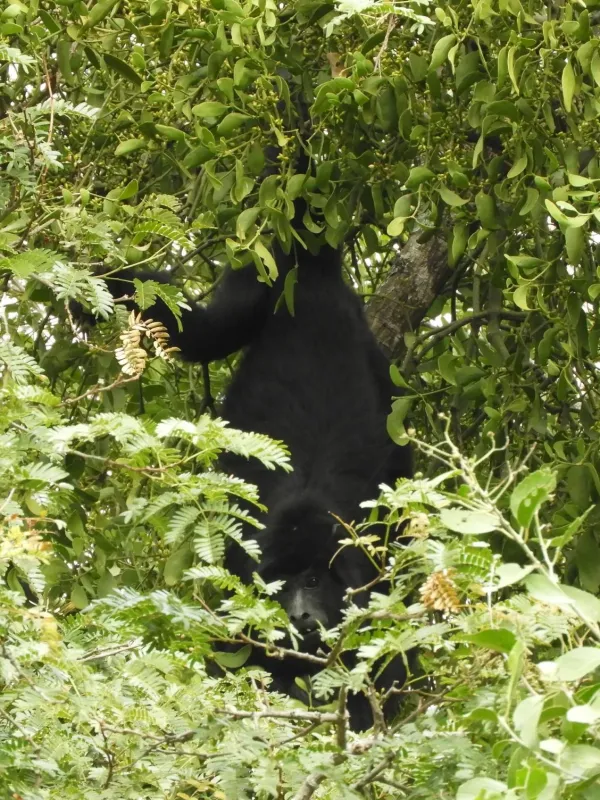
Description
How to identify
The Black howler is a large primate species belonging to the spider monkey family, characterized by a distinct sexual dimorphism in its coat color.
Adult males are typically covered in dense, jet-black fur, whereas females and younger individuals exhibit a lighter, yellowish-brown coloration.
The most prominent identifying feature is their large hyoid bone, which enables them to produce powerful, guttural roars that can travel great distances.
They are strictly arboreal animals, spending almost their entire lives in the forest canopy and descending to the ground only under rare circumstances.
Their biological adaptations are centered around a folivorous and frugivorous diet, often leading them to exploit high-energy food sources on plantations.
What it damages
Black howlers cause significant economic losses in tropical fruit plantations, particularly targeting avocado, citrus, and mango crops.
They consume both developing and mature fruits, often discarding half-eaten pieces that lead to increased waste and rot in the field.
Beyond fruit consumption, their movement through the canopy involves breaking heavy branches, which causes structural damage to the trees and reduces yield.
The resulting wounds on the bark and twigs provide entry points for secondary infections, such as fungi and pathogens, affecting the tree's long-term health.
In cases of high population density, these primates can strip entire sections of a plantation, rendering the produce unmarketable for commercial standards.
When it appears
Howler monkey activity is consistent year-round, although crop raiding increases significantly during the peak harvest seasons of various plantation fruits.
During periods of drought, when natural forest food sources diminish, these primates shift their focus to cultivated plants as an alternative survival strategy.
Their daily activity peaks during the early morning and late afternoon hours, coinciding with the most intense periods of foraging within the canopy.
As they do not have a seasonal breeding cycle tied to food availability, social groups may remain in or near agricultural lands throughout the entire year.
Habitat fragmentation remains the primary driver that pushes these groups into agricultural areas, forcing them to adapt to anthropogenic food sources.
Signs of infestation
The most immediate sign of their presence is the distinctive, loud vocalizations that echo across the plantation, usually at dawn or dusk.
Observation of discarded fruit husks and partially eaten produce strewn across the plantation floor is a clear indicator of recent foraging activity.
Broken branches and snapped twigs are characteristic of their heavy movement patterns as they navigate through the plantation canopy.
The presence of feces deposited on foliage and beneath the trees serves as a biological indicator of the group's established foraging routes.
Visual confirmation of bark stripping or specific bite marks on fruits confirms the identity of the species responsible for the localized damage.
Control measures
Effective management requires a multi-layered approach, emphasizing non-lethal deterrents such as visual scaring devices and localized fencing.
Maintaining native forest buffers between natural habitats and crops is the most sustainable way to reduce the pressure of primate foraging on plantations.
Ultrasonic repellents can serve as a temporary measure, although frequent changes in frequency are necessary to prevent the animals from habituating to the sound.
For high-value plots, installing physical barriers or applying non-toxic repellent sprays to the fruit trees can help minimize direct feeding attempts.
- Monitoring crop perimeters with motion-sensor cameras
- Planting non-commercial fruit trees as a diversion
- Utilizing loud, randomized acoustic alerts to disrupt foraging
Taxonomy
- Latin name
- Alouatta caraya
- Family
- Atelidae
- EPPO code
- ALOUCA
Discussion
No discussions yet — be the first.