
Howler monkeys
Alouatta
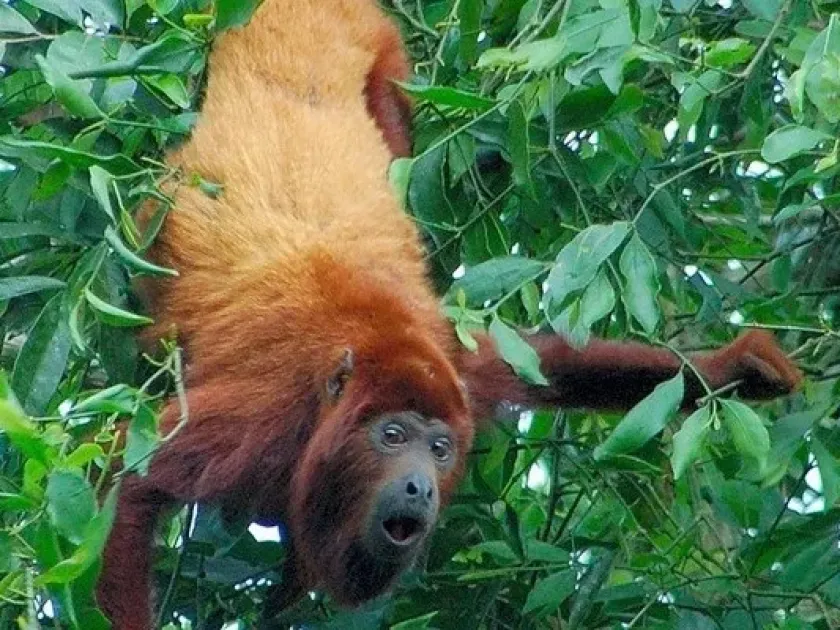
Description
How to identify
Howler monkeys (genus Alouatta) are primates belonging to the family Atelidae. They are well-known for their size and their exceptionally loud vocalizations, which can travel through dense forest canopies for several kilometers.
They possess a prehensile tail, which serves as a highly functional appendage for navigating through tree branches, allowing them to access fruit in the high canopy of orchard trees.
Biologically, howler monkeys are primarily folivorous and frugivorous. Their digestive system is specialized for a high-fiber diet, which drives them to consume large volumes of plant material on a daily basis.
They live in social troops with defined home ranges. When human agricultural expansion overlaps with these ranges, the monkeys naturally utilize the cultivated fruits as a convenient high-energy food source.
These animals are highly adaptable and display intelligent social behaviors, making them a complex challenge for farmers operating in or near tropical rainforest margins.
What it damages
Howler monkeys can cause significant economic losses in fruit orchards, particularly those growing mangoes, citrus, avocados, and bananas. They often feed intensively during the peak ripening season.
A major part of the damage is caused by the wasteful feeding habits of the troop. They frequently pluck immature fruit, bite into it, and discard it, resulting in a loss of marketable yield far exceeding their actual nutritional requirements.
In addition to fruit consumption, they can cause structural damage to trees by breaking branches due to their weight and by stripping young buds or leaves, which impairs tree growth.
Repeated damage to the bark and buds can hinder the development of perennial trees and lower overall productivity, making the plantation more susceptible to secondary infections or pests.
Because they act in groups, a single visitation by a troop can devastate a large portion of an orchard within a very short timeframe, significantly impacting the farm's seasonal output.
Signs of infestation
The most prominent sign of their presence is their loud, distinct howling calls, which usually occur at dawn or dusk, alerting farmers to the troop's current location.
Accumulated debris on the orchard floor, such as half-eaten fruits, skins, and pits, provides clear evidence that monkeys have been feeding in the tree canopy directly above.
Physical evidence of damage, including snapped twigs, scarred branches, and missing foliage, is common in areas frequently visited by these primates.
Visual confirmation of the monkeys is usually straightforward given their size and boisterous behavior, making it easy to identify the culprits during inspections.
Changes in the local bird and animal activity within the plantation can also serve as an indirect indicator, as many native species avoid areas occupied by active groups of howler monkeys.
Control measures
Mitigating damage from howler monkeys requires a multifaceted management strategy that focuses on exclusion and deterrence rather than direct elimination.
Electric fencing, installed strategically around the perimeter of the orchard, is a highly effective exclusion method that teaches monkeys to avoid the protected area.
Acoustic deterrents that replicate the calls of predators or alert signals can be used to repel the monkeys, although their effectiveness often diminishes if the sound patterns are not rotated.
Management of the surrounding landscape, such as clearing canopy bridges and maintaining buffer zones between forest patches and orchards, can restrict the monkeys' ability to move safely into the crop area.
Motion-activated deterrents, such as automated water sprayers or flashing lights, can create an uncomfortable environment for the primates, effectively discouraging them from foraging on the farm.
Taxonomy
- Latin name
- Alouatta
- Family
- Atelidae
- EPPO code
- ALOUSP
Discussion
No discussions yet — be the first.