
Alloxysta brassicae
Alloxysta brassicae
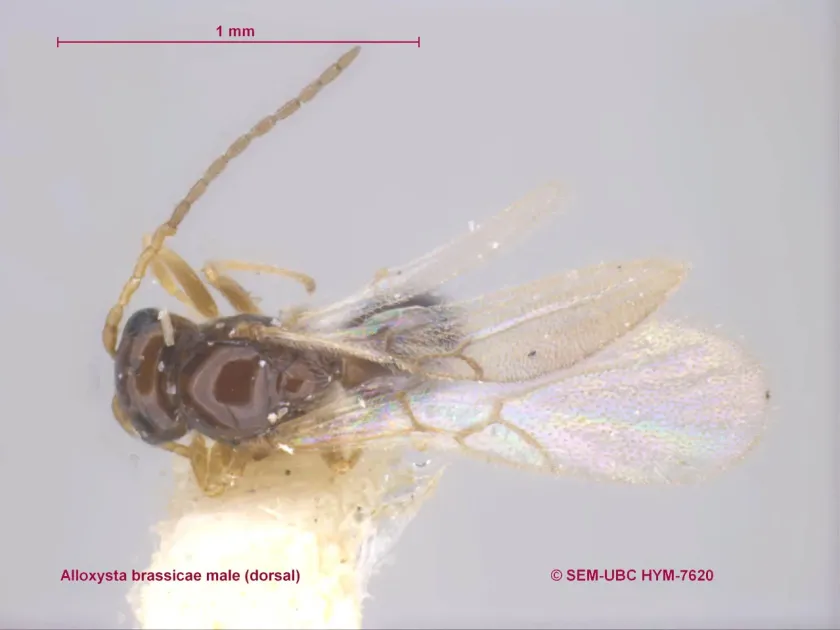
Description
How to identify
Alloxysta brassicae is a minute insect belonging to the order Hymenoptera and the family Charipidae. It is widely recognized as a hyperparasitoid, meaning it parasitizes other parasitoids.
Adults are extremely small, typically measuring between 1.5 and 2 mm in length. Their bodies are dark, often black or dark brown, making them inconspicuous in the field.
They possess transparent wings with a distinct venation pattern characteristic of the family. Long, filiform antennae assist them in locating host larvae hidden within aphids.
The lifecycle of Alloxysta brassicae is inextricably linked to the presence of aphids and the primary parasitoids (braconid wasps) that infest these aphids.
Because they act as secondary parasites, they occupy a unique position in the food web, often functioning as a natural regulator of primary parasitoid populations.
What it damages
Alloxysta brassicae does not feed on plant tissues, meaning it does not cause direct physical damage to crops like cabbage or other cruciferous plants.
However, it causes significant indirect damage by parasitizing the primary parasitoids that control aphid populations. This interference disrupts biological control efforts.
When primary parasitoids are suppressed by Alloxysta brassicae, aphid colonies are allowed to proliferate, leading to leaf curling, stunted growth, and poor crop yield.
In commercial greenhouses, the presence of these hyperparasitoids can lead to a collapse of aphid management programs, resulting in economic losses for growers.
Therefore, while not a direct pest, this species is considered a detrimental factor in integrated pest management (IPM) where primary parasitoids are the main line of defense.
When it appears
The activity period of Alloxysta brassicae corresponds with the peak development of aphid populations on cruciferous crops, typically from late spring through autumn.
Adults emerge as soon as temperatures become favorable, usually starting in late May, and continue their reproductive cycles throughout the warmer months.
Their population density often follows the trends of host availability; as aphid colonies grow, the number of primary parasitoids increases, subsequently fueling the growth of Alloxysta brassicae.
The insect completes multiple generations per season, allowing for rapid colonization of new aphid populations in different parts of the agricultural landscape.
Overwintering usually occurs in the pupal stage, protected within the mummified remains of aphids found in plant debris or the upper layer of the soil.
Signs of infestation
The primary sign of their presence is the observation of aphid mummies with abnormal emergence holes, which differ in size or shape from those created by primary parasitoids.
Detecting the adults themselves is difficult due to their microscopic size, but monitoring using yellow sticky cards can reveal their presence within the crop canopy.
A sudden, unexplained increase in aphid numbers in areas where primary parasitoids were successfully established is a strong indicator of hyperparasitoid intervention.
Field scouting should focus on the density of mummified aphids and comparing the ratio of successfully emerged primary parasitoids versus evidence of secondary parasites.
- Presence of unusual exit holes on aphid mummies.
- Increased aphid colony density despite the presence of parasitoid mummies.
- Inconsistent results in biological control efficiency.
Control measures
Direct chemical control against Alloxysta brassicae is strongly discouraged, as broad-spectrum insecticides will inevitably kill the primary parasitoids, worsening the aphid problem.
The most effective strategy is a balanced IPM approach, including crop rotation and the management of wild host plants that may serve as reservoirs for these insects.
In greenhouse settings, using fine-mesh screening and maintaining high hygiene standards can help prevent the ingress of these secondary parasites from the external environment.
Biological control programs should prioritize monitoring for hyperparasitism and be ready to supplement primary parasitoids if control efficiency declines significantly.
Promoting floral diversity around fields encourages native predators that can suppress aphid populations independently, reducing the reliance on parasitoids and minimizing the impact of hyperparasitism.
Taxonomy
- Latin name
- Alloxysta brassicae
- Order
- Hymenoptera
- Family
- Charipidae
- EPPO code
- ALXYBR
Discussion
No discussions yet — be the first.