
Alcidodes weevil
Alcidodes
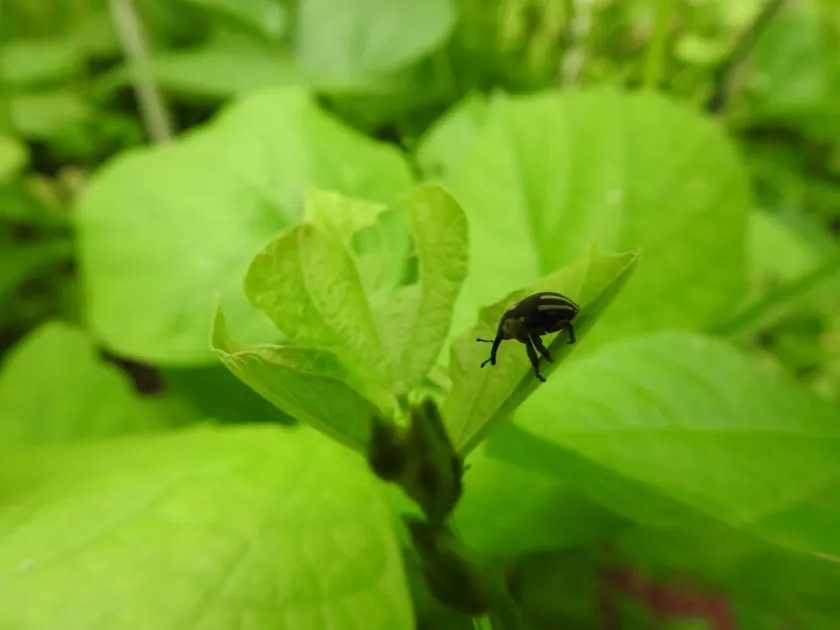
Description
How to identify
Weevils of the genus Alcidodes belong to the Curculionidae family within the order Coleoptera. These insects are characterized by an elongated snout (rostrum) that aids them in penetrating plant tissues.
Adults typically possess a stocky body covered in dense scales or hairs, with coloration ranging from dark brown to gray, providing excellent camouflage against tree bark.
The larvae of this genus are legless, C-shaped grubs, typically creamy white in color with a distinct brown head capsule.
They lead a hidden lifestyle, developing inside stems, shoots, or fruits of plants, which makes them difficult to detect during the early stages of infestation.
Accurate species identification often requires laboratory examination of adult genitalia, as morphological characteristics of many Alcidodes species are highly similar.
What it damages
This pest affects a wide range of tropical and subtropical crops. It causes significant economic damage to plantations of cotton, soybean, coffee, and various legumes.
Larvae bore tunnels inside stems, disrupting the plant's vascular system, which leads to the wilting of individual branches or the entire plant.
Adults feed on buds, young shoots, and occasionally fruits, creating characteristic puncture wounds that serve as entry points for secondary infections.
Damaged stems become brittle and frequently snap under their own weight or during strong winds, leading to critical yield losses.
Under outbreak conditions, this pest can devastate large portions of crops, requiring immediate intervention from agricultural experts.
Signs of infestation
A key sign of infestation is the appearance of gall-like swellings or enlargements on the stems of plants, where the larvae feed internally.
Sudden wilting of shoot tips during sunny hours, even when soil moisture is adequate, indicates damage to the plant's conductive vessels.
Inspection of the stem surface may reveal small exit holes through which larvae expel frass or through which adult weevils emerge.
Leaves and young fruits may show numerous small feeding punctures caused by adults, which darken over time and may lead to organ deformation.
Stunted growth and premature shedding of flowers or developing fruit are indirect indicators of high weevil population density.
Control measures
Effective management begins with cultural practices, such as the destruction of crop residues after harvest, where the insects may overwinter.
Strict adherence to crop rotation helps disrupt the pest's life cycle, preventing the buildup of population numbers on a single field over multiple seasons.
Systemic insecticides are recommended during peak adult activity periods to prevent egg-laying within plant tissues.
Regular monitoring using pheromone traps is essential to determine the most effective timing for chemical control measures.
In integrated pest management (IPM) programs, the use of biological control agents and natural predators is encouraged to suppress weevil populations naturally.
Taxonomy
- Latin name
- Alcidodes
- Order
- Coleoptera (beetles)
- Family
- Curculionidae
- EPPO code
- ALCISP
Discussion
No discussions yet — be the first.