
Rusty-winged click beetle
Agriotes ferrugineipennis
Description
How to identify
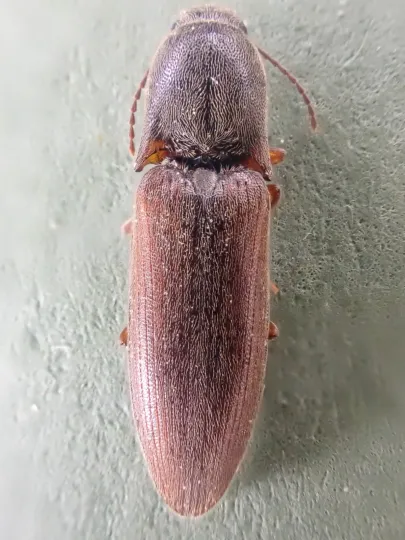
The rusty-winged click beetle (Agriotes ferrugineipennis) is a member of the Coleoptera order and the Elateridae family. Adult beetles are characterized by their elongated, flattened bodies and distinct reddish-brown wing covers.
The larval stage, commonly referred to as the wireworm, is arguably the most recognizable form of this pest. They have a hard, cylindrical body with a yellowish-orange color, resembling a piece of copper wire due to their high chitin content.
This species is highly adapted to the soil environment. Adults emerge in spring to mate, after which females lay eggs in soil rich in moisture and organic matter, favoring grassy or weedy areas.
The larval development stage can span several years, during which the larvae pass through multiple instars, gradually growing in size while living and feeding in the soil horizons.
Monitoring for this pest typically involves soil sampling and the use of bait traps to determine infestation levels in fields before and during the planting season.
What it damages
The pest poses a significant threat to various agricultural crops, including cereals, maize, potatoes, sugar beets, and various vegetable crops, causing economic losses globally.
The larvae are responsible for the damage, as they feed on seeds, roots, and subterranean stems. This feeding behavior destroys the plant's vascular system, causing stunted growth or total plant death.
In cereal fields, wireworms often cause patchy stands by killing young seedlings shortly after germination. This frequently necessitates replanting of the affected areas.
For tuber and root crops like potatoes, wireworms tunnel deep into the edible parts, reducing harvest quality and exposing the tubers to secondary rot infections during storage.
General crop vigor is significantly reduced even in cases of light infestation, as the plants struggle to absorb nutrients and water through compromised root systems.
When it appears
Adult beetles become active in early spring as soil temperatures rise, moving from their overwintering depths to the surface to feed and locate mates for reproduction.
The egg-laying period typically occurs between late spring and early summer. Moist soil conditions during this time are critical for the successful survival of the early larval instars.
Wireworms are most active in the upper soil layers during the spring and autumn months when soil moisture levels are conducive to their movement and feeding near plant roots.
During the dry summer period, the larvae retreat to deeper soil layers to avoid desiccation, remaining in a dormant or less active state until the return of moisture.
As winter approaches, the larvae migrate vertically downward in the soil profile, moving below the frost line to survive the winter temperatures successfully.
Signs of infestation
The primary visual indicator of a wireworm infestation is the presence of thinning, uneven plant stands across the field where seedlings are visibly stunted or dead.
Affected plants often show chlorosis (yellowing) and wilting, which is a direct consequence of root system destruction by the feeding larvae underground.
Root and tuber crops will exhibit clear signs of tunneling and small holes on the surface, which penetrate deep into the flesh, often leading to secondary pathogen colonization.
In fields with high wireworm populations, the soil will often contain noticeable larval specimens when excavated, especially near the root zone of unhealthy plants.
- Patchy field emergence and stunted growth.
- Wilting seedlings with severed subterranean stems.
- Damage and tunnels in potatoes and root vegetables.
- Presence of larvae in soil samples taken near damaged plants.
Control measures
A successful integrated pest management strategy relies heavily on cultural practices, such as deep fall tillage, which exposes larvae to predators and unfavorable environmental conditions.
Crop rotation is a powerful tool to disrupt the multi-year life cycle of the wireworm, particularly by incorporating non-host crops into the planting schedule.
Chemical control often involves the use of insecticide seed treatments, which provide an essential shield to seedlings during the critical stages of early establishment.
In-furrow application of granular insecticides during planting can provide a localized protection zone, effectively reducing larval damage to the roots and underground stems.
Biological control alternatives, such as applying entomopathogenic fungi or beneficial nematodes, offer eco-friendly options for suppressing wireworm populations in the soil.
Taxonomy
- Latin name
- Agriotes ferrugineipennis
- Order
- Coleoptera (beetles)
- Family
- Elateridae
- EPPO code
- AGRIFE
Discussion
No discussions yet — be the first.