
Long-tailed tit
Aegithalos caudatus
Description
How to identify
The long-tailed tit (Aegithalos caudatus) is a small bird in the long-tailed tit family (Aegithalidae) within the order Passeriformes.
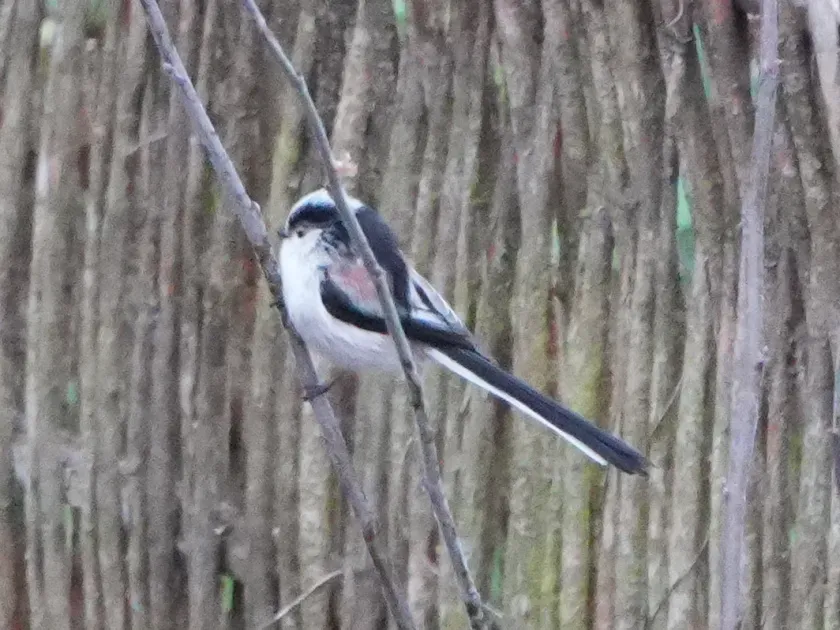
It is easily recognized by its very long tail, which is significantly longer than its tiny body, giving it a distinctive silhouette in flight.
The plumage consists of a delicate mix of white, black, and pink colors, making it one of the most visually appealing birds in the orchard.
These birds are highly energetic and are rarely seen standing still, preferring to constantly forage across the branches of trees and bushes.
With an average weight of only 7 to 10 grams, they are capable of reaching even the outermost, thinnest twigs to locate food sources.
What it damages
Technically, the long-tailed tit is not an agricultural pest but rather a highly efficient predator of various small insects and larvae.
In rare instances during winter food shortages, they may peck at fruit buds, which can occasionally lead to minor bud loss in orchards.
Such damage is generally negligible and is vastly outweighed by the massive number of harmful insects they consume throughout the year.
They do not target mature fruit, meaning there is no risk to the marketable harvest of stone fruits or pome fruits in commercial farming.
They are widely considered to be beneficial organisms that contribute significantly to the biological suppression of wintering pest populations.
When it appears
Long-tailed tits are most frequently observed in gardens and orchards during the autumn, winter, and early spring seasons.
During these cooler months, they gather in small, social flocks that move systematically from tree to tree to maximize foraging efficiency.
The breeding season occurs in spring, during which time the flocks disperse into pairs to build intricate, domed nests in dense thickets.
Their activity patterns are highly dependent on the availability of insect eggs and larvae hidden in the bark of fruit trees.
Observation of their presence is simplest during the dormant period when the lack of leaves makes it easier to spot their movements.
Signs of infestation
One of the primary signs of their presence is a characteristic high-pitched, stuttering call emitted while the flock is in motion.
Close inspection of twigs may reveal cleaned-out crevices in the bark where the birds have successfully extracted overwintering insects.
A reduction in the population of aphids and small caterpillars in the spring is often a direct result of their foraging activities in the orchard.
Their nests, while hard to find, are architectural marvels constructed from moss, lichen, and spider silk, located in tree forks.
Visual confirmation of small, fluffy birds with disproportionately long tails indicates a healthy bird community within the garden ecosystem.
Control measures
Direct control measures against the long-tailed tit are unnecessary and counterproductive as they provide valuable ecological services.
If bud protection is strictly required in sensitive nurseries, simple visual deterrents like hanging tapes are usually more than sufficient.
Chemical intervention to control these birds is not advised due to their protected status and their role as beneficial biological control agents.
Providing supplementary food sources, such as fat balls away from primary crops, can effectively redirect their attention if needed.
Focusing on integrated pest management that encourages the presence of these birds will lead to a more sustainable and healthy orchard environment.
Taxonomy
- Latin name
- Aegithalos caudatus
- Family
- Aegithalidae
- EPPO code
- AEGICA
Discussion
No discussions yet — be the first.