
Smaller tea tortrix
Adoxophyes honmai
Description
How to identify
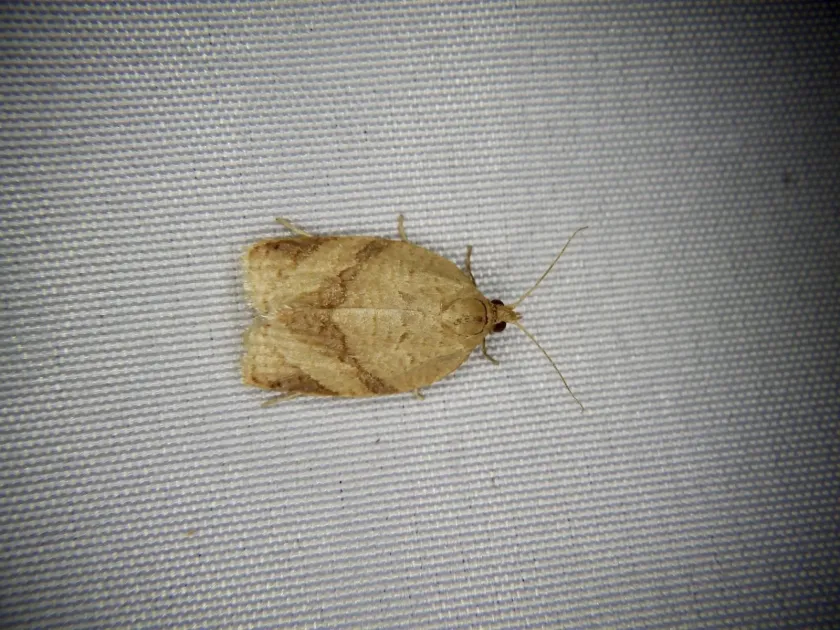
The smaller tea tortrix (Adoxophyes honmai) belongs to the order Lepidoptera and the family Tortricidae. The adult moth has a wingspan of approximately 18–22 mm.
The forewings are generally light to yellowish-brown with characteristic dark, wavy transverse bands. The hindwings are paler and grayish in appearance.
Larvae pass through five to six developmental stages. The caterpillar typically has a greenish body with a distinct light-brown or yellowish head capsule, providing camouflage on foliage.
Females lay eggs in dense clusters, resembling fish scales. The surface of these egg masses is covered with a protective, transparent, sticky secretion that prevents desiccation.
This species is closely related to the summer fruit tortrix, and it is a significant pest in both subtropical tea plantations and various fruit-bearing orchards.
What it damages
As the common name implies, this pest is a primary threat to tea crops. However, it is highly polyphagous and infests a wide range of agricultural and horticultural plants.
Host plants include apple, pear, peach, plum, citrus, as well as various ornamental trees and forestry species.
Young larvae primarily feed on the underside of leaves, skeletonizing them by consuming the parenchyma while leaving the epidermis intact.
Late-stage caterpillars feed on growing tips, buds, and young fruit, causing physical deformity, yield loss, and susceptibility to secondary infections.
Severe infestations can lead to significant defoliation, which weakens the host plant and reduces its overall vigor and winter hardiness.
When it appears
The lifecycle of the smaller tea tortrix consists of several generations per year, with the number of generations depending heavily on regional climatic conditions.
The pest overwinters as young larvae, hiding within silk-lined hibernacula located in bark crevices or among old foliage on the host plant.
In spring, as temperatures rise, the overwintered larvae emerge to feed on developing buds and emerging leaves, marking the start of the primary infestation period.
Adult moth flight for the first generation typically occurs in late spring or early summer, followed by mating and oviposition on the upper surfaces of leaves.
Peak pest pressure often aligns with the period of rapid vegetative growth, requiring consistent field monitoring throughout the mid-summer months.
Signs of infestation
The most diagnostic sign of infestation is the presence of rolled or folded leaves, which the caterpillars bind together with silk webbing to form shelters.
Surface damage on developing fruit is another indicator; these feeding marks often develop into corky patches as the fruit matures, ruining its market value.
Webbing present on apical buds and shoot tips, accompanied by stunted or twisted growth, confirms the presence of active larval feeding.
Accumulated frass (excrement) within the silken webs is a clear sign that larvae are currently active and damaging the plant tissues.
- Rolled or webbed leaves at shoot tips.
- Visible silk strands connecting leaf edges.
- Superficial scarring and feeding marks on young fruits.
- Stunted or deformed shoot development.
Control measures
Effective management of the smaller tea tortrix relies on an integrated pest management (IPM) strategy that combines cultural, biological, and chemical methods.
Cultural practices, such as winter pruning and the removal of dead leaves and bark, help to destroy the overwintering larval population before the spring season.
Biological control methods often involve the use of parasitoids, such as Trichogramma wasps, which are highly effective at suppressing pest populations by parasitizing eggs.
Chemical control should be implemented based on monitoring data; insecticides are most effective when applied against early-stage larvae before they create protective leaf rolls.
The use of pheromone traps is essential for tracking moth flight peaks, ensuring that pesticide applications are timed accurately for maximum efficacy.
Taxonomy
- Latin name
- Adoxophyes honmai
- Order
- Lepidoptera (butterflies)
- Family
- Tortricidae
- EPPO code
- ADXPHO
Discussion
No discussions yet — be the first.