
Oak knot-horn moth
Acrobasis sylviella
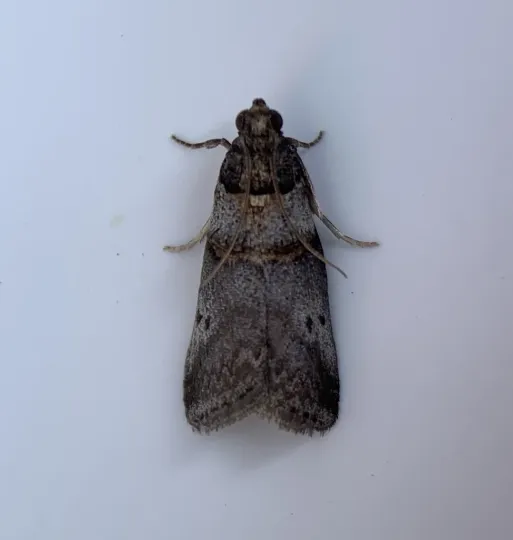
Description
How to identify
The oak knot-horn moth (Acrobasis sylviella) is a small lepidopteran belonging to the Pyralidae family, commonly found in oak-dominant forests.
Adult moths have a wingspan of approximately 20–25 mm, with forewings featuring brownish-grey patterns that provide excellent camouflage against oak bark.
Larvae, or caterpillars, are typically brownish-green with a dark head capsule, designed to feed concealed within silk structures on the tree.
The life cycle undergoes complete metamorphosis: egg, larva, pupa, and adult, with development usually synchronized with the flushing of oak leaves.
The species typically overwinters as a larva, protected within a thick silk cocoon tucked into crevices or near branch forks on the host tree.
What it damages
The primary host for this species is the oak (Quercus), particularly targeting young, succulent growth in the spring and early summer months.
Larvae feed on developing buds, flowers, and young foliage, often mining inside the tissues or skeletonizing the surface of the leaves.
Such feeding activities disrupt the development of shoots and can lead to the stunting of growth in younger trees or individual branches.
Extensive defoliation may occur in cases of severe infestation, significantly reducing the tree's photosynthetic capacity and stored energy reserves.
In nurseries, damage to the terminal buds caused by this moth is a significant issue as it forces lateral branching, leading to stem deformities.
When it appears
The flight period for adults generally occurs during late spring and early summer, coinciding with favorable warm weather for mating and oviposition.
Caterpillars emerge shortly thereafter, establishing themselves on young shoots and expanding their silk nests as they grow larger throughout the season.
Feeding activity is most intense during the mid-summer period when the nutritional demand of the rapidly growing larvae is at its peak.
Pupation takes place within the protective nests as summer progresses, marking the end of the active feeding phase for the generation.
The species usually completes one generation per year, entering a state of diapause by late summer to survive the winter season.
Signs of infestation
The most diagnostic sign of an infestation is the presence of silk nests, often mixed with larval frass, attached to terminal oak shoots.
Leaves associated with these nests often appear wilted, curled, or partially skeletonized, providing a clear visual indicator of larval presence.
The silk webbing itself is often conspicuous, especially on smaller trees, holding together chewed leaf fragments and waste material.
Stunted shoot tips that fail to elongate or branch irregularly are common long-term markers of previous or ongoing moth activity.
- Silk webbing nests on terminal shoots.
- Skeletal or curled leaves near the nests.
- Presence of larval frass within webbed areas.
Control measures
Biological control relies on maintaining healthy populations of parasitoid wasps and insectivorous birds that feed on moth larvae.
Chemical applications of insecticides are most effective if timed precisely to the larval emergence stage, before they build extensive protective webbing.
In nursery settings, manual removal and destruction of infested shoots can significantly reduce the local population density of the moth.
Monitoring using light traps or pheromone lures is recommended to detect the presence of adults and time preventive interventions effectively.
Promoting overall forest health and preventing environmental stress helps trees recover from defoliation and resist secondary pest attacks.
Taxonomy
- Latin name
- Acrobasis sylviella
- Order
- Lepidoptera (butterflies)
- Family
- Pyralidae
- EPPO code
- ACBASY
Discussion
No discussions yet — be the first.