
Oak leaf-roller moth
Acrobasis consociella
Description
How to identify
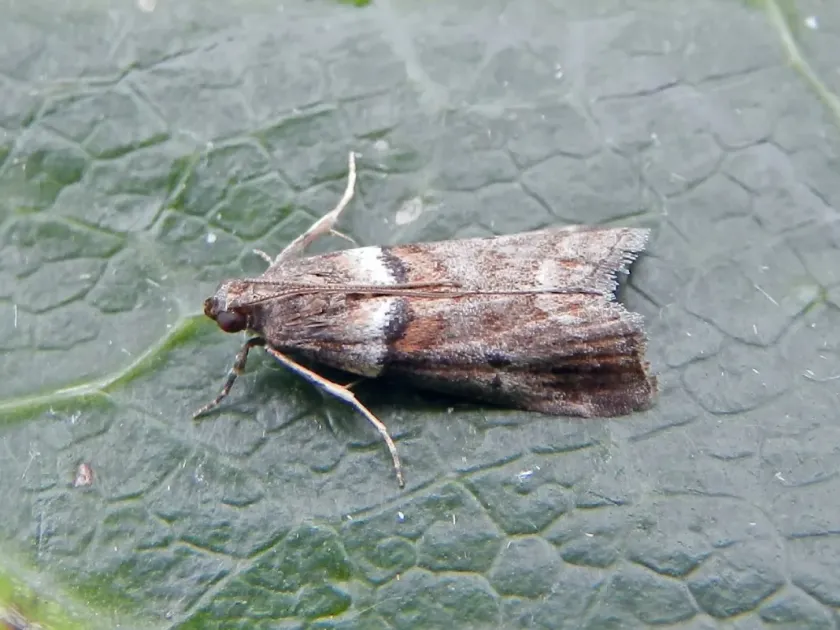
The oak leaf-roller moth (Acrobasis consociella) belongs to the order Lepidoptera, family Pyralidae. It is a small moth with a wingspan ranging from 15 to 20 mm.
The forewings display a greyish-brown pattern with transverse stripes and darker spots, providing excellent camouflage against oak bark.
Larvae reach 15 mm in length and exhibit a dirty-green or brownish color with a dark head capsule and sparse, light-colored hairs.
The pupa is brownish, approximately 10 mm long, and develops inside protective shelters constructed from leaves webbed together with silk.
Females lay small, oval-shaped eggs individually or in small clusters on the undersides of young oak leaves.
What it damages
The primary host plants are oak species (Quercus), with common oak (Quercus robur) and sessile oak being the most frequently affected.
In rare instances, the pest may infest other species within the Fagaceae family if they grow in proximity to the primary oak hosts.
Young trees in nurseries and young forest plantations under 20 years of age suffer the most significant economic impact.
While mature trees are rarely killed, heavy infestations can cause canopy thinning, tree stress, and significant reduction in annual biomass growth.
Infestations typically occur in localized patches but can expand rapidly under favorable weather conditions, leading to wider forest degradation.
When it appears
Adult moths typically fly during June and July, which corresponds to the mating and oviposition period on host foliage.
Larval development begins during the summer and continues into the autumn, leading to the preparation of overwintering sites.
The species overwinters as young larvae inside tough silken cocoons securely attached to twigs or hidden beneath bark scales.
In early spring, as buds begin to burst, the larvae emerge from their winter shelters to begin intensive feeding on developing tissues.
Pupation occurs in late spring or early summer within the webbed leaf nests, marking the beginning of the next generation's flight phase.
Signs of infestation
The most diagnostic sign of infestation is the presence of dense, webbed leaf nests where several leaves are bundled together by silk.
Feeding larvae consume the leaf parenchyma, leaving behind skeletonized leaf parts that eventually turn brown and wither.
Large quantities of silk webbing on branches make infestation sites easily visible, allowing for early detection in forest management.
Affected young shoots often show signs of deformity and stunting due to the removal of photosynthetic leaf area by the larvae.
Frass (larval excrement) is often trapped inside the silk nests, often serving as a secondary indicator of high larval activity.
Control measures
Biological control using formulations based on Bacillus thuringiensis is highly effective when applied during the peak larval feeding period.
In nursery settings or high-value forest stands, systemic insecticides may be applied if the pest density exceeds economic injury thresholds.
Manual removal and destruction of the silk nests are recommended for small-scale infestations or individual young saplings in gardens.
- Timing insecticide applications to coincide with early spring budburst.
- Encouraging natural predators such as birds and parasitoid wasps.
- Using pheromone-baited traps to monitor moth population dynamics throughout the season.
Integrated pest management protocols should be followed to protect beneficial insect populations and maintain ecological balance in the forest.
Taxonomy
- Latin name
- Acrobasis consociella
- Order
- Lepidoptera (butterflies)
- Family
- Pyralidae
- EPPO code
- ACBACN
Discussion
No discussions yet — be the first.