
Eastern black-headed budworm
Acleris variana
Description
How to identify
The Eastern black-headed budworm (Acleris variana) is a moth belonging to the family Tortricidae, known for being a significant defoliator of coniferous forests throughout North America and Eurasia.
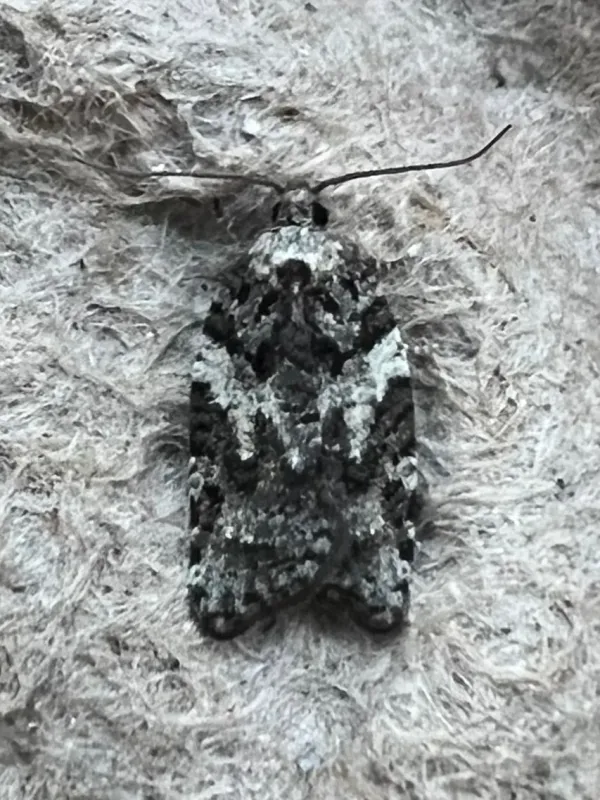
The adult moth has a wingspan of approximately 15-20 mm, with variable forewing patterns ranging from dull grey to brown, which provide excellent camouflage against tree bark.
The larvae are easily identified by their shiny black or dark brown head capsules, while their bodies are typically pale green, blending perfectly with the foliage of their host trees.
This insect undergoes complete metamorphosis: egg, larva, pupa, and adult. Eggs are laid individually on the needles and overwinter until the following spring.
Development is tightly synchronized with the host plant's growth, ensuring that larvae emerge precisely when the new needles start to develop.
What it damages
Host trees primarily include various species of spruce (Picea), hemlock (Tsuga), and fir (Abies), which are favored for the high nutritional quality of their new growth.
The larvae prefer feeding on current-year foliage, mining into the needles or webbing them together to consume the internal tissues, which leads to needle drying and discoloration.
Repeated defoliation by this pest causes significant stress to the trees, leading to stunted growth, top-killing, and in severe cases, the eventual death of the host tree.
In nursery settings, damage can be particularly devastating as the loss of terminal buds disrupts the vertical growth of young saplings, rendering them unsuitable for sale.
Infested forests often show a thin, ragged appearance in the upper canopy, which indicates the intensity of the outbreak and the extent of the feeding damage.
When it appears
Larval emergence occurs in early spring, coinciding with the bud burst of spruce and fir trees, which provides the newly hatched larvae with immediate access to food.
Active larval feeding continues throughout the spring and early summer, with the most intensive feeding occurring during the peak of foliage development in June.
Pupation typically occurs in mid-to-late summer within silken shelters constructed between the damaged needles, lasting for about two to three weeks.
Adult moths emerge in late summer, with flight activity peaking in August, when they mate and lay the overwintering eggs on the needles of the host trees.
The life cycle is univoltine in most regions, meaning only one generation is produced per year, which dictates the timing of management interventions.
Signs of infestation
The most prominent sign of infestation is the presence of silk webbing that binds together needles and shoots, creating visible clumps where larvae hide while feeding.
Small piles of frass, which are the larval excrement, often collect within the webbed needles, providing a clear visual indication of active feeding sites.
The foliage turns reddish-brown as it dries out, and eventually, the damaged needles drop prematurely, causing the tree canopy to appear sparse and unhealthy.
Close inspection of the upper branches often reveals small, pale-green larvae with dark heads retreating into their webbing when disturbed.
- webbed clumps of spruce or fir needles;
- accumulated larval frass on branches;
- discolored and prematurely falling needles;
- thinning of the canopy in the upper tree tiers.
Control measures
Integrated Pest Management (IPM) strategies for this species focus on early monitoring using pheromone traps to predict population surges and potential outbreak years.
Chemical control involving systemic insecticides is often used in high-value plantations or urban landscapes to provide broad-spectrum protection during the spring emergence period.
Biological control agents, particularly Bacillus thuringiensis (Bt), are highly recommended as they specifically target lepidopteran larvae while sparing beneficial insects and pollinators.
Silvicultural practices, such as maintaining stand diversity and avoiding overly dense monocultures, can increase the natural resilience of the forest against budworm outbreaks.
In smaller managed areas, manual removal of infested shoots can be effective if caught early, preventing the spread of larvae to healthy parts of the canopy.
Taxonomy
- Latin name
- Acleris variana
- Order
- Lepidoptera (butterflies)
- Family
- Tortricidae
- EPPO code
- ACLRVA
Discussion
No discussions yet — be the first.