
Beech leaf moth
Acleris sparsana
Description
How to identify
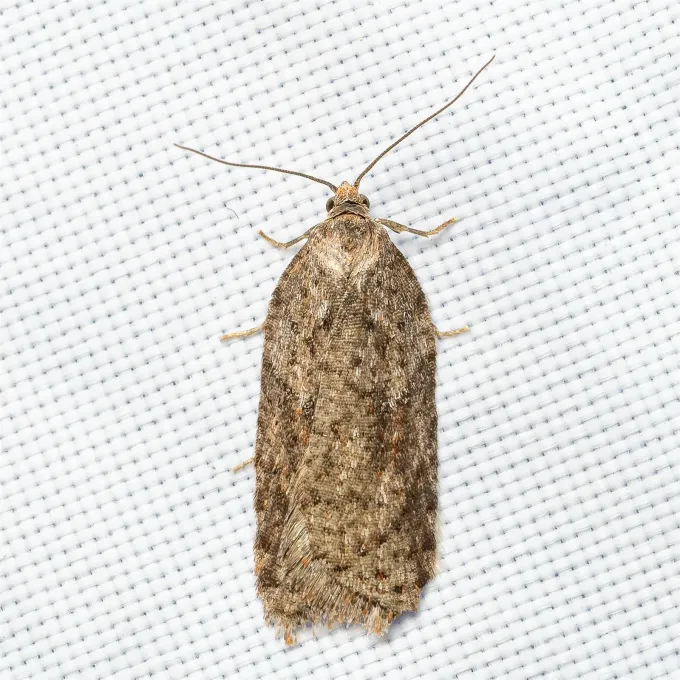
The Beech leaf moth (Acleris sparsana) belongs to the order Lepidoptera and the family Tortricidae. It is a small moth with a wingspan ranging from 16 to 22 mm.
The forewings have a cryptic brownish or grayish pattern, providing excellent camouflage against tree bark, which is vital for their survival during the day.
The larvae are typical of the Tortricidae family, characterized by a light green body and a dark head, allowing them to hide efficiently within rolled leaves.
Adult moths are primarily nocturnal or crepuscular, spending the daylight hours in a state of rest in hidden areas like bark crevices.
Identification is often based on the observation of specific leaf-rolling habits rather than the direct sighting of the adult moths due to their elusive nature.
What it damages
As the name suggests, the primary host plant for this species is the European beech (Fagus sylvatica), where the moth can reach high densities.
The larvae also feed on related species such as hornbeam (Carpinus) and hazel (Corylus), especially in mixed forest stands where these trees co-occur.
Larvae consume young leaves, buds, and flowers, which directly impacts the tree's photosynthetic capacity during the critical growth phase of spring.
Severe infestations can lead to significant defoliation, which stresses the tree and makes it more susceptible to secondary pests and fungal infections.
In young plantations or nurseries, the feeding activity can stunt tree growth and lead to irregular canopy development, affecting the health of the trees.
When it appears
The life cycle of the Beech leaf moth is generally univoltine, meaning it completes one generation per year under standard climatic conditions.
Adult females overwinter in sheltered locations, such as deep cracks in the bark or amongst leaf litter, emerging in early spring as temperatures rise.
The eggs are laid on the developing buds or young leaves, ensuring that the larvae have immediate access to food upon hatching in late spring.
Larval development takes place during the late spring and early summer months, which coincides with the period of peak foliage growth for beech trees.
Pupation occurs within the folded leaves, and the next generation of adult moths emerges in late summer to early autumn before finding hibernation sites.
Signs of infestation
The most diagnostic sign of infestation is the presence of leaves rolled into tubes or clusters held together by fine, silky webbing produced by the larvae.
Frass (larval droppings) can often be found accumulated inside the rolled leaves or on the surface of leaves located below the feeding sites.
Larval feeding results in skeletonization or irregular holes in the leaf blades, as they consume tissue while leaving tougher veins intact.
The canopy may appear thin, discolored, or greyish-brown when the larvae have successfully defoliated a large portion of the foliage on infested branches.
- Leaves folded and bound with silk.
- Small dark pellet-like frass on foliage.
- Irregular leaf holes and skeletal damage.
Control measures
Biological control through the preservation of insectivorous bird populations and predatory insects is the most effective long-term strategy for forest health.
In cases where infestations exceed economic thresholds, the use of biological insecticides containing Bacillus thuringiensis is recommended.
Sanitation practices, such as the removal of heavily infested branches in urban or nursery settings, can help reduce local population pressure.
Maintaining diverse forest ecosystems encourages natural enemies of the moth, which often keep the population from reaching outbreak levels.
Monitoring during the early spring allows for timely intervention if chemical or biological controls are deemed necessary to protect young or high-value trees.
Taxonomy
- Latin name
- Acleris sparsana
- Order
- Lepidoptera (butterflies)
- Family
- Tortricidae
- EPPO code
- ACLRSR
Discussion
No discussions yet — be the first.