
Grey tortrix
Acleris senescens
Description
How to identify
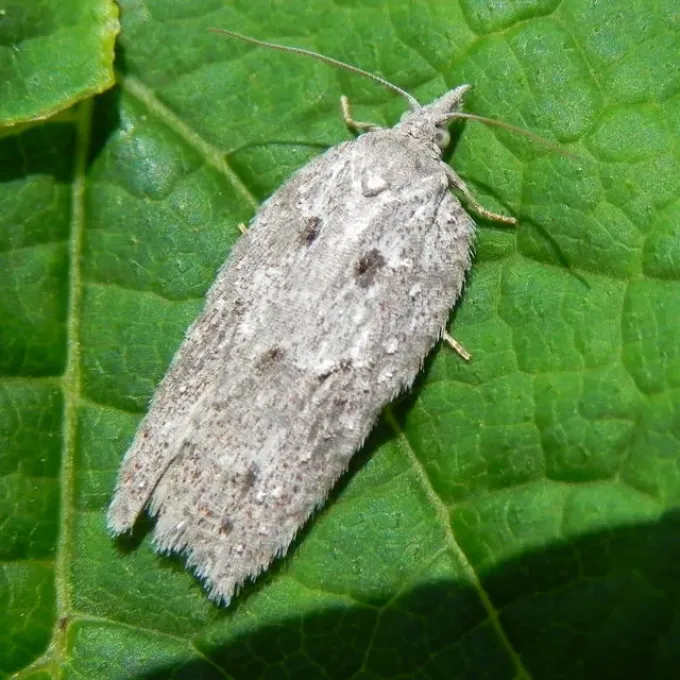
The grey tortrix (Acleris senescens) is a moth species belonging to the family Tortricidae, order Lepidoptera. The adult moth has a wingspan of approximately 15–20 mm, with a greyish-brown coloration that provides excellent camouflage against tree bark.
The larvae, or caterpillars, are highly mobile and exhibit a light green to olive body color, typically featuring a distinctively dark head capsule. They go through several larval instars, growing significantly during their development.
Adults are primarily crepuscular and nocturnal, spending daylight hours resting on the undersides of leaves or within dense foliage to avoid predators. Their behavior makes them difficult to spot during routine garden inspections.
The species undergoes a complete metamorphosis, including egg, larva, pupa, and adult stages. Depending on the geographical region and climate, the grey tortrix can complete one or two generations within a single growing season.
Overwintering usually occurs in the egg stage. Females deposit their eggs in the crevices of tree bark or near the base of buds, ensuring that larvae emerge exactly when fresh food becomes available in spring.
What it damages
This species is a polyphagous pest, though it primarily targets fruit-bearing trees such as apples, pears, and plums. It is also frequently found on various ornamental shrubs, making it a concern for nursery stock and landscape gardening.
Larval feeding causes the most severe damage in early spring, as caterpillars bore into developing buds, destroying the future flowers or shoots entirely. This early-season impact can drastically reduce the year's potential yield.
As the caterpillars grow, they begin to feed on leaves, webbing them together into rolled bundles. Inside these shelters, they are well-protected from environmental factors and many natural predators, consuming the leaf tissue from within.
Heavy infestations can lead to damage on young fruitlets, where larvae eat into the flesh. This leads to scarring, fruit deformation, or premature fruit drop, which significantly degrades the crop's market value.
In nurseries, the damage to terminal buds can cause stunted growth or distorted branching in young saplings, which may permanently affect the structural development of the tree.
Signs of infestation
A primary indicator of infestation in the spring is the presence of «blind» buds that fail to open. A close examination reveals hollowed-out tissue or larval frass within the bud scales.
Rolled leaves secured with silk webbing are the most visible sign of an active infestation. These leaf rolls are characteristic of tortricid larvae and are easily observed during mid-summer inspections.
The presence of fine webbing in the crotches of branches, often combined with small amounts of excrement on foliage, confirms active feeding by the larvae.
Distorted and stunted shoot growth, especially at the tips of branches, is often a direct result of larval activity affecting the apical meristem, leading to an irregular growth pattern.
Damage to the fruit skin appears as shallow pits or irregular markings. While these wounds might seem minor, they often serve as entry points for secondary pathogens like brown rot.
Control measures
Physical removal of infested leaf rolls and webs is a practical and effective management strategy for small-scale gardens or early-stage infestations, as it directly reduces the local population.
Biological control methods, specifically the application of Bacillus thuringiensis, are highly effective against young larvae. This approach is preferred for integrated pest management as it minimizes harm to beneficial insects.
Chemical intervention should be reserved for cases where population levels exceed economic thresholds. It is essential to choose products that are selective and to respect pre-harvest intervals to ensure safety.
Applying dormant oil or targeted sprays in early spring helps to eliminate overwintering egg clusters on the bark, significantly lowering the initial population density before the growing season starts.
- Monitoring adult activity using pheromone traps.
- Encouraging the presence of natural predators, such as birds and lacewings.
- Regular pruning to remove infested branches and improve airflow.
- Proper orchard hygiene, including the removal of dead wood and debris.
Taxonomy
- Latin name
- Acleris senescens
- Order
- Lepidoptera (butterflies)
- Family
- Tortricidae
- EPPO code
- ACLRSE
Discussion
No discussions yet — be the first.