
Oak leafroller
Acleris semipurpurana
Description
How to identify
The oak leafroller (Acleris semipurpurana) belongs to the order Lepidoptera and the family Tortricidae. It is a significant defoliating pest that specifically targets oak species in various regions.
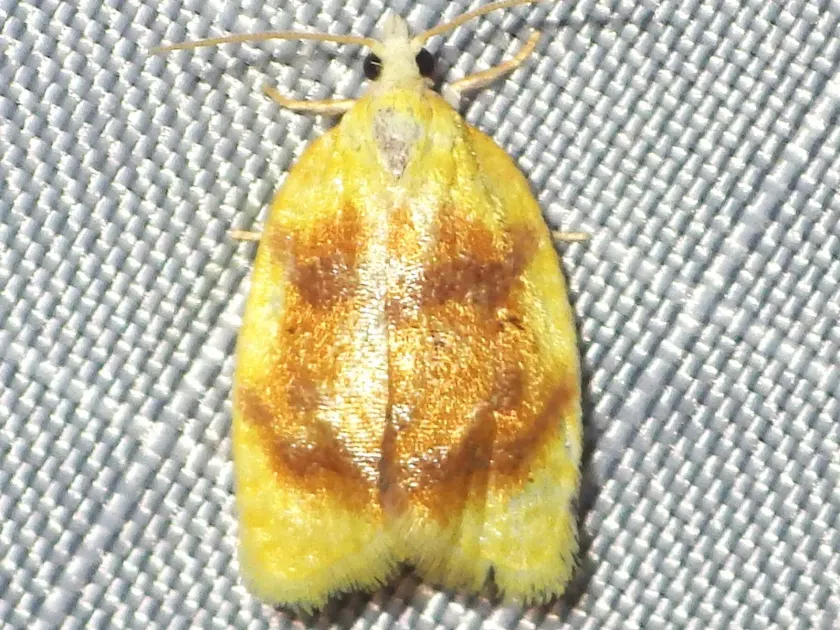
The adult moth is small with a wingspan ranging from 15 to 18 mm. Their forewings typically exhibit intricate patterns in shades of brown and gray, providing excellent camouflage on tree bark.
The larvae, which cause the damage, pass through several developmental stages. Initially, they are tiny and pale, later turning greenish with dark heads as they mature.
The species completes one generation per year. The life cycle involves egg, larva, pupa, and adult stages, with synchronization to the host tree's phenology being critical.
Eggs are the overwintering stage, laid by females in late summer or autumn. They remain on the twigs, ready to hatch in synchrony with the spring budburst of the oak.
What it damages
This pest primarily attacks oak trees (Quercus). During outbreaks, high populations can result in the complete defoliation of extensive forest areas.
The larvae feed on expanding buds and young leaves. By consuming the leaf tissue, they severely disrupt the photosynthetic capacity of the tree during the critical spring growth phase.
Repeated yearly defoliation significantly stresses the trees, making them vulnerable to secondary pests like wood borers and pathogens like root rot or fungi.
Severe infestations can lead to crown dieback, reduced radial growth, and in extreme cases, the mortality of weakened or mature oak stands.
Beyond leaf damage, the larvae can also feed on developing catkins, which interferes with the reproductive success of the oak population.
When it appears
Larval emergence occurs in early spring, precisely when the oak buds begin to swell and open. This timing is essential for the survival of the neonate larvae.
The feeding period typically lasts from late April through May, depending on the local climate and temperature gradients of the season.
Pupation takes place within the rolled leaves or in bark crevices. The adult moths emerge in mid-summer and are primarily nocturnal.
The mating and egg-laying processes occur throughout the summer months, with eggs being deposited firmly on the smooth bark of twigs.
Spring temperatures play a decisive role in the population density; late frost events can cause high mortality among the newly hatched larvae.
Signs of infestation
The most visible sign is the presence of webbed, rolled-up leaves at the tips of the branches. Larvae spin silk to construct these protective shelters.
Leaves often appear skeletonized or have ragged edges. In cases of severe infestation, the tree canopy may look sparse or brown by late spring.
Frass (larval waste) accumulates on the leaves and branches beneath the feeding sites, which is a clear indicator of active larvae present in the canopy.
Dieback of the terminal twigs is frequently observed, as the larvae preferentially feed on the succulent, growing parts of the shoots.
- Webbing and leaf rolling on branch tips.
- Irregular holes and notches on leaves.
- Visible accumulation of larval droppings.
Control measures
Integrated Pest Management (IPM) is recommended for forest areas. Encouraging natural predators, such as insectivorous birds and parasitic wasps, is essential.
In high-value areas like nurseries or urban parks, chemical control using targeted insecticides can be applied during the larval emergence period.
Biological pesticides, such as those derived from Bacillus thuringiensis, are highly effective against the larvae while maintaining safety for non-target species.
Good forest management practices, including thinning and promoting mixed-species stands, can increase the resilience of oak forests against leafroller outbreaks.
Monitoring population trends with pheromone traps helps land managers predict infestation severity and time control measures effectively.
Taxonomy
- Latin name
- Acleris semipurpurana
- Order
- Lepidoptera (butterflies)
- Family
- Tortricidae
- EPPO code
- CROISE
Discussion
No discussions yet — be the first.