
Rhomboid tortrix
Acleris rhombana
Description
How to identify
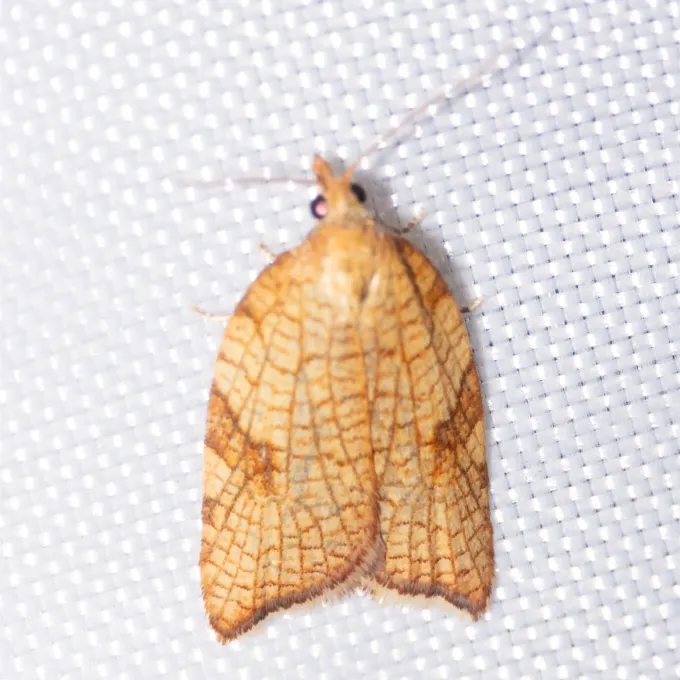
The Rhomboid tortrix (Acleris rhombana) belongs to the order Lepidoptera and the family Tortricidae. It is a moth species distinguished by a specific rhombic pattern on its forewings.
Adult moths have a wingspan of approximately 15–20 mm. The forewings are typically brown or ochre, featuring a dark, rhombic-shaped patch in the center, which serves as a primary diagnostic feature.
The larvae, or caterpillars, are small (up to 15 mm in length) and have a yellowish-green to green body with a dark, sclerotized head capsule typical for the family.
Pupae are brown and usually found sheltered within rolled leaves or tucked into crevices of the tree bark, secured by a small amount of silk.
Eggs are small, oval, and deposited singly or in small groups on the bark of twigs, where they remain throughout the winter period.
What it damages
This species is a known pest of various rosaceous trees, commonly affecting apple, pear, plum, and hawthorn in commercial and private orchards.
Larvae feed on leaves, creating irregular holes or skeletonizing the leaf blade, which can lead to reduced plant vigor if infestations are severe.
Young caterpillars often tie leaves together with silk, feeding inside the protected environment. They may also feed on young fruits, creating superficial scars or deep pits.
Injured fruit is prone to secondary fungal infections and rot, leading to poor storage quality and a significant loss of market value.
Severe infestations reduce the tree's photosynthetic capacity, which impacts overall growth, fruit development, and the formation of next year's fruit buds.
When it appears
In most temperate climates, Acleris rhombana typically completes one generation per year, though warmer climates may support a second generation.
The winter stage is the egg, which survives on the bark of host plants. Hatching usually coincides with the bud-burst stage of fruit trees in early spring.
Larval activity peaks between May and June, a period characterized by rapid foliage consumption and the spinning of characteristic leaf nests.
Pupation occurs in early summer, with the life cycle transitioning to the adult stage by mid-summer, depending on ambient temperatures.
Adult moths emerge in late summer and autumn (August to September) to mate and lay eggs, completing the annual cycle before the onset of winter.
Signs of infestation
The most visible sign of infestation is the presence of leaves tightly rolled or tied together with silk, forming nests where larvae hide.
Shoots may show signs of stunted or deformed growth, with localized areas of leaf damage where the caterpillars have been actively grazing.
Fruit damage appears as surface-level scarring or small entry holes covered by larval frass and webbing, making affected fruit easily identifiable.
Presence of fine silken threads connecting leaves or binding leaves to fruit is a strong indicator of tortricid activity in the tree canopy.
During the dormant season, careful inspection of young twigs may reveal tiny, flattened egg masses that blend into the bark, indicating potential for spring emergence.
Control measures
Integrated pest management (IPM) programs often rely on pheromone traps to monitor adult moth populations and determine the precise timing for interventions.
Cultural practices include the removal of infested shoots during winter pruning and the maintenance of healthy, well-pruned trees to reduce refuges for larvae.
Biological control methods, including the application of Bacillus thuringiensis or specific granuloviruses, are effective against early-instar larvae.
Chemical control should be strictly targeted at the larval stage before they roll the leaves, as the protection provided by silk shelters significantly reduces insecticide efficacy.
Promoting the population of natural predators and parasitoids, such as lacewings and parasitic wasps, is essential for long-term population suppression in orchards.
Taxonomy
- Latin name
- Acleris rhombana
- Order
- Lepidoptera (butterflies)
- Family
- Tortricidae
- EPPO code
- ACALCN
Discussion
No discussions yet — be the first.