
Lesser apple leafroller
Acleris minuta
Description
How to identify
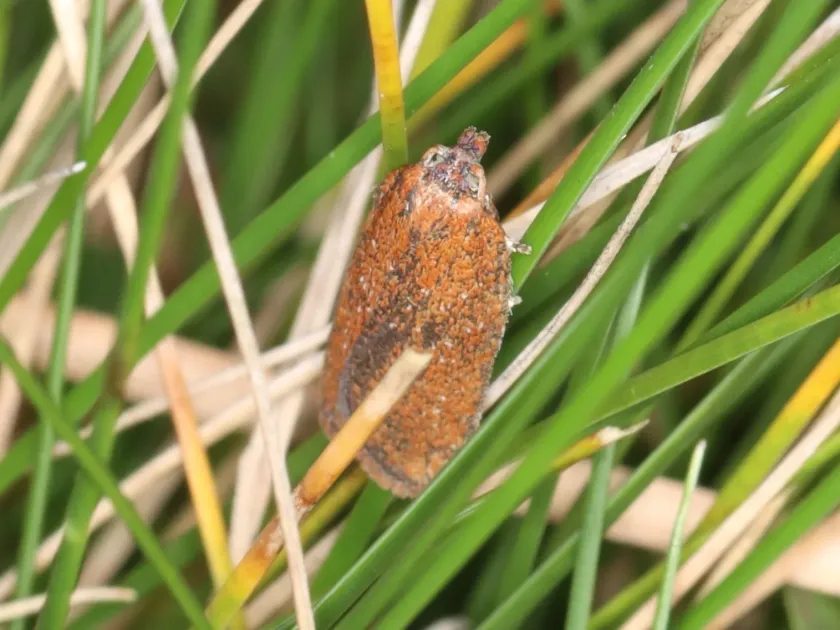
The lesser apple leafroller (Acleris minuta) belongs to the Tortricidae family. It is a small moth, with adult wingspans reaching approximately 12–15 mm. The forewings display variable coloration, often mimicking bark patterns to enhance survival.
Larvae pass through several instars, with the bodies appearing yellowish-green. As they mature, their heads become more distinct, and they develop a characteristic active movement, often wriggling violently when disturbed.
This species typically undergoes two generations per year. The adults (moths) overwinter in protected locations, such as under tree bark, in leaf litter, or in crevices, which allows them to emerge as soon as spring temperatures rise.
Eggs are laid individually or in small clusters on the underside of leaves. The emergence of larvae is highly dependent on local weather conditions, making timing crucial for orchard scouting and integrated pest management programs.
Accurate identification is essential for differentiating this species from other leafrollers. Monitoring adults using pheromone-baited traps provides data that helps growers predict infestation peaks effectively.
What it damages
Primary host plants include species in the Rosaceae family, notably apple, pear, plum, and quince. The insect is capable of causing significant economic damage if not kept under control within commercial orchards.
The larvae are responsible for the damage. They roll leaves into tubes or create nests using silken webs, which provide shelter against predators and pesticides. This behavior significantly complicates traditional chemical treatments.
During the larval stage, they feed on leaves, leading to severe defoliation. In addition, larvae often migrate to young fruits and tender buds, where they feed on the tissue, resulting in scarring or loss of the crop.
Defoliation negatively impacts the tree's photosynthetic capacity, which can lead to weakened tree health and reduced vigor. Consequently, this can cause a decline in overall yield and lower fruit quality in subsequent seasons.
Persistent infestations often result in fruit deformity, especially when larvae damage the fruit skin. Such fruits become susceptible to fungal infections and rot, further decreasing the total marketable yield for the grower.
Signs of infestation
The most visible sign of an infestation is the presence of rolled or folded leaves on the canopy. If these are opened, larvae or their frass (excrement) can typically be found inside the webbed nest.
Webbing between two leaves or between a leaf and a fruit is a strong indicator of activity. In early spring, damaged buds that fail to develop correctly are an early warning sign of larvae that have overwintered near the tree.
On the fruit surface, shallow irregular feeding scars are common. These scars eventually darken and can lead to secondary pathogens entering the fruit, causing localized rot and softening of the pulp.
The presence of adult moths in the vicinity of the orchard, often observed during dusk, indicates that egg-laying is occurring. Growers should look for small, flattened eggs on the lower leaf surfaces.
Yellowing or browning leaves that remain attached to the shoot due to silk threads are a clear sign of leafroller activity, indicating the need for immediate action to protect the remaining leaf area.
Control measures
Effective management of Acleris minuta requires an integrated approach. This includes biological controls, cultural practices, and, when thresholds are exceeded, the strategic use of insecticides.
Cultural practices, such as removing and destroying infested leaves or branches, can significantly reduce localized pest populations. Maintaining tree health through proper pruning ensures better spray coverage during applications.
Biological control methods, including the use of Bacillus thuringiensis, are highly effective against younger larval stages and have a minimal impact on beneficial insects and pollinators within the orchard.
Chemical control should be timed based on pheromone trap monitoring to target the first and second generations of larvae. Rotating insecticide modes of action is vital to prevent the development of resistance.
- Deploy pheromone traps for population monitoring.
- Encourage natural predators like parasitic wasps and lacewings.
- Use selective insecticides targeting young larvae.
- Sanitize orchards by removing leaf litter during the dormant season.
Taxonomy
- Latin name
- Acleris minuta
- Order
- Lepidoptera (butterflies)
- Family
- Tortricidae
- EPPO code
- ACLRMI
Discussion
No discussions yet — be the first.