
Acleris holmiana
Acleris holmiana
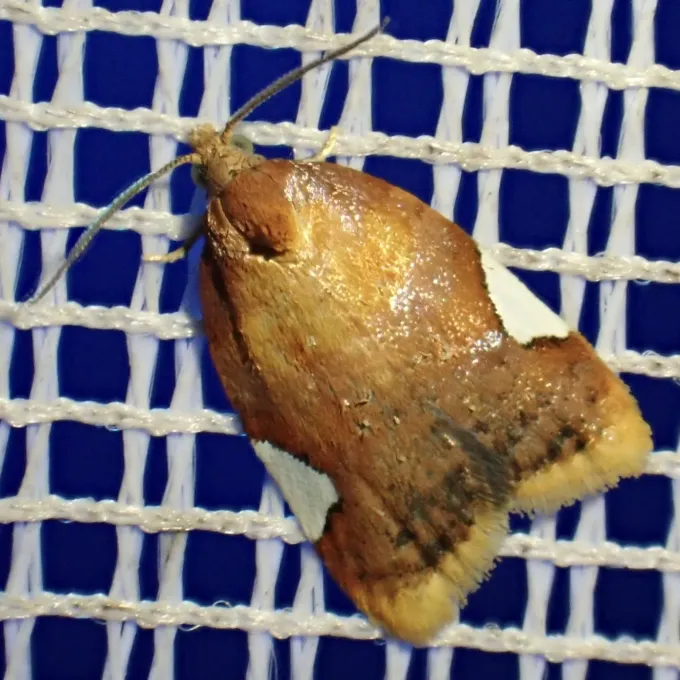
Description
How to identify
Acleris holmiana, known as the white-marked tortrix, is a species of moth in the family Tortricidae. It is a common pest found in orchards throughout Europe and Asia.
The adult moth has a wingspan of approximately 12–15 mm. Its forewings are reddish-brown and are distinguished by a prominent white or silvery triangular patch on the costal margin.
The larvae, or caterpillars, are yellowish-green with a dark brown head capsule. When fully grown, they reach about 10–12 mm in length and exhibit active movement when disturbed.
The pupa is brownish and is typically found enclosed within a leaf that the larva has rolled or tied together using silk threads for protection during the metamorphosis stage.
The species is primarily nocturnal, meaning that adult moths are most active at night, which often leads to underestimation of their population during daylight inspections.
What it damages
The pest primarily targets plants within the Rosaceae family. The most commonly affected hosts include apple, pear, plum, cherry, hawthorn, and wild rose bushes.
The damage is caused by the larvae, which feed on the leaves by creating rolls or cigar-like tubes. They skeletonize the leaf tissue, leaving only the veins and epidermis.
Heavy infestations lead to significant leaf loss, which reduces the plant's ability to undergo photosynthesis, eventually stunting the growth of young shoots and branches.
In high population years, larvae may feed on the skin of young fruit, causing superficial scarring or disfigurement, which reduces the commercial value of the crop.
Prolonged feeding and the loss of photosynthetic area weaken the tree's vigor, potentially making it more susceptible to various fungal pathogens and abiotic stress factors.
When it appears
The species overwinters at the egg stage. The eggs are typically laid on the bark of young twigs or branches, appearing as small, flat, and hard-to-detect shields.
Larval emergence usually occurs in late spring, coinciding with the budburst and flowering stages of apple and pear trees, ensuring a steady food supply for the young insects.
The larval development period lasts roughly four to six weeks, after which the insects reach their final larval instar and proceed to pupate within the protection of the leaf rolls.
Adult moths of the summer generation emerge throughout July and August. They are responsible for mating and depositing the eggs that will remain dormant throughout the winter.
Depending on local climatic conditions, the species may complete one or two generations per year, with warmer regions supporting a more rapid life cycle.
Signs of infestation
The most visible sign of infestation is the presence of curled or rolled leaves at the tips of the shoots, often held together by noticeable silken webbing.
Evidence of larval feeding, such as ragged holes or chewed leaf margins combined with the presence of fine dark frass, indicates an active infestation within the leaf roll.
Yellowing and premature abscission of leaves in the middle of summer, particularly on the outer branches, are often symptoms of damage caused by these leaf-rolling caterpillars.
Careful inspection of the tree bark during the dormant season may reveal the presence of the small, flattened egg masses, which are crucial for early monitoring.
The presence of adult moths with the distinct white triangular marking can be confirmed using light traps or by carefully shaking the branches in the evening.
Control measures
Cultural practices are essential, including the removal and destruction of infested branches or pruned material during the winter months to eliminate overwintering eggs.
Biological control using microbial insecticides, specifically those containing Bacillus thuringiensis, is highly effective if applied before the larvae form the protective leaf rolls.
- Implement pheromone traps to accurately time the insecticide applications based on adult flight patterns.
- Apply contact-stomach insecticides during the "green tip" or petal fall stages for maximum impact.
- Promote the presence of natural predators, such as parasitic wasps and predatory beetles, to manage population density naturally.
Timing is critical in chemical management; once the larvae have securely rolled the leaves, they become largely shielded from contact pesticides, significantly reducing treatment efficacy.
Systemic insecticides provide a better outcome by penetrating the leaf tissue, ensuring that the larvae consume the toxicant even when feeding protected inside the rolled foliage.
Taxonomy
- Latin name
- Acleris holmiana
- Order
- Lepidoptera (butterflies)
- Family
- Tortricidae
- EPPO code
- ACALHO
Discussion
No discussions yet — be the first.