
Western blackheaded budworm
Acleris gloverana
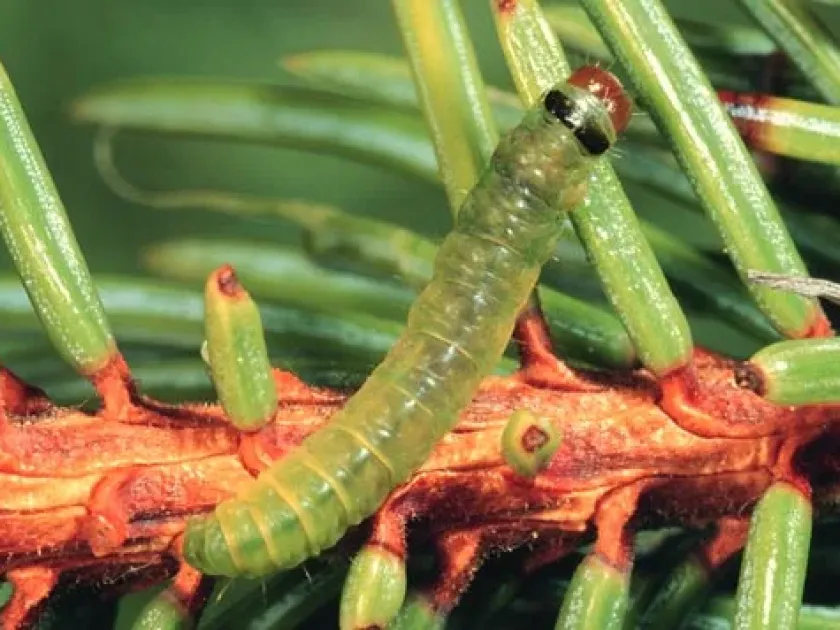
Description
How to identify
The Western blackheaded budworm (Acleris gloverana) is a moth species within the family Tortricidae, known for its significant impact on conifer forests.
Adult moths have a wingspan of approximately 15 to 20 mm, with forewings featuring variegated shades of gray and brown that provide excellent camouflage against tree bark.
The larvae are named for their distinctive black head capsules, which are easily visible during their early developmental stages. Their bodies are typically olive-green to greenish-brown.
Pupation occurs within small, webbed nests created by the larvae among the needles, often reinforced with silk, making them somewhat protected from external elements.
The life cycle consists of complete metamorphosis: egg, larva, pupa, and adult, with each stage adapted to specific seasonal shifts in the forest environment.
What it damages
The primary hosts of this species include various conifer trees, with a strong preference for western hemlock (Tsuga heterophylla) and several species of spruce (Picea).
Larvae feed predominantly on the current year’s needles, causing severe defoliation that impacts the tree's ability to undergo photosynthesis effectively.
Prolonged or heavy infestations lead to top-kill or, in extreme cases, the total mortality of the tree, significantly altering forest stand composition.
Trees stressed by repeated defoliation become highly susceptible to secondary attacks from bark beetles and other wood-boring insects.
Economic damage is substantial in timber-producing regions, as growth rates plummet and the aesthetic value of urban or recreational forests is severely diminished.
When it appears
The insect overwinters in the egg stage, which is deposited singly on the underside of needles, usually in the upper portion of the host tree's crown.
Eggs hatch in the spring, typically coinciding with the bud burst of the host trees, providing the young larvae immediate access to fresh, tender foliage.
Larval development continues through late spring and early summer, with the feeding intensity peaking as the larvae progress through their developmental instars.
Adult moths emerge in late summer to early fall, marking the period for mating and oviposition (egg-laying) for the next annual generation.
The species generally completes one generation per year, though population densities can fluctuate wildly due to environmental factors and natural predator availability.
Signs of infestation
Early signs of infestation include the presence of silk webbing among the needles, which the larvae use to bind foliage together into protected feeding shelters.
Foliage damage appears as chlorotic (yellowing) or necrotic (browning) needles that may eventually fall, creating a sparse appearance in the tree crown.
A noticeable accumulation of frass (larval excrement) beneath the infested branches acts as a clear indicator of high larval activity in the canopy above.
When disturbed, larvae may drop from branches on silken threads, a behavior that can be used by field technicians for population surveys.
A general thinning of the canopy and visible browning of the upper crown are symptomatic of advanced or heavy outbreaks.
Control measures
Integrated Pest Management (IPM) strategies often begin with the use of pheromone traps to monitor adult flight periods and population trends.
Biological control agents, such as the application of Bacillus thuringiensis (Bt), are frequently utilized because they target the larvae while remaining safe for most non-target species.
Chemical control is generally reserved for severe outbreaks where there is a risk of significant forest mortality, employing selective insecticides applied during the peak feeding phase.
Natural predators, including various parasitoid wasps and insectivorous birds, play a critical role in keeping population numbers in check under normal conditions.
Forest management practices, such as maintaining stand diversity and promoting healthy growth conditions, are essential for reducing the risk of large-scale budworm outbreaks.
Taxonomy
- Latin name
- Acleris gloverana
- Order
- Lepidoptera (butterflies)
- Family
- Tortricidae
- EPPO code
- ACLRGL
Discussion
No discussions yet — be the first.