
Rusty-dot pearl
Acleris ferrugana
Description
How to identify
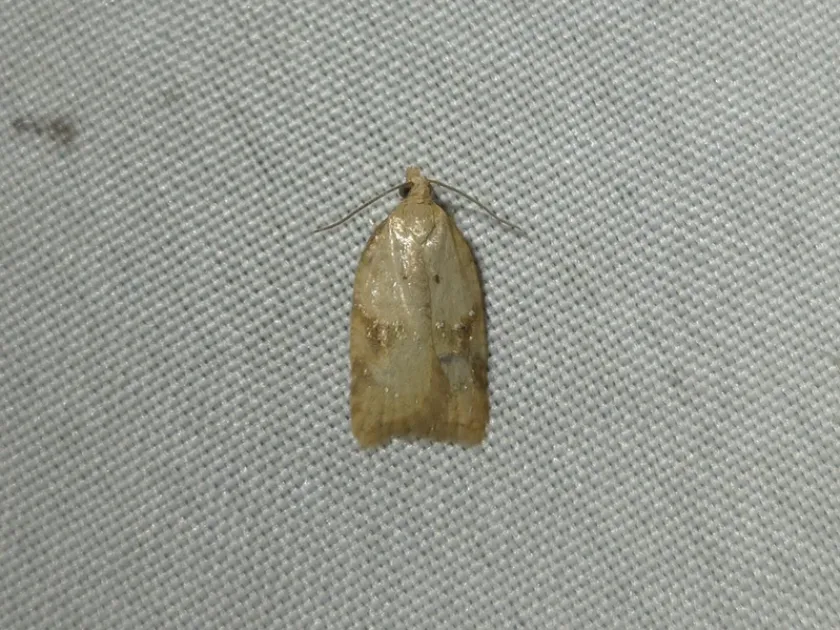
The Rusty-dot pearl (Acleris ferrugana) is a small moth belonging to the Tortricidae family. Adult moths have a wingspan of approximately 14–18 mm, with forewings typically displaying ochre-rusty or brownish-yellow patterns.
Coloration can vary significantly depending on seasonal environmental conditions, making field identification somewhat challenging. The body is slender and scaled, featuring thread-like antennae characteristic of many tortricid species.
Its life cycle involves complete metamorphosis, including egg, larva (caterpillar), pupa, and imago stages. The larvae are yellowish-green with dark heads and well-developed legs for crawling.
Adult moths usually hibernate in bark crevices, under leaf litter, or in other protected spots, which provides them with high resilience against harsh winter conditions.
Precise species confirmation often requires examination of genitalia or observation of the specific leaf-rolling technique used by larvae for feeding and pupation.
What it damages
This pest primarily affects deciduous trees and shrubs, including species of birch (Betula), oak, beech, and hornbeam. It is particularly problematic in nurseries and parkland settings.
Larvae feed on leaf tissues, skeletonizing them or consuming entire blades, leaving behind only the tougher leaf veins. This significantly reduces the photosynthetic capacity of the host tree.
Severe infestations can cause premature leaf drop, hindering nutrient storage before winter. Young saplings are most vulnerable, as larval feeding stunts their annual growth.
Damaged leaves often become entry points for secondary pathogens, such as fungi and bacteria, which can exacerbate the stress on the weakened host plant.
In forest and park ecosystems, high population densities can lead to significant defoliation, negatively impacting both the aesthetic and ecological value of the trees.
When it appears
Adult moth activity typically begins in early spring as temperatures rise. The flight period can be prolonged due to the complex life cycle, potentially involving multiple generations per year.
Larvae are most active during late spring and early summer when fresh foliage is abundant and provides the necessary nutrients for their rapid development.
Pupation usually occurs mid-summer inside rolled leaves secured with silk. Successive generations of moths continue their cycle through the season, lasting until late autumn.
Autumn marks the emergence of the final generation, which, after minimal feeding, enters a state of diapause to survive the winter months.
Monitoring using pheromone traps is the most reliable way to identify peak flight times and schedule appropriate management interventions.
Signs of infestation
The primary indicator of infestation is the presence of curled or rolled leaves secured with fine silk threads, which serve as shelters for larvae and pupae.
Visible feeding damage, such as irregularly shaped holes or skeletonized leaf patches, indicates active larvae presence during the initial growth stages.
Small dark frass (excrement) pellets found within the silk-bound nests are definitive markers of recent larval activity on the affected foliage.
The presence of adult moths, often observed fluttering when foliage is disturbed, confirms an established population within the garden or forest site.
Advanced signs of infestation include widespread yellowing and premature leaf senescence on affected branches, indicating sustained herbivory pressure.
Control measures
Biological control methods include the use of Bacillus thuringiensis-based products, which effectively target young larvae while remaining safe for beneficial insects.
Chemical control involves applying systemic or contact insecticides during peak larval emergence periods to minimize overall foliage damage.
Agrotechnical practices, such as clearing and destroying fallen leaves in autumn, significantly reduce overwintering populations and lower pest pressure for the following season.
Encouraging natural predators, including birds, predatory bugs, and lacewings, is a crucial component of an integrated pest management (IPM) strategy.
Regular inspection and manual removal of infested shoots in small-scale gardens help contain local outbreaks before they reach critical levels.
Taxonomy
- Latin name
- Acleris ferrugana
- Order
- Lepidoptera (butterflies)
- Family
- Tortricidae
- EPPO code
- ACALFE
Discussion
No discussions yet — be the first.