
Rose tortrix
Acleris bergmanniana
Description
How to identify
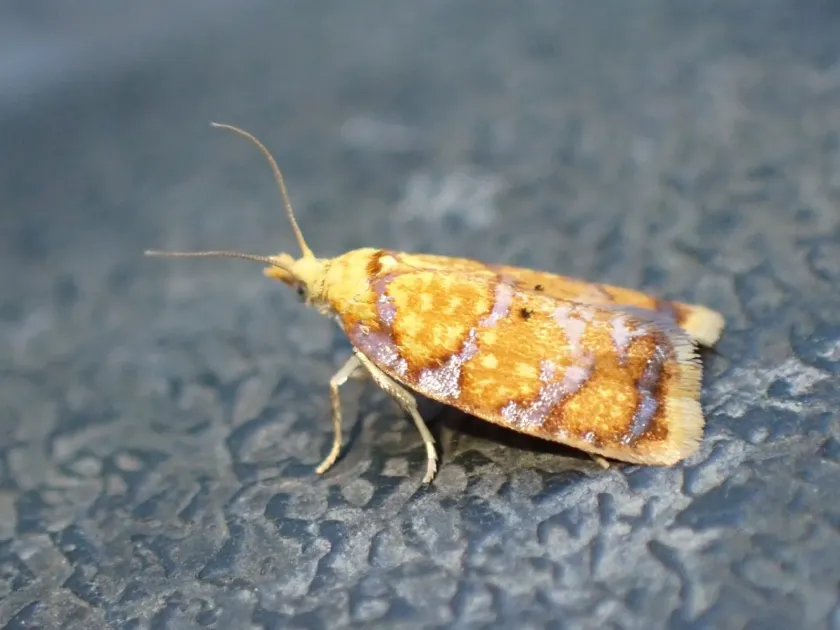
The Rose tortrix (Acleris bergmanniana) is a moth of the family Tortricidae, known for being a specialized pest of rose plants.
Adult moths have a wingspan of approximately 15–18 mm. Their forewings feature an ochre or yellowish-brown pattern with darker spots and streaks.
The larvae are light green with a dark head capsule, growing up to 10–12 mm in length before pupating inside the rolled leaves.
Overwintering occurs at the egg stage, with eggs typically laid on the bark of one-year-old rose shoots near the buds.
The life cycle is univoltine, meaning there is only one generation per year, with adult moths appearing in late spring and early summer.
What it damages
The primary host plants are garden roses (Rosa spp.), including wild species and commercially grown hybrid varieties.
Larvae feed on emerging buds, leaves, and tender shoots, causing significant structural damage to the plant's growth points.
Feeding often results in the destruction of flower buds, leading to a complete loss of blooms if the infestation is severe.
The aesthetic value of the bushes is severely compromised due to leaf deformation, skeletonization, and the presence of webbing.
Stunted growth is a frequent consequence of larval feeding, which can weaken the rose plant and make it susceptible to secondary infections.
Signs of infestation
The most distinctive symptom is the presence of leaves rolled or folded into tight tubes or clusters, secured with thin silk webbing.
Brownish or eaten buds that fail to bloom properly are a clear indicator of larval activity occurring within the floral tissues.
Visible silk webbing on the terminal parts of the shoots serves as a bridge for the larvae to move between adjacent leaves.
The presence of fine, granular frass (excrement) caught within the webbed leaf clusters confirms active infestation by tortrix caterpillars.
In early spring, small, flat, shield-like egg masses may be visible on the bark of rose stems, often near the buds.
Control measures
Hand-picking and destroying rolled leaves is the most immediate and effective non-chemical control method for small rose gardens.
Pruning out infested shoots during the dormant season helps remove overwintering eggs, thereby reducing the spring population density.
If chemical control is necessary, apply insecticides when young larvae are active, usually just as the buds begin to burst.
Biological control agents, such as Bacillus thuringiensis, can be used to manage populations while preserving beneficial insects.
- Monitor the garden regularly during the early spring flushing period.
- Encourage natural predators like ladybugs and predatory wasps.
- Maintain plant vigor through balanced fertilization and proper irrigation.
Taxonomy
- Latin name
- Acleris bergmanniana
- Order
- Lepidoptera (butterflies)
- Family
- Tortricidae
- EPPO code
- TORTBE
Discussion
No discussions yet — be the first.