
Taiwan fig weevil
Aclees taiwanensis
Description
How to identify
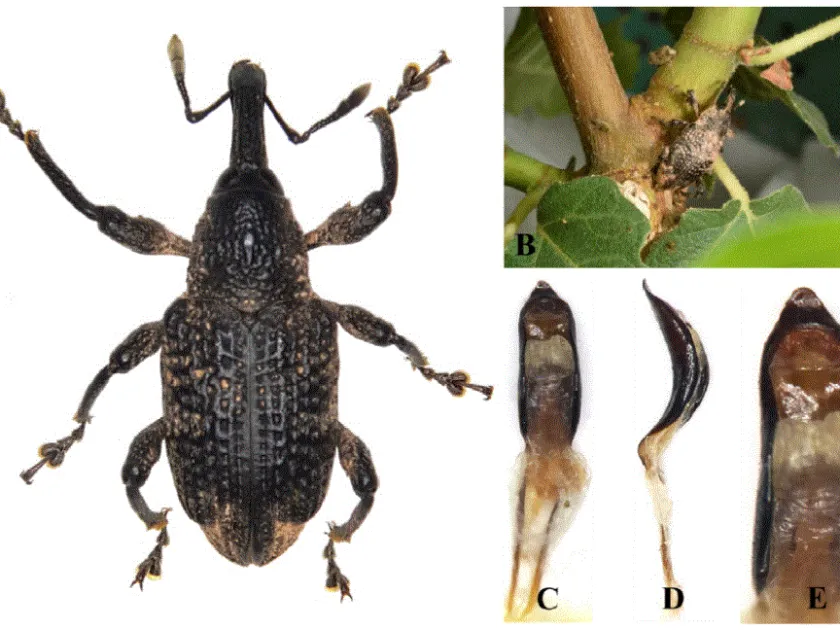
The Taiwan fig weevil (Aclees taiwanensis) is a member of the Curculionidae family within the order Coleoptera. This beetle is relatively large, typically measuring between 15 and 20 mm in length.
The adult insect has a dark brown to black coloration and a prominent long snout (rostrum). Its elytra (wing covers) feature a rugged, textured surface that provides excellent camouflage against the bark of fig trees.
The larvae are legless, creamy-white grubs with a well-developed head capsule and powerful mandibles, which are specifically adapted for boring into and consuming dense woody tissue.
The lifecycle consists of four stages: egg, larva, pupa, and adult. Adults are primarily nocturnal, making them difficult to spot during daylight hours when they remain stationary in crevices.
Originally native to parts of Asia, this species has become a significant invasive pest. Due to its potential for rapid spread, it is now subject to strict monitoring in many countries that cultivate figs commercially.
What it damages
The primary host of the Taiwan fig weevil is the common fig (Ficus carica). The pest shows a high degree of host specificity, focusing its reproductive efforts exclusively on fig trees.
Adult beetles feed on leaves and young shoots, causing minor mechanical damage. The true destructive capacity, however, lies with the larvae, which tunnel extensively through the heartwood and sapwood.
These tunnels compromise the structural integrity of the tree and severely impede the transport of water and nutrients. This internal damage causes the tree to weaken, shed foliage, and ultimately collapse.
In addition to structural damage, the galleries created by the larvae provide entry points for secondary pathogens, such as fungi and bacteria, which can hasten the death of the host tree.
Commercial plantations can face catastrophic losses if an infestation is not managed early, as heavily infested trees often become too structurally unstable to survive even moderate winds.
Signs of infestation
The most reliable sign of an infestation is the presence of frass, or wood shavings, accumulating at the base of the tree. This material is expelled from the larval tunnels as the grubs feed.
Small, perfectly circular holes on the bark—usually 3 to 5 mm in diameter—indicate exit points where adult weevils have emerged after completing their pupation cycle inside the wood.
Infested trees often display symptoms of nutritional stress, including premature leaf yellowing, wilting, and thinning of the canopy. Branch dieback is also a frequent and alarming indicator of deep wood penetration.
On the foliage, you may observe irregular, notched edges along the leaves, caused by adult feeding. While not life-threatening, these signs serve as a helpful clue to the presence of the beetle.
If you suspect an infestation, observe the tree's health closely. Any unexplained loss of vigor or the presence of hollow-sounding sections in the trunk can point to advanced internal larval activity.
Control measures
Management of the Taiwan fig weevil is challenging due to the hidden lifestyle of the larvae. Regular, diligent inspection of the trunk and branches is the most critical step for early detection.
If a tree is severely infested, physical removal and complete destruction of the wood by burning is necessary to prevent the adult population from emerging and spreading to neighboring trees.
Monitoring the adult population using pheromone traps is a highly effective strategy to time insecticide applications. Treatments must be targeted precisely when adults emerge to feed.
Chemical control focuses on surface application of registered insecticides during the beetle's peak activity period. Adhering to safety guidelines and harvest intervals is essential when treating edible crops.
Biological control alternatives, such as using entomopathogenic nematodes, show great promise. These microscopic worms can be introduced into the larval galleries to kill the grubs without the use of harsh chemicals.
Taxonomy
- Latin name
- Aclees taiwanensis
- Order
- Coleoptera (beetles)
- Family
- Curculionidae
- EPPO code
- ACEETW
Discussion
No discussions yet — be the first.