
Fig weevil
Aclees cribratus
Description
How to identify
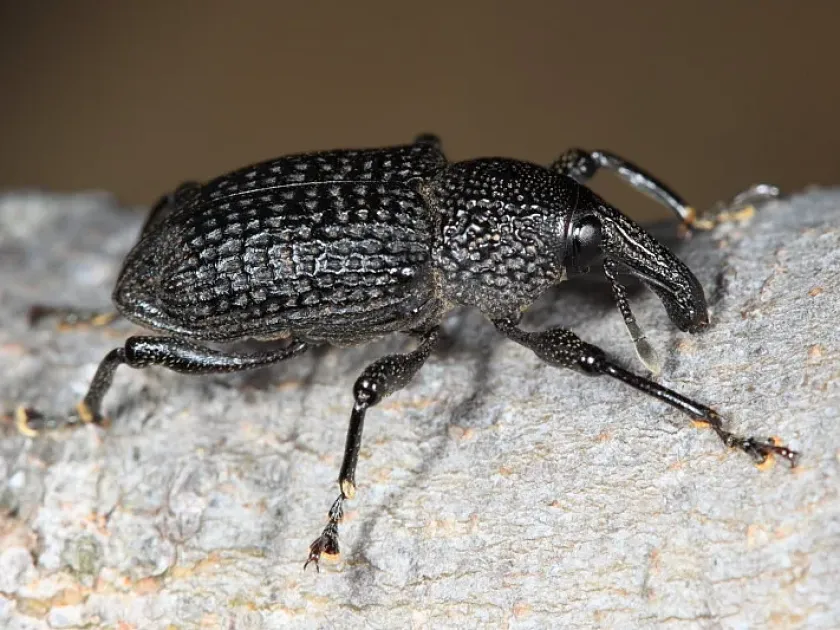
The Fig weevil (Aclees cribratus) is a destructive pest belonging to the Curculionidae family within the order Coleoptera. Adult beetles are characterized by a matte black body, measuring approximately 15–20 mm in length.
Like other weevils, they possess a distinct elongated snout (rostrum) equipped with elbowed antennae. The elytra are textured with small pits and bumps, providing excellent camouflage against the bark of fig trees.
Larvae are legless, fleshy, and typically cream-colored with a hard, dark-colored head capsule. They spend their entire developmental cycle buried deep within the wood, which makes them difficult to spot.
These insects are primarily nocturnal, remaining hidden during daylight hours in bark crevices or at the base of the tree trunk to avoid predators and desiccation.
They exhibit strong physiological adaptations, allowing them to establish populations in various climatic conditions where their host plant, the fig, can grow.
What it damages
The primary host for this pest is the common fig (Ficus carica). The damage affects all parts of the tree, from young saplings to mature, fruit-bearing trees.
Adult beetles feed on the margins of leaves, creating notched patterns. While this foliage loss is visible, the true economic impact is caused by the larval stage.
Larvae tunnel through the trunks and branches, consuming the cambium and destroying the tree's vascular system. This disrupts the transport of water and nutrients, leading to systematic decline.
Heavily infested trees lose their structural integrity and are prone to mechanical failure, often snapping during strong winds due to the hollowed-out internal structure.
Without intervention, severe infestations lead to the total collapse and death of the fig trees, resulting in significant yield losses and long-term orchard damage.
When it appears
Adult activity typically begins in late spring when temperatures are consistently warm enough to support the insect's reproductive behavior.
During the warmer months, females chew small holes in the bark to deposit eggs. This ensures that larvae are embedded within the protective environment of the wood.
Larval development continues throughout the summer and autumn. They tunnel extensively through the heartwood and sapwood, growing in size as they consume the tree's internal tissues.
Overwintering occurs primarily in the larval stage within the host tree, providing a stable microclimate that protects the insect from freezing temperatures during winter.
The emergence of a new generation of adults usually coincides with the start of the growing season, marking a critical time for monitoring and intervention.
Signs of infestation
The presence of sawdust-like material, known as frass, at the base of the trunk or in branch crotches is the most reliable early indicator of an infestation.
Exit holes, appearing as clean, circular punctures on the bark, indicate that adult beetles have successfully emerged, confirming that the tree is already significantly damaged.
Branch dieback is a common sign of internal tunneling. When larvae sever the phloem and xylem, the distal portions of the branches begin to wilt and wither.
Yellowing and premature leaf drop often occur as the tree's ability to pull nutrients from the roots is compromised by the internal destruction caused by the larvae.
Deep vertical cracks in the bark or localized soft spots on the trunk can suggest areas where internal galleries are most concentrated.
Control measures
Managing the Fig weevil requires a multi-pronged approach that targets the pest's lifecycle at different stages, emphasizing early detection.
Physical removal and immediate destruction of infested branches by burning are essential to prevent the spread of larvae to healthy sections of the orchard.
Systemic insecticides applied during the evening when adults are most active can help reduce population levels and prevent new egg-laying cycles.
- Regular orchard inspections for frass accumulation.
- Trunk whitening or banding to deter oviposition.
- Nutrient management to ensure tree vigor and recovery.
The use of pheromone-based traps is highly recommended for monitoring the arrival of adults, allowing for precision timing of chemical applications.
Taxonomy
- Latin name
- Aclees cribratus
- Order
- Coleoptera (beetles)
- Family
- Curculionidae
- EPPO code
- ACEECR
Discussion
No discussions yet — be the first.