
Sanci Bark Beetle
Acanthotomicus suncei
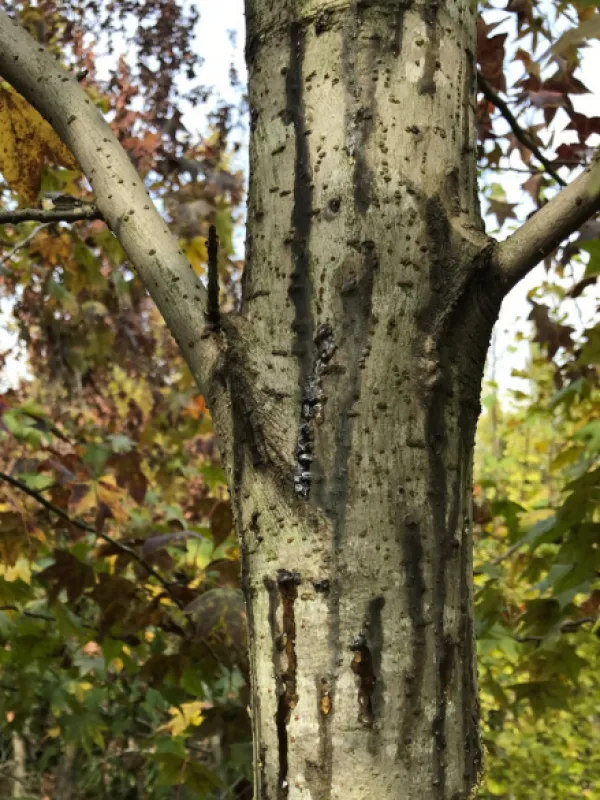
Description
How to identify
The Sanci Bark Beetle (lat. Acanthotomicus suncei) belongs to the order Coleoptera and the family Curculionidae (subfamily Scolytinae). It is a small insect morphologically adapted to survive and breed under tree bark.
Adult beetles feature a cylindrical, dark-colored body covered with fine hairs, which assists in movement through the galleries they bore. The larvae are legless, white-colored grubs equipped with strong mandibles for chewing wood tissues.
The life cycle of this beetle is strictly tied to the physiological state of its host tree. Adults utilize pheromone signals to communicate and locate vulnerable trees that are suitable for establishing a new brood.
This species displays specific host preferences based on its native distribution. Distinguishing this beetle from other Scolytinae requires professional entomological expertise and precise morphological identification under magnification.
Understanding the biology and behavior of Acanthotomicus suncei is essential for foresters and botanists to monitor potential population outbreaks effectively in affected regions.
What it damages
The Sanci Bark Beetle primarily attacks deciduous and occasionally coniferous tree species. The pest poses a significant threat to weakened or stressed tree stands in both forested areas and urban landscapes.
The beetle damages the cambium layer by creating intricate gallery systems beneath the bark, which effectively disrupts the nutrient and water transport within the tree. This often leads to crown dieback and rapid tree mortality.
Beyond mechanical damage, the Sanci Bark Beetle frequently serves as a vector for pathogenic fungi. These fungi enter the tree tissues through the beetle's galleries, causing rot and significantly reducing the host's natural resistance.
The impact of this pest intensifies during periods of drought or following severe storm damage. In such weakened conditions, beetle populations can multiply rapidly, leading to major outbreaks that threaten entire forest patches.
Infected trees become breeding grounds for the next generation of beetles, potentially endangering surrounding healthy trees if sanitation measures are not implemented promptly.
Signs of infestation
The first sign of an infestation is the appearance of tiny entry holes in the bark. These holes are often associated with piles of "frass" or boring dust, which accumulates in bark crevices beneath the site of attack.
Visual symptoms on the tree include premature yellowing or wilting of the foliage or needles. Over time, the tree crown loses its density, becoming thin and sparse as the internal conductive tissues fail.
Removing a section of the bark will reveal the characteristic gallery patterns created by the beetles. These galleries are essential for identifying the specific pest and the severity of the infestation.
In advanced stages of the attack, larvae, pupae, or adult beetles can be found beneath the bark, confirming an active infestation. This stage requires immediate intervention to mitigate further spread.
A sudden increase in woodpecker activity on a specific tree is often an indicator of a bark beetle infestation, as the birds search for the larvae beneath the bark, leaving large holes in the wood surface.
Control measures
The cornerstone of managing the Sanci Bark Beetle is the prompt identification and removal of infested trees through sanitary logging. Removing these sources of infestation before the next generation of beetles emerges is critical.
Pheromone traps are extensively used for monitoring beetle population densities. These tools help foresters detect outbreaks at an early stage, allowing for more precise and timely management actions.
Chemical control measures using insecticides may be applied in nursery settings or on high-value ornamental trees. However, due to the beetle's protected life cycle under the bark, chemical applications are often limited in effectiveness.
Silvicultural practices that promote high tree vigor are the most reliable long-term preventative measures. These include proper irrigation, maintaining soil health, and preventing mechanical injuries to trees.
- Conduct regular forest health monitoring surveys.
- Ensure timely removal and disposal of infested materials.
- Deploy pheromone traps to track insect activity.
- Maintain proper forest density to reduce stress on individual trees.
Taxonomy
- Latin name
- Acanthotomicus suncei
- Order
- Coleoptera (beetles)
- Family
- Curculionidae
- EPPO code
- ACTTSU
Discussion
No discussions yet — be the first.