
Spiny bark beetle
Acanthotomicus spinosus
Description
How to identify
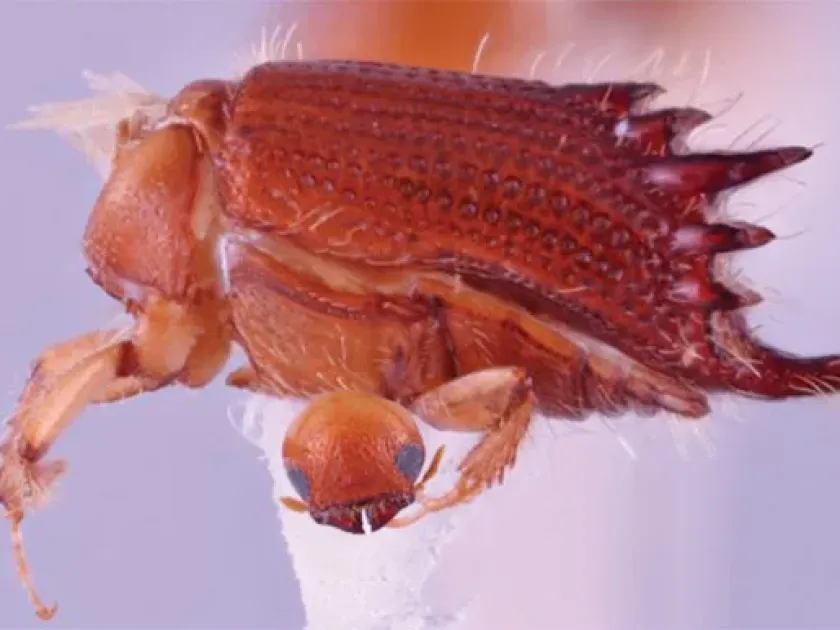
The spiny bark beetle (Acanthotomicus spinosus) is a member of the Coleoptera order and the Curculionidae family. It is a small, cylindrical insect adapted for life within the subcortical layers of host trees.
The species is distinguished by the presence of characteristic spines on the declivity of its elytra. This unique morphological feature is the basis for its specific name and requires careful inspection to distinguish it from other similar bark beetles.
The larvae are small, legless grubs, typically white or yellowish, with a hardened, dark head capsule. They spend their entire development phase feeding on the inner bark and cambium layer of the host tree.
Pupation occurs within small chambers carved by the larvae at the end of their galleries. The life cycle involves distinct stages that are deeply integrated into the tree's bark structure.
Entomologists identify this species through a combination of its physical characteristics, such as the arrangement of spines, and the distinct pattern of galleries left on the surface of the sapwood beneath the bark.
What it damages
This beetle primarily affects various conifer species, such as spruce and fir. In many cases, it targets trees that are already stressed due to drought, pollution, or physical injuries to the trunk or roots.
While often considered a secondary pest, high populations of the spiny bark beetle can become aggressive, attacking healthy trees. This mass attack strategy overwhelms the tree's natural resin defenses.
The damage occurs when adults and larvae create extensive networks of tunnels. These galleries sever the vascular system, preventing the transport of water and nutrients, which inevitably leads to the tree's decline.
The beetle acts as a vector for various wood-decaying fungi. As they move through the tree, they introduce fungal spores into the sapwood, which accelerate the decaying process and contribute to the tree's death.
Extensive damage results in canopy yellowing and thinning, eventually leading to tree mortality. This can create large patches of deadwood in a forest, increasing the risk of wildfires and further pest outbreaks.
When it appears
Activity typically begins in the spring when average daily temperatures reach a threshold of approximately 15°C (59°F). At this time, overwintering adults emerge to seek suitable hosts.
Throughout the growing season, beetles engage in mating and egg-laying. Depending on the local climate and temperature, the beetle may complete one or two generations per year.
The summer months represent the peak of infestation activity. Warm temperatures accelerate larval development, and the high rate of boring activity can lead to rapid deterioration of the tree's vital functions.
As autumn approaches, activity decreases. The newly emerged generation seeks suitable sites for overwintering, usually within the bark crevices or in the leaf litter at the base of the host tree.
Overwintering occurs in the adult stage. The insects remain dormant during the cold months, protected by the thick bark or environmental debris, ready to emerge once the spring warmth returns.
Signs of infestation
The most prominent sign of an infestation is the presence of "frass" or boring dust. This fine, sawdust-like material is expelled by the beetles and accumulates in bark fissures or at the base of the tree.
Resin exudation, often referred to as "pitch tubes," appears on the bark surface. This is a sign that the tree is attempting to push out the invading beetles, though it is often unsuccessful in cases of heavy infestation.
Changes in crown color are a critical indicator of long-term damage. The needles may fade from green to a yellowish hue and eventually turn a reddish-brown as the tree dies due to water stress.
Peeling away a section of the bark reveals the intricate system of tunnels. The primary "maternal gallery" is usually visible, with the larval galleries branching out perpendicular to it.
The shedding of bark in large flakes or chunks indicates that the tree is likely dead or in the final stages of mortality, signifying that the beetles have completed their development and emerged.
Control measures
Sanitation felling is the most effective control method. Removing and destroying infested trees before the next generation emerges significantly reduces the beetle population within a forest area.
Pheromone traps are widely used for monitoring and management. By placing these traps, foresters can attract beetles away from healthy trees and gather data on population density for timely intervention.
In ornamental or urban settings, systemic or contact insecticides can be applied to the trunk during the flight period to prevent new attacks and protect vulnerable high-value trees.
Promoting forest health through proper silvicultural practices, such as thinning overstocked stands, helps maintain tree vigor and reduces the susceptibility of the forest to bark beetle damage.
The removal of logging slash and fallen timber is essential, as these materials provide breeding grounds for the beetles. Prompt disposal of such debris limits the availability of sites for colony expansion.
Taxonomy
- Latin name
- Acanthotomicus spinosus
- Order
- Coleoptera (beetles)
- Family
- Curculionidae
- EPPO code
- ACTTPI
Discussion
No discussions yet — be the first.