
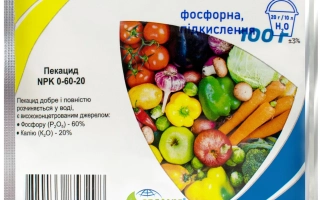


Prices in stores
from3.38 €per 1 kg
pack from 1.37 € per 100 g
9 offers from 7 stores
Fertilizer Type
Mineral
Phosphorus (P2O5)
P2O5 - 40-55%
Potassium (K2O)
K2O - 10-20%
Method of Application
Drip Irrigation
Your mark
3 votes
100% positive ratings
Store offers · 9 from 7 stores
9 offers in 7 stores — from 3.38 € per 1 kg.
Available at: agrocenterinua-0747f5 · ami-od-ua · bolagro-com-ua · Domus · GreenSteam · Pomidorka · Posadka
Prices are collected automatically from store websites and converted at the current exchange rate. Check the price and availability on the store website before ordering.
Description
Pekacid 0-60-20 — a new, specially developed phosphorus-potassium fertilizer designed for use in drip irrigation systems. Specialists from the Israeli company "Rotem Amfert Negev Ltd," part of ICL Fertilizers, developed a new fertilizer — Pekacid — which strongly acidifies water (pH 2.2) and is a highly concentrated source of phosphorus (60% P2O5) and potassium (20% K2O). Due to these properties, in addition to nourishing plants, Pekacid excellently cleans drip irrigation systems and lines of any type.
Clogging of drippers leads to uneven watering and, consequently, to uneven plant growth. This reduces yield and increases the percentage of substandard produce.
Prolonged irrigation with hard water leads to soil alkalization, during which many micronutrients (boron, iron, manganese, zinc, copper) become unavailable to plants. Deficiency of these nutrients leads to reduced yield and quality of produce, as well as triggering diseases.
On alkaline soils, phosphorus is present in an unavailable form for plants, negatively affecting root development and further plant growth.
Agronomic advantages:
Maintains optimal soil and water pH levels.
Increases nutrient availability, especially micronutrients, as well as phosphorus and magnesium.
Enhances nutrient uptake and mobility in the root system.
Reduces nitrogen loss through evaporation.
Increases water filtration in the soil.
System cleaning:
Provides acid to neutralize and break down bicarbonates.
Prevents dripper blockage in irrigation systems.
When used in concentrated form, Pekacid breaks down existing carbonate deposits and cleans drip irrigation systems.
Acidifying properties:
Bicarbonate (HCO3-), neutralizing power = 0.240.
Pekacid is a very effective acidifying agent: a dose of 240 g of Pekacid neutralizes 1 eq of bicarbonate (HCO3-) in 1000 L of water.
Traditionally, nitric and phosphoric acids are used for acidifying water and clearing drippers. However, acids are hazardous substances, complicating their transportation, storage, and use.
The solution to hard water problems was recently found in the homeland of drip irrigation — Israel, where farmers achieve high yields of vegetables and fruits even on rocky desert soils and with water of high salt concentration.
Pekacid dissolves rapidly in water (solubility at 20°C reaches 670 g/L) and is intended for use in drip irrigation systems and overhead watering through hoses. Regular application of this product prevents the formation of calcium deposits in pipes and drippers and extends the lifespan of drip irrigation systems.
The phosphorus content in Pekacid is 15% higher than in conventional monopotassium phosphate or phosphoric acid. Pekacid can be used on all crops (tomato, potato, cucumber, pepper, cabbage, roses, apple trees, etc.) grown with drip irrigation on neutral or alkaline soils. During the season, 50–100 kg of Pekacid is applied per hectare.
Two application options are possible:
1 — 2 times per month at 0.5–1 kg/1000 m2.
2 — 3 times per season at 2–3 kg/1000 m2.
The first irrigation is conducted 7–10 days after emergence of seedlings or immediately after transplanting seedlings into the soil.
Regular irrigation with solutions containing Pekacid allows acidifying the soil and thereby increasing the availability for plants of phosphorus and micronutrients. Initial trials of this fertilizer showed remarkable results: the number of clogged drippers decreased, and the level of available phosphorus on alkaline soils significantly increased after the start of Pekacid use.
Pekacid is simply indispensable for those who use irrigation water with pH greater than 7.2 and grow vegetables, flowers, or fruits on alkaline soils. Its use in drip irrigation systems increases yield, solves the problem of dripper clogging, and enhances nutrient availability from the soil.
Pekacid was registered in Russia in 2007.
Video · 1 video
Suggest a video →Composition
Nutrient elements
Macronutrients
Phosphorus · Phosphorus fertilizers · Potassium · Potassium fertilizers
Application
Used on crops
Specifications
| Fertilizer Type | |
|---|---|
| Phosphorus (P2O5) | P2O5 - 40-55% |
| Potassium (K2O) | K2O - 10-20% |
| Method of Application | |
| Form of the preparation | |
| Application rate | 3 - 10 kg/ha |
| Preparation Purpose | |
| Catalog | Catalog → Fertilizers |
| Manufacturer | ICL Fertilizers |
| Country | Israel |
No reviews yet. Be the first to share your experience.
Alternatives
Fertilizers · similar fertilizers






Ultrasol Magnum R 44
SQM Дубаї – FZCO, Об’єднані Арабські Емірати, Дубаї
055 1 offer
3.52 €per 1 kg ≈ 179 ₴
See also
Often considered together with this product


Recently viewed
Products you’ve viewed on this site
Reviews