
PLOS ONE study finds no food/feed safety signal for novel Vip3Cb1 insecticidal protein in GM crop context
A new PLOS ONE research article published on March 18, 2026 reports a comprehensive food and feed safety assessment of Vip3Cb1, a Vip3C-class insecticidal protein used to protect crops against major Lepidopteran pests. The paper was received on July 29, 2025 and accepted on February 22, 2026. The authors framed the work around whether sequence divergence from established Vip3A proteins changes the safety profile when the protein is considered for use in GM crop systems.
According to the paper, Vip3Cb1 was identified from a strain in the Paenibacillus popilliae-containing clade and is associated with trait deployment in GM cotton (MON 89151), with related expression work also discussed for maize. The authors report that Vip3Cb1 shares about 84% amino-acid identity with three Vip3Ca proteins and 66% identity with Vip3Aa19/Vip3Aa20 used in commercial cotton and maize contexts. They specifically tested whether the roughly 30% sequence difference versus Vip3Aa could alter food/feed safety conclusions.
The bioinformatics package included screening against the AD_2024 allergen database (2,748 sequences), the TOX_2024 toxin set (7,338 sequences), and the broad PRT_2024 protein dataset (286,068,982 sequences). The study reports no significant homology signals to known allergens or toxins under the thresholds used for protein safety assessment. This was a central element of the weight-of-evidence approach applied in the article.
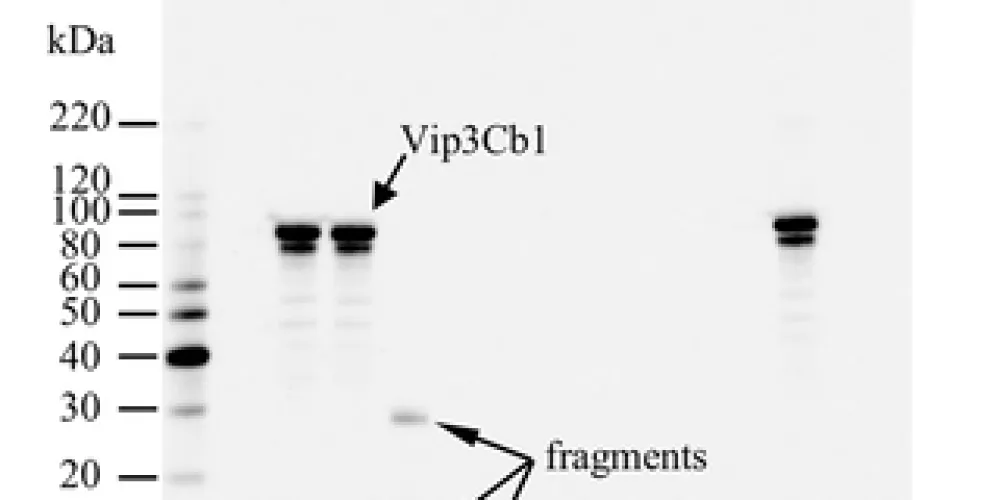
Exposure-related behavior was tested through digestibility and heat-lability experiments. In simulated gastric fluid conditions (pepsin, pH 1.2), nearly all full-length Vip3Cb1 (~99%) was degraded within 0.5 minutes. In pancreatin assays, nearly all full-length protein (~99%) was degraded within 5 minutes. The authors also observed smaller persistent fragments (about 10 kDa and 8 kDa) and reported loss of structural integrity and biological activity at elevated temperatures, supporting low likelihood of dietary exposure to intact functional protein.
For in vivo toxicology, the team ran an acute oral gavage study in CD-1 mice at a limit dose of 5,000 mg/kg body weight. The design included vehicle, BSA protein control, and Vip3Cb1 groups with male and female animals (60 total) followed for 14 days with survival, body weight, feed intake, and gross necropsy endpoints. The paper reports no Vip3Cb1-related adverse effects and sets NOAEL at greater than or equal to 5,000 mg/kg body weight.
The article additionally notes that Vip3Cb1 concentration in cottonseed is low (about 0.8 micrograms per gram), and the authors estimate that delivering a 5,000 mg/kg dose through whole cottonseed to a ~30 g mouse would require consumption of about 188 kg in one day, which they describe as impractical. Overall, the published conclusion is that the combined bioinformatics, in vitro, and in vivo evidence did not indicate a human or animal food/feed risk signal for Vip3Cb1. The paper also discloses that authors are Bayer Crop Science employees and that the work is published open access under Creative Commons.
Not yet comments. Be the first!
Comments · 0