
From Export Bans to Price Crashes: Why Onion Farmers Need More Than Buffer Stock Purchases
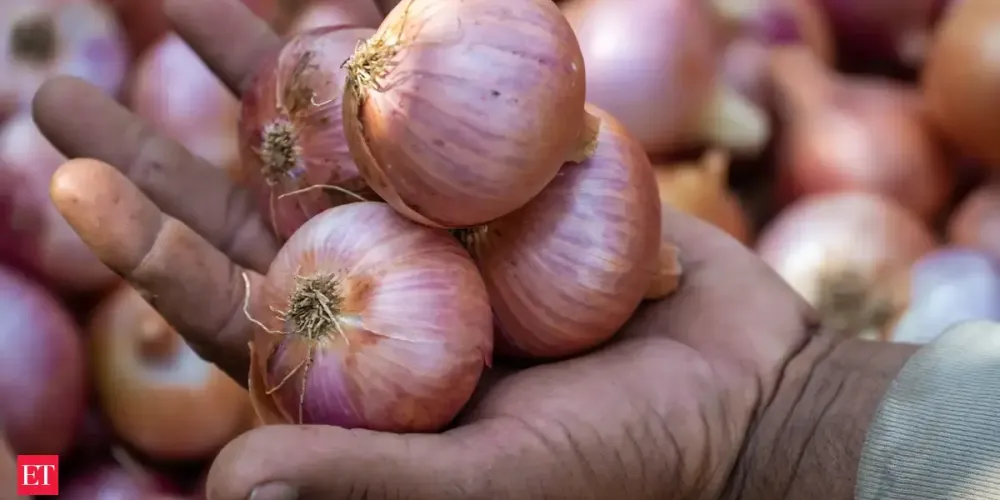
Onion farmers in India, particularly in the state of Maharashtra, which accounts for a third of the nation's total output, find themselves trapped in a recurring cycle of unviable farming. Their livelihoods are consistently undermined by market instability and inadequate policy responses. Despite the government recently raising the minimum assured procurement price (MAPP) for onions under the Price Stabilisation Fund (PSF) scheme to Rs 1,730 per quintal from the previous Rs 1,650 per quintal, farmers contend that these prices still fail to cover their production costs. This marks the second hike in 10 days, intended to support farmers and build buffer stocks, yet it has not addressed the deeply entrenched structural issues plaguing the sector.
The financial viability of onion cultivation in Maharashtra is gravely challenged. The estimated production cost of one kilogram of onion is around Rs 20, to which another Rs 5 per kg is added for storage over 3-5 months. This brings the total cost to approximately Rs 25 per kg, without even factoring in handling, sorting, and spoilage losses. However, many farmers are reportedly forced to sell their onions at just Rs 10-12 per kg, incurring substantial losses. Data indicates that the average price at mandis during January-May 2026 was lower than Rs 15-16 per kg compared to the corresponding period last year, exacerbating their predicament. In regions of Maharashtra with limited summer water resources, where few viable crop alternatives exist, farmers are heavily dependent on onions, making them particularly vulnerable to such fluctuations.
Adding to the challenge are frequent policy shifts concerning exports. India produces approximately 30 million tonnes of onions annually against a domestic consumption of about 15 million tonnes, signifying a substantial surplus that necessitates export to stabilize prices and protect farmers' incomes. However, as Anil Ghanwat, former President of the Shetkari Sanghatana farmers’ association, points out, policy uncertainty has eroded India's standing in the global market. He stated that “Policy uncertainty destroys investment and long-term supply-chain planning.” India’s global onion export share has plummeted from nearly 40% to below 5%, according to industry estimates. For instance, Bangladesh, once 26% of India's exports, cut reliance after an abrupt 2020 ban, boosting its domestic output and seed imports.
The impact of these export bans is palpable. The December 2023 export ban and duties imposed until March 2025 left 2025-26 exports nearly 39% below 2022-23 levels, according to Pushan Sharma, Director at Crisil Intelligence. This policy uncertainty has hurt India’s credibility in key markets like Bangladesh and Indonesia, pushing buyers toward rival exporters. With exports absorbing less surplus, heavy domestic arrivals drove prices down harder. Former Agriculture Secretary Siraj Hussain emphasizes that while the government periodically imposes export bans to shield urban consumers from sharp price increases, it often neglects the long-term interests of farmers.
Furthermore, existing buffer stock procurement operations have had a limited impact. Onion farmers in Nashik, home to Lasalgaon, Asia’s biggest wholesale onion market, have protested NAFED and NCCF procurement operations, demanding that these agencies either overhaul their practices or exit. Farmers describe the grading norms as opaque and subjective, leading to high rejection rates for their produce. This underscores the need for fundamental changes in support mechanisms that go beyond merely increasing procurement prices. Experts advocate for a stable and predictable policy that allows urban consumers to pay market price for onions while ensuring farmers receive fair compensation for their labor and investment. Attempts to solicit comments from the Ministry of Consumer Affairs on this critical issue remained unanswered, highlighting the urgent need for a more attentive and strategic approach beyond short-term adjustments.
Not yet comments. Be the first!
Comments · 0