
Tractor Navigation. Benefits, Payback, and Real Savings for Farmers.
GPS navigation for tractors reduces fuel costs by 10-15% and fertilizer costs by 8-12%. Find out when the system pays for itself in just 1 season and which operations it is indispensable for.
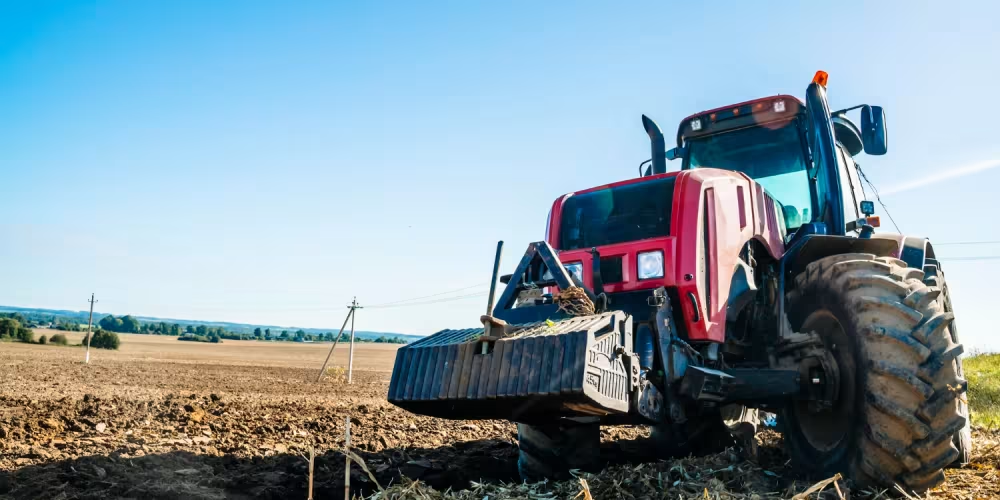
Where money leaks without precise steering
The main problem when working fields without navigation is overlaps and skips. On large fields, an error of 30-40 cm on every pass adds up over the season into real hectares of repeatedly treated land. Where the machine passes twice, there is overspending on fertilizers, crop protection products, and fuel. Where a strip is missed, there is yield loss.
According to research data, overlaps during seeding without a navigator account for 8 to 12% of the implement working width. On a 1,000-hectare field, this means hundreds of tons of materials and hundreds of liters of fuel wasted every year. At the same time, the operator may not even realize the scale of the deviation — it builds up gradually, pass after pass.
Overlaps during herbicide application are also an agronomic risk: a double dose on part of the field harms the crop and leaves an additional chemical load in the soil. Skips, on the contrary, leave unprotected areas where weeds gain an advantage.
How much can actually be saved
Below are the savings indicators from implementing GPS navigation, confirmed by FieldBee studies and the practical experience of Ukrainian farms.
| Cost item | Average savings | Explanation |
|---|---|---|
| Fuel | 10-15% | Fewer idle passes and overlaps |
| Seed | up to 8% | Elimination of double seeding |
| Fertilizers and crop protection products | up to 12% | Precise application without overlaps |
| Operation time | up to 12% | Straighter movement, fewer turns |
| Equipment productivity | +25% | Night shifts, reduced operator fatigue |
Total savings across all resources in farms that switched to precision farming range from 3 to 7% of operating costs. With a land bank starting from 500 hectares, these are already significant amounts even in the first season.
When navigation is mandatory rather than optional
There are operations where steering deviations are especially costly. In such cases, a navigator is no longer just an option.
Without navigation, a tractor operator cannot maintain an accurate line in darkness, fog, or dust. With navigation, a farm can confidently run machinery in two shifts without losing treatment quality.
Corn, sunflower, and sugar beet require perfectly straight rows. A deviation of more than 5 cm means the cultivator starts cutting plants instead of weeds during междурядной cultivation.
A sprayer or spreader without navigation is guaranteed to create overlaps. Every extra pass is a direct loss in inputs and extra chemicals in the soil.
The larger the field block, the harder it is to keep direction using visual marks. A navigator compensates for operator fatigue and minimizes human error throughout the entire shift.
Basic system or RTK: what should a farmer choose
There are three categories of solutions. The choice depends on the crop, acreage, and accuracy requirements.
| Parameter | Parallel steering | SBAS / EGNOS | RTK |
|---|---|---|---|
| Accuracy | 20-40 cm | 10-20 cm | 2-3 cm |
| Entry cost | Low | Medium | High |
| Solid seeding | Yes | Yes | Yes |
| Row crops | No | Partially | Yes |
| Inter-row cultivation | No | Partially | Yes |
| Autopilot, hands-free | No | Depends | Yes |
| Base station | Not required | Not required | Required |
Parallel steering, basic level
Accuracy of 20-40 cm. Suitable for solid crops such as wheat, barley, and rapeseed, as well as fertilizer application. The most affordable option is an antenna plus a tablet with software. Payback is high even on smaller areas.
RTK navigation, precision level
Accuracy up to 2-3 cm with connection to a base station. Mandatory for row crops where precise inter-row cultivation and row-based fertilizer application are required. More expensive to purchase, but it quickly pays off on suitable crops.
Autopilot integrated into the tractor
Automatic steering without operator participation. It frees the driver from routine work and allows them to control the implement rather than constantly watch the line. It is especially effective on long passes during seeding and spraying.
Payback period: real calculations
A farm with 500 hectares of arable land. The cost of a basic navigation system is 50,000-80,000 UAH. With fuel consumption of 15 l/ha and a fuel price of 55 UAH/l, the total fuel cost per season is approximately 412,500 UAH. A 10% saving already means 41,000 UAH saved on fuel alone.
Add savings on fertilizers and crop protection products — approximately 30,000-50,000 UAH — and the system pays for itself in the very first season. With an RTK system costing 150,000-200,000 UAH and used on row crops, the payback period is 1.5-2 seasons.
Implementation in practice: what should be considered
- Compatibility with machinery. Before purchasing, check whether your tractor supports electro-hydraulic steering for autopilot. Older models require additional installation of a hydraulic block.
- RTK network coverage. In Ukraine, RTK network coverage has expanded significantly. Check the availability of base stations in your area before choosing a system.
- Operator training. Learning to use a basic navigator takes 2-4 hours. Resistance from tractor operators is rare if you clearly explain how it reduces their personal workload.
- Field data storage. Modern systems record pass tracks. This makes it possible to analyze treatment quality and plan future seasons without guesswork.
Precise steering is no longer a technology of the future. It is a basic tool for any farm that counts money and wants stable yields without unnecessary costs. The question is not whether navigation is needed, but how much its absence is still costing.
Editorial team agronom.info
Materials are prepared by the portal's agronomists and editors. We use only trusted sources: Ukrainian agricultural universities, variety registries, open scientific publications.
Related articles
Features of selecting components for restoring the operability of agricultural machinery
Cultivator or Walk-Behind Tractor: Fundamental Differences and Technical Distinctions

Comments · 1