
Andean potato latent virus
Tymovirus latandigenum
Description
Symptoms
True to its name, the virus is often latent, meaning infected plants frequently show no visible symptoms. This makes field detection extremely difficult without specialized laboratory testing.
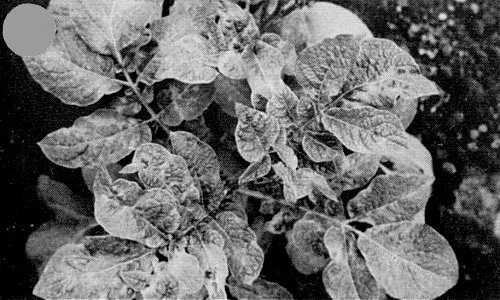
When symptoms appear, they typically present as mild mosaic patterns on the foliage. These patterns consist of faint, irregular chlorotic spots that are often overlooked by growers.
In some cultivars, there may be slight leaf deformation or stunted growth, though these symptoms can easily be confused with nutrient deficiencies or environmental stress.
Tubers generally do not exhibit external symptoms. Internal tissues remain unchanged to the naked eye, allowing infected tubers to appear healthy and suitable for planting.
Confirmation of the virus requires diagnostic techniques such as Enzyme-Linked Immunosorbent Assay (ELISA) or Reverse Transcription Polymerase Chain Reaction (RT-PCR) to detect viral antigens.
Pathogen
The Andean potato latent virus (APLV) is a plant pathogenic virus belonging to the genus Tymovirus. It contains a positive-sense single-stranded RNA genome and forms spherical particles approximately 28–30 nm in diameter.
The virus is notable for its stability in the environment and its ability to exist in multiple serological strains, which complicates diagnostic efforts and agricultural management.
Native to the Andean region of South America, the virus naturally infects wild potato species. Through human activity and trade, it has become a concern in various potato-growing regions globally.
It is biologically related to other viruses in the Tymoviridae family, sharing similar replication mechanisms but showing specific host-range preferences primarily among Solanaceous crops.
Transmission occurs through mechanical contact, such as contaminated tools or human handling, and via insect vectors like leaf beetles, which are highly efficient at spreading the virus in the field.
Conditions for development
The spread of APLV is closely tied to the presence of insect vectors. Warm weather increases the activity of these pests, creating an environment favorable for the virus to move between plants.
Mechanical transmission is a major factor, especially in large-scale potato production. Frequent handling of plants during pruning, weeding, or irrigation management provides opportunities for virus transmission.
Environmental stability allows the virus to persist in plant debris and soil for some time. This persistence increases the risk of re-infection if proper field hygiene is not maintained.
Nearby wild Solanaceous weeds act as vital reservoirs for the virus. If these are not removed, they provide a continuous supply of the virus for insect vectors to pick up and move to the crops.
In storage conditions, close contact between healthy and infected tubers can facilitate the spread, particularly if the tubers have abrasions or mechanical damage on their surfaces.
Why it matters
The primary economic harm stems from the cumulative impact of the virus on seed quality. Over several seasons, the virus builds up in the potato stock, leading to significant yield degradation.
Yield reduction can range from 10% to 20% depending on the potato variety and the severity of the viral load. Infected plants have reduced photosynthetic capacity, directly limiting tuber development.
Tuber quality is compromised, making the crop less desirable for market and less durable during long-term storage. Increased susceptibility to secondary rot infections is a common secondary effect.
For breeders, the virus represents a major hurdle, as it can interfere with the physiological parameters of new lines, making it difficult to maintain pure genetic stocks in breeding programs.
The necessity for ongoing diagnostic monitoring and the replacement of infected seed stock create a financial burden for growers, reducing the overall profitability of the farm.
Protection
The most effective strategy is the use of certified virus-free seed tubers. Starting with clean material produced through meristem culture is the best defense against APLV.
Strict field sanitation is essential. This includes the removal of all wild Solanaceous weeds around the perimeter of potato fields to eliminate secondary host plants.
Disinfecting agricultural equipment and tools is mandatory. Using a 10% bleach solution or other recommended sanitizers helps stop the mechanical transmission of the virus between rows.
Implementing an integrated pest management (IPM) program to control leaf beetles and other sucking insects reduces the rate at which the virus spreads during the growing season.
Regular inspection of fields for any signs of mosaic or abnormal growth followed by the immediate removal of symptomatic plants can help prevent the spread of the infection.
Discussion
No discussions yet — be the first.