
Rice tungro disease
Tungrovirus
Description
Symptoms
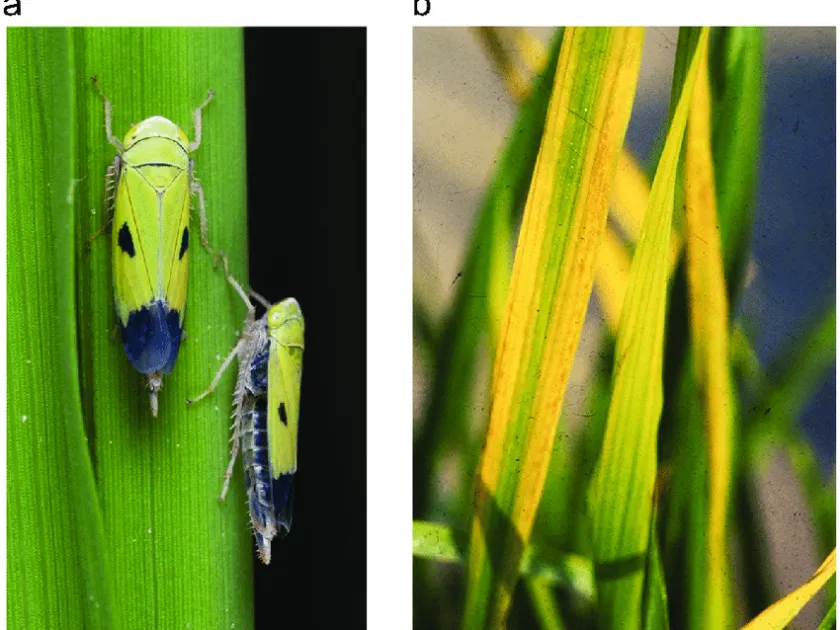
The most distinctive symptom of rice tungro is the yellowing or orange-yellow discoloration of leaves, which typically starts from the leaf tip and progresses downwards.
Stunting of the plant is another hallmark sign, with infected plants appearing significantly shorter and less vigorous than healthy plants in the same field.
Infected tillers show reduced growth, and there is a noticeable decline in the number of tillers per hill, leading to a sparse and unhealthy-looking canopy.
Flowering is often delayed, and panicles may emerge incompletely or fail to emerge entirely, remaining trapped within the leaf sheath.
Grains produced by infected plants are often deformed, sterile, or poorly filled, resulting in a dramatic decrease in the overall grain weight and milling quality.
Pathogen
Rice tungro disease is a significant viral ailment caused by the combined presence of Rice tungro spherical virus (RTSV) and Rice tungro bacilliform virus (RTBV).
These viruses are transmitted by leafhoppers, most notably Nephotettix virescens, in a semi-persistent manner. This means that insects acquire the virus after feeding on infected plants and can transmit it for a limited period.
RTBV is the primary agent responsible for the severe symptoms, while RTSV serves to assist the transmission of the bacilliform virus, essentially acting as a helper virus.
The virus does not have a persistent presence in the leafhopper, but the insect remains a vector as long as the viral particles are present in its salivary glands or intestinal tract.
Reservoirs for the virus include wild grasses and rice ratoons, which sustain the pathogen during periods when the main crop is not present.
Conditions for development
The incidence of rice tungro is highly dependent on the population dynamics of the leafhopper vectors, which thrive in warm and humid tropical conditions.
Continuous rice cropping cycles throughout the year allow the virus and its insect vectors to maintain a constant presence, increasing the risk of endemic outbreaks.
High nitrogen fertilization levels can sometimes exacerbate the disease by creating lush, dense growth that is highly attractive to leafhoppers.
The presence of susceptible weed species in or around paddy fields provides an essential survival habitat for leafhoppers during the fallow season.
Temperature fluctuations and rainfall patterns influence the migration and reproduction rates of Nephotettix species, directly impacting the disease spread.
Why it matters
Rice tungro is considered one of the most destructive viral diseases of rice, causing severe economic losses in Asia by potentially destroying entire harvests.
Early infection during the seedling or vegetative stage is particularly damaging, often leading to total crop failure and the need for replanting.
The disease weakens the plant's physiological integrity, making it more prone to secondary infestations by stem borers or fungal pathogens.
Reduced photosynthetic activity causes an overall decline in biomass, severely limiting the potential for grain filling and nutrient accumulation.
The widespread nature of the disease forces farmers to invest heavily in chemical inputs to control vectors, significantly increasing the cost of production.
Protection
The primary control strategy is the deployment of rice cultivars that are genetically resistant or tolerant to the virus and its leafhopper vector.
Strategic application of insecticides at the early stage of the crop cycle is essential to reduce the vector population and prevent the spread of the virus.
Synchronized planting over large geographic areas helps to minimize the interval between crops, thereby breaking the survival cycle of the virus.
Good field sanitation, including the removal of weeds that act as virus reservoirs, is a critical preventative practice in integrated pest management.
Regular monitoring using light traps or sweep nets to track leafhopper density allows for timely decision-making regarding protective chemical interventions.
Discussion
No discussions yet — be the first.