
Solanum topocuvirus
Topocuvirus solani
Description
Symptoms
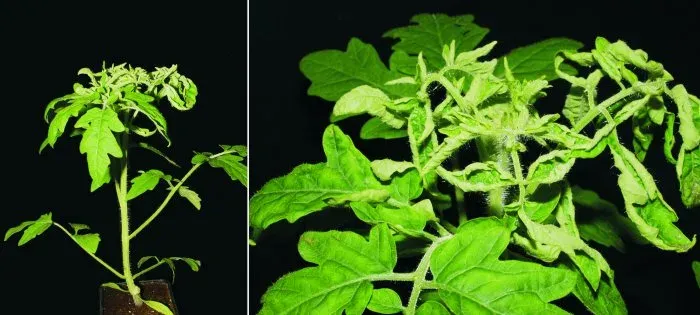
Initial symptoms of infection include chlorosis, often appearing as distinct mosaic patterns or interveinal yellowing on younger leaves. As the disease progresses, the leaves exhibit significant curling and distortion, reflecting the disruption of plant hormones.
Stunting is a hallmark of the infection, where plants appear significantly shorter and bushier than healthy ones. This reduction in size is due to shortened internodes, which severely limits the plant's ability to maximize its photosynthetic capacity.
Reproductive development is also adversely affected by the virus. Flowers often abort before setting fruit, and any fruits that do develop are frequently malformed, discolored, or stunted, rendering the crop unmarketable for fresh consumption.
In severe cases, plants may exhibit necrosis on the stems and leaf margins, leading to premature wilting and death of affected branches. The weakened state of the plant makes it susceptible to opportunistic infections from soil-borne pathogens.
- Mosaic patterns and leaf yellowing;
- Severe leaf curling and crinkling;
- Stunted growth with shortened internodes;
- Fruit malformation and reduced fruit set;
- Necrotic lesions on stems and foliage.
Pathogen
The causative agent is Topocuvirus solani, a member of the Geminiviridae family. This virus is characterized by a circular single-stranded DNA genome. It is an obligate parasite, meaning it requires living host tissue or a specific insect vector for survival and transmission.
The virus replicates within the host plant cells by hijacking the plant's replication machinery to produce viral DNA. This process disrupts normal cellular functions and leads to the systemic distribution of the pathogen throughout the phloem, resulting in visible physiological stress.
Transmission of the virus is primarily mediated by the tobacco whitefly, Bemisia tabaci. The insect acquires the virus while feeding on an infected plant and retains the ability to inoculate healthy plants for a significant portion of its lifespan, facilitating the spread across fields.
Due to the virus's reliance on the vector, its epidemiology is closely linked to the lifecycle and population density of the whitefly. The virus does not persist in the soil, which makes management strategies centered on vector control highly effective.
A wide range of host plants, including common weeds in the Solanaceae family, serves as a reservoir for the virus. These reservoirs allow the pathogen to persist in the environment between planting seasons, posing a constant risk to newly established crops.
Conditions for development
The spread of the disease is highly dependent on high whitefly populations. Environmental conditions that promote the rapid breeding and migration of Bemisia tabaci, such as warm, dry weather, significantly increase the risk of an outbreak.
The virus thrives in warm temperatures, typically between 25 and 30 degrees Celsius. These conditions accelerate both the vector's activity and the replication rate of the virus within the host, leading to rapid symptom manifestation.
Proximity to unmanaged weed populations provides a critical environment for the virus to overwinter. These weeds serve as an initial source of inoculum, allowing the whitefly to transmit the virus to adjacent susceptible vegetable crops as soon as they are planted.
Plant density plays a significant role in the dissemination of the pathogen. Dense canopy structures create a microclimate that is favorable for whitefly movement and facilitates the rapid spread of the virus from one plant to another within a field.
Dry environmental conditions can force whitefly populations to migrate from drought-stressed weeds to irrigated commercial crops, making the field edges particularly vulnerable to early-season viral outbreaks.
Why it matters
The economic impact of Solanum topocuvirus is severe, often resulting in significant yield losses. In cases of early infection, the crop may suffer total failure, leading to massive financial deficits for commercial growers.
Product quality is greatly diminished, as deformed and discolored fruits fail to meet consumer standards. This forces growers to discard large portions of their harvest, further increasing the cost of production and reducing overall profitability.
The systemic infection weakens the plant's overall immune system. Consequently, infected crops require higher inputs of chemical treatments to manage secondary infections, which increases the environmental footprint and the cost of the farming operation.
The need to remove and destroy infected plant material is labor-intensive and disrupts the uniformity of the field. This loss of plant stands reduces the efficiency of field management and complicates harvesting processes.
Persistent presence of the virus in a region may force farmers to abandon specific high-value varieties or even entire cropping systems, leading to a long-term shift in regional agricultural production and a loss of market competitiveness.
Protection
The primary control strategy focuses on the intensive management of whitefly populations. Applying systemic insecticides targeted at the vector significantly disrupts the transmission chain, preventing the virus from spreading throughout the crop.
Sanitation is a critical preventive measure. Keeping fields and surrounding areas free of weeds that serve as alternative hosts reduces the reservoir of the virus, thereby lowering the initial infection pressure at the start of the season.
Exclusion methods, such as the use of insect-proof netting in greenhouses, are highly effective in preventing whitefly entry. This physical barrier is crucial for protecting young, highly vulnerable seedlings during the early stages of development.
Regular field monitoring using yellow sticky traps is essential to detect the presence of vectors early. Early detection allows for immediate intervention before the virus can become widespread within the production area.
If infected plants are detected, they should be rogue-removed and destroyed promptly to prevent them from acting as a source of further infection. Strict hygiene protocols, including disinfecting tools, must be followed to avoid mechanical spread.
Discussion
No discussions yet — be the first.