
Tomato pith necrosis
Tomato necrosis
Description
Symptoms
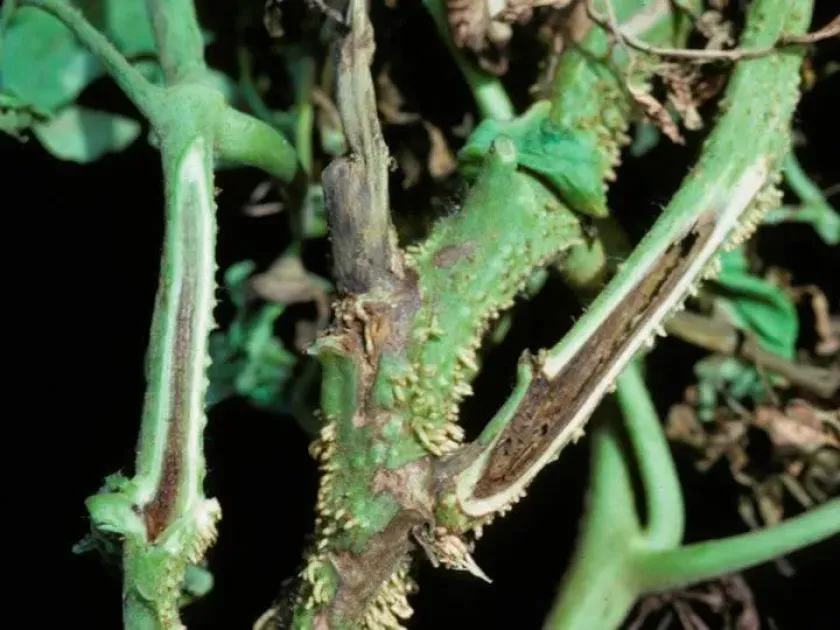
Initial symptoms include the appearance of dark, brown streaks along the stem, which can extend for several centimeters. These streaks are often visible mid-season.
When the stem is cut longitudinally, the pith (the central part) shows characteristic browning, rotting, and necrosis. In advanced cases, the pith becomes hollowed out.
Leaves on infected plants may exhibit chlorosis (yellowing) and wilting, despite regular irrigation. Growth becomes stunted, and the plant may lose its vigor rapidly.
A common diagnostic feature is the development of adventitious roots along the stem, often starting near the site of the infection as the plant attempts to compensate.
If the infection is severe, the entire plant may collapse and die, especially when conditions favor rapid bacterial multiplication.
Pathogen
The pathogen responsible for this disease is the bacterium Pseudomonas corrugata. It is a soil-borne bacterium that can survive in soil and plant debris between growing seasons.
The disease primarily affects tomato crops grown in greenhouses or protected environments. It enters the plant through natural openings, pruning wounds, or sites damaged by insects.
The bacteria colonize the vascular tissues, specifically the xylem, obstructing the transport of water and nutrients. Secondary infection spreads through splashing water or contaminated tools.
It thrives in environments with high humidity and moderate temperatures, often appearing when greenhouse ventilation is inadequate. The pathogen is highly contagious within a crop.
Understanding the life cycle of Pseudomonas corrugata is essential for implementing effective management strategies to prevent systemic spread within the greenhouse.
Conditions for development
High humidity within the greenhouse, particularly above 80%, is the primary factor promoting the development and spread of tomato pith necrosis.
Excessive nitrogen fertilization leads to succulent, soft tissue growth that is much more susceptible to bacterial invasion than stronger, well-balanced tissue.
Temperature fluctuations, especially cool nights followed by warm days, can stress the plants and create conditions where the pathogen can spread rapidly.
Poor ventilation leads to stagnant air and condensation on leaves, providing a moist pathway for bacteria to enter the plant stems.
Mechanical damage during pruning or training is a significant risk factor, as open wounds allow the bacteria to bypass the plant's natural defenses.
Why it matters
The disease causes significant damage by disrupting the plant's vascular system, leading to total yield loss in individual affected plants.
In severe outbreaks, tomato pith necrosis can cause substantial economic loss, potentially affecting a large percentage of the greenhouse production.
Affected fruits often fail to develop properly, becoming small or malformed, and are ultimately unsuitable for market sale, reducing the overall crop quality.
The rapid spread of the pathogen necessitates rigorous removal of infected material, which increases labor costs and complicates crop management.
Persistent presence of the bacterium in the substrate or greenhouse structure makes subsequent crop protection more difficult and costly.
Protection
Rigorous sanitation is the cornerstone of control. Infected plants should be promptly identified, removed, and safely destroyed to prevent further spreading.
Tools used for pruning and maintenance must be sanitized regularly with alcohol or bleach solutions to prevent the mechanical transmission of bacteria from one plant to another.
Improving greenhouse ventilation and humidity control is critical to reducing the incidence of the disease. Keeping the foliage dry helps limit infection opportunities.
Providing balanced fertilization, avoiding excessive nitrogen, helps maintain plant structural integrity, making them more resilient to pathogenic invasion.
- Sanitize greenhouse surfaces annually
- Use pathogen-free growing media
- Practice integrated pest management
- Ensure proper plant spacing for airflow
- Dispose of infected plant tissue immediately
Discussion
No discussions yet — be the first.