
Peanut mosaic virus
Soymovirus virgarachidis
Description
Symptoms
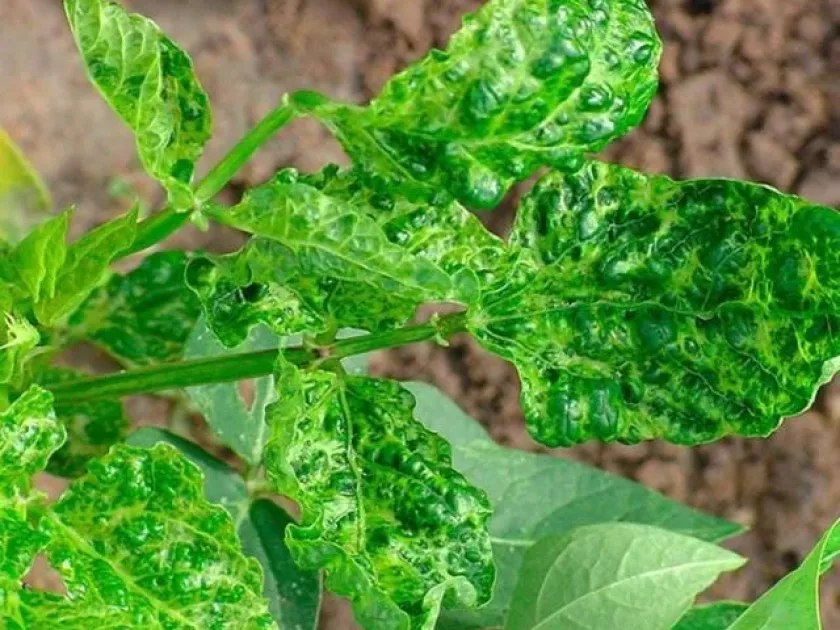
The primary visual symptom of the disease is the appearance of a characteristic mosaic pattern on the leaf blades of the infected plant. Leaves exhibit a mottled color, with alternating light green and dark green patches of irregular shape.
As the infection progresses, noticeable deformation and crinkling of the leaf blades occur. Leaf margins may curl or become wavy, which significantly reduces the photosynthetic surface area of the plant.
Plants infected with the virus at early stages show significant stunting in growth and development. Internodes become shortened, causing the plant to take on a dwarf or stunted appearance.
In some cases, chlorotic rings or stripes may appear on affected plant parts, depending on the viral strain and the peanut variety. Symptoms are often more pronounced during cool weather conditions.
Flowering in diseased plants is sluggish, and the number of pods formed is drastically reduced. The fruit may develop as stunted, small, or deformed, rendering them unsuitable for commercial sale.
Pathogen
The pathogen is the Peanut mosaic virus, belonging to the potyvirus group. The virus has a high capacity for replication within host tissues, disrupting normal metabolism and chlorophyll synthesis.
Virions are filamentous and contain single-stranded RNA. The infection systematically affects all plant organs, spreading through vascular bundles, making it impossible to cure an already infected plant.
The main reservoirs for the virus in nature are perennial weeds from the legume family. The virus persists in these plants through the winter, waiting for the start of the new growing season to migrate to commercial crops.
In field conditions, the virus is spread primarily by aphids. These insects acquire the virus while feeding on infected weeds and transfer it to healthy peanut plants within a very short period.
The virus can be transmitted through seed material, although the percentage of seed infection is usually lower than via insect vectors. Using infected seeds contributes to the primary appearance of disease outbreaks in the field.
Conditions for development
High aphid populations favor the development and spread of the virus. Dry and warm weather promotes active insect reproduction, which directly correlates with an increase in the number of infected plants.
The presence of abandoned fields with abundant weed growth near peanut crops creates ideal conditions for maintaining the infection reservoir. Weeds act as a green bridge for virus transmission at the start of the season.
Failure to rotate crops and planting peanuts on the same land for several years leads to the accumulation of the virus in the soil and the surrounding ecosystem, significantly increasing the risk of epiphytotics.
Dense planting facilitates the movement of insect vectors from one plant to another. Under such conditions, contact transmission of the virus occurs much more intensively and rapidly.
Moderate temperatures, which are optimal for aphid activity, also support the rapid progression of the virus. Sharp temperature fluctuations and environmental stress can weaken plant immunity, facilitating infection entry.
Why it matters
The main danger of the virus lies in an irreversible reduction in yield, which can fall by 30–70% depending on the level of infection. Diseased plants lose their capacity for normal pod production.
The quality of the peanut harvest is also significantly reduced: the seeds become small, shriveled, and lose flavor. Oil content in the kernels decreases, which is critical for the processing industry.
Infected plants become more susceptible to secondary fungal and bacterial infections. The virus weakens metabolic processes, leading to the premature death of specific plant parts.
Economic damage includes the cost of additional protective measures, culling of seed material, and the necessity of managing insect vector populations throughout the season.
Peanut mosaic virus poses a serious threat to commercial seed production. Infected seeds cannot be used for planting the following year, as this guarantees significant harvest losses.
Protection
The key protection method is the use of high-quality, certified seed material that is free from viruses. This serves as a primary barrier to prevent the disease from entering the fields.
Thorough weed control must be maintained both inside the field and along its borders. Eradicating viral reservoirs significantly reduces the primary infection background at the start of the growing season.
Controlling aphid populations is a critical aspect. The application of systemic insecticides during the early growth stages of peanuts allows for the disruption of the virus transmission cycle by insect vectors.
Maintaining spatial isolation between new peanut fields and areas where the disease was observed in previous seasons helps prevent rapid infection of young seedlings.
- Utilizing peanut varieties with enhanced virus resistance.
- Spatial isolation of fields from perennial legumes.
- Timely destruction of post-harvest crop residues.
- Adherence to scientifically sound crop rotation practices.
Discussion
No discussions yet — be the first.