
Raspberry leaf curl
Robigovirus tortifoliae
Description
Symptoms
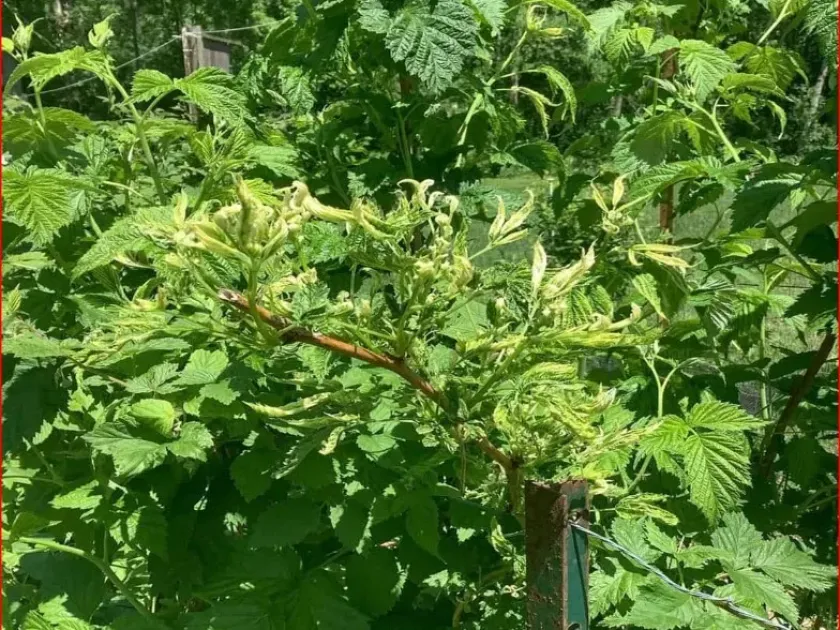
The main diagnostic feature of this disease is the characteristic deformation of leaf blades. The leaves lose their natural flat shape, with edges curling inward or outward, resulting in a distinct "tube" or "boat" appearance.
As the disease progresses, significant deformation of apical shoots occurs. The leaves become stiff, brittle, and often exhibit chlorotic or yellowish-green patterns, which severely impairs the plant's photosynthetic capacity.
In advanced cases, affected bushes show clear signs of stunted growth and development. Shoots become shortened, and internodes are compressed, giving the plant a stunted and sickly overall appearance.
In later stages, premature leaf drop occurs. The plant loses its ability to prepare properly for winter, which leads to a critical decrease in its cold tolerance and risks complete winterkill.
The root system of infected bushes also begins to degrade over time. The development of fine feeder roots slows down, leading to the gradual desiccation and death of the entire raspberry bush over several seasons.
Pathogen
The causative agent of the disease is the virus Robigovirus tortifoliae, which belongs to a group of viral pathogens transmitted by specific vectors in intensive horticultural systems.
This virus is an obligate parasite that localizes primarily in the plant's phloem cells. The movement of viral particles occurs through the vascular system, allowing the pathogen to spread quickly throughout the entire plant structure.
The primary vectors of the virus are insects with piercing-sucking mouthparts, particularly aphids and leafhoppers. By feeding on the sap of infected plants, these insects acquire viral particles and transmit them to healthy bushes.
The virus can also be spread through infected planting material. Using cuttings or suckers taken from diseased mother plants ensures that the virus will infect the new plantation.
The virus remains within the plant's tissues for the duration of its life. Currently, there is no effective therapeutic method to cure an already infected raspberry bush under field conditions.
Conditions for development
The most active spread of the disease occurs during periods of massive insect vector migration. Warm and humid weather fosters aphid population growth, which directly correlates with the increase in infection hotspots.
Overcrowded raspberry plantings create an ideal microclimate for pests. Poor air circulation and the lack of regular pruning facilitate the rapid transmission of the infection across the entire patch.
Weakened plants suffering from nutrient deficiencies or soil drought are significantly more susceptible to viral infection. Various stress factors lower the natural immune resistance of the raspberry bushes.
Failure to observe strict quarantine measures when bringing in new seedlings from non-certified nurseries is a major factor in introducing the disease to new sites. Symptoms are often misidentified.
Disease outbreaks typically coincide with periods of active sap flow in spring and mid-summer. It is during these phases that insects are most aggressive in attacking young shoots, facilitating virus transmission.
Why it matters
The primary danger of the virus lies in the irreversible decline in yield. Infected bushes eventually cease to produce high-quality berries, with fruits becoming small, dry, and lacking flavor.
The disease leads to a substantial reduction in the productive lifespan of the plantation. While healthy raspberry patches can remain productive for over a decade, infected bushes usually degenerate within 3–4 years.
The disruption of plant metabolism makes the raspberry bushes highly vulnerable to secondary fungal and bacterial infections. This leads to complex pathologies that accelerate the total death of the plants.
Economic losses are not limited to crop failure but also include the need for total eradication of the plantation. Infected soil may require a long quarantine period before replanting.
The virus poses a major threat to breeding collections. Infection of valuable cultivars leads to the permanent loss of genetic material and disruption of certified breeding cycles.
Protection
The main method of management is strict phytosanitary control. All bushes showing even minor symptoms of leaf curling should be immediately uprooted with their root systems and burned.
Systematic control of insect vectors is an essential part of plant protection. The application of systemic insecticides helps manage aphid and leafhopper populations, thereby limiting the spread of the virus.
When establishing new plantations, only certified, disease-free planting material should be used. It is strictly prohibited to source seedlings from bushes with any history of poor health.
Adherence to good agricultural practices, such as proper spacing between rows, timely weeding, and balanced fertilization, helps maintain high plant vigor and resistance to environmental stress.
Maintaining spatial isolation between new plantings and old, potentially infected areas is crucial. This helps prevent the migration of insect vectors from contaminated sites to healthy ones.
Discussion
No discussions yet — be the first.