
Maize mosaic
Potyvirus zeatessellati
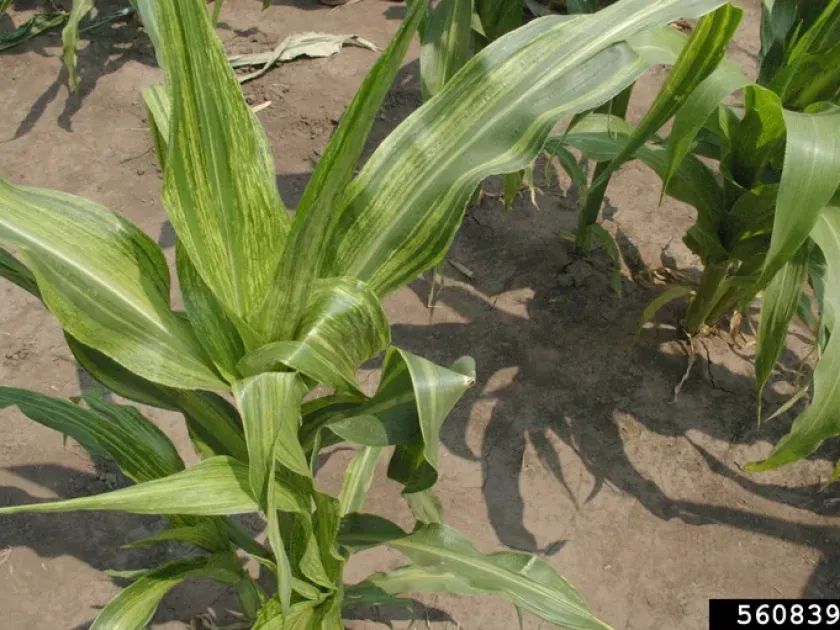
Description
Symptoms
The most prominent symptom is the development of a distinct mosaic pattern on the leaves, characterized by irregular patches of light green, yellow, and dark green discoloration.
Chlorotic streaks, often running parallel to the leaf veins, appear as the virus interferes with chloroplast development, leading to a striped appearance on the foliage.
Infected plants exhibit reduced growth rates and stunting, which is most evident when young seedlings are exposed to the virus early in the growing season.
Leaves may show signs of curling, distortion, or brittleness, which are secondary effects of the systemic infection disrupting the plant's hormonal balance and nutrient transport.
- Mottled or mosaic leaf patterns.
- Yellowish streaks along the leaf veins.
- Significant plant stunting.
- Curled and distorted leaf development.
- Poor cob and grain formation.
Pathogen
The causal agent is the Maize mosaic virus, classified within the Potyvirus genus. It is an obligate parasite that colonizes the vascular tissues of the corn plant, disrupting normal physiological functions.
This virus is primarily transmitted by insect vectors, specifically aphids, which acquire the pathogen while feeding on infected plant tissues and subsequently transfer it to healthy crops.
The virus cannot survive for long periods in the environment outside of a living host. It relies on living tissue to maintain its viability, often over-wintering in perennial grasses or infected crop residues.
The transmission process is typically non-persistent, meaning the insect can acquire and transmit the virus within a short feeding period, making rapid spread possible in favorable conditions.
Mechanical transmission, though less significant in broad-acre farming, can occur through contaminated equipment or close foliage contact, facilitating the spread within dense stands.
Conditions for development
Disease prevalence is heavily influenced by the population density of aphid vectors. Warm, dry weather patterns often lead to population spikes, increasing the risk of widespread transmission.
Nearby reservoirs, such as perennial weeds or grasses, act as bridges for the virus, allowing it to persist between seasons and move into emerging corn fields.
The timing of the initial infection is critical; early-season infestations in young corn are the most damaging, as the plant is most vulnerable to developmental setbacks.
Fields that are poorly managed with high weed pressure provide an ideal environment for vectors to thrive and transmit the virus more efficiently between neighboring plants.
Optimal environmental conditions for the virus correspond to the peak activity periods of the insect vectors, which typically occur during the mid-to-late vegetative stages of the corn crop.
Why it matters
Maize mosaic causes significant yield reduction by inhibiting the plant's ability to efficiently perform photosynthesis and translocate nutrients to the developing reproductive structures.
Grain quality is negatively impacted, resulting in poorly filled cobs, lighter grain weight, and a lower overall harvest volume compared to non-infected fields.
The stress caused by the viral infection makes the corn plants more susceptible to secondary environmental stresses, including moisture deficiency and extreme heat.
Infected plants are also more prone to invasion by opportunistic pathogens, such as stalk rot fungi, which can further decrease the structural integrity and health of the crop.
If the infection occurs early, the crop may suffer from uneven maturity, complicating harvesting processes and reducing the overall economic value of the produce.
Protection
The primary control strategy involves managing vector populations through the strategic application of systemic insecticides during the most susceptible growth stages.
Rigorous weed control, particularly of perennial grass species in and around fields, is essential to eliminate local reservoirs of the virus.
Selecting and planting resistant or tolerant corn hybrids is the most sustainable long-term method for mitigating the impact of viral diseases in high-risk areas.
Implementing proper field hygiene, including the removal and destruction of infected debris after harvest, helps to reduce the inoculum load for the following season.
Maintaining adequate crop rotation cycles disrupts the continuity of host plants, which can significantly reduce the establishment of the virus in a specific area.
Discussion
No discussions yet — be the first.